Pharmaceutical research · Solvent recovery
Using a 50L Rotary Evaporator in Pharmaceutical Solvent Recovery Studies
Selecting a 50L rotary evaporator for pharmaceutical solvent recovery studies starts with the research objective: recovering solvent from a process solution or concentrating an already prepared extract. The useful purchasing question is not simply whether a flask holds 50 liters, but whether the complete evaporation, condensation, vacuum, and cooling arrangement fits the intended working batch and solvent load.
Define the recovery task before selecting the equipment
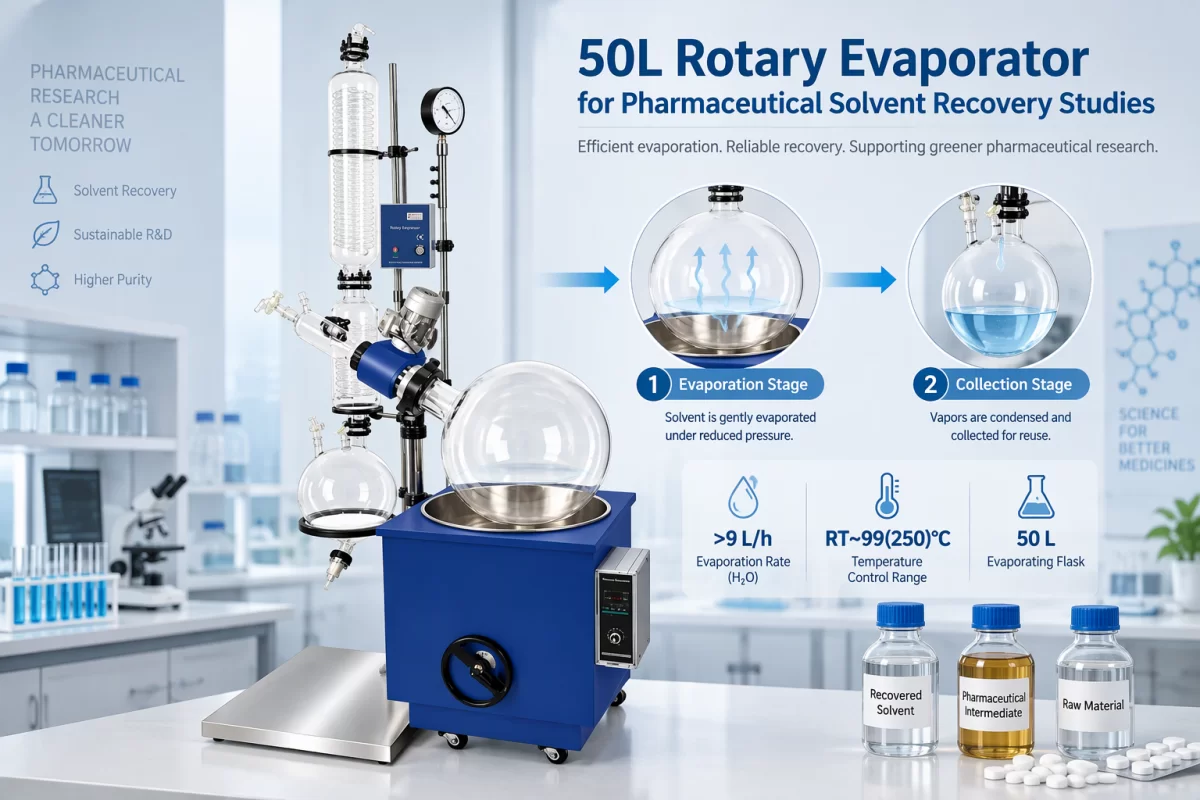
In pharmaceutical research, rotary evaporation can support studies of solvent removal, concentration endpoints, and recovery balances. Rotation spreads liquid over the flask surface, bath heating supplies energy, and reduced pressure can lower the temperature required for boiling. Vapor then passes to the condenser and the recovered liquid collects in the receiving flask. For background on this mechanism, read how rotary evaporators remove solvents.
This role must remain distinct from final drug fractionation or purification. Concentrating an extract does not establish selective isolation of its target constituents, and collecting a solvent fraction does not establish that it is suitable for reuse without testing. The appropriate scope here is R&D, trials, or small-batch work following a process and safety assessment—not a conclusion about commercial drug production, sterile processing, or pharmaceutical compliance.
R1050 flask capacity and installation planning
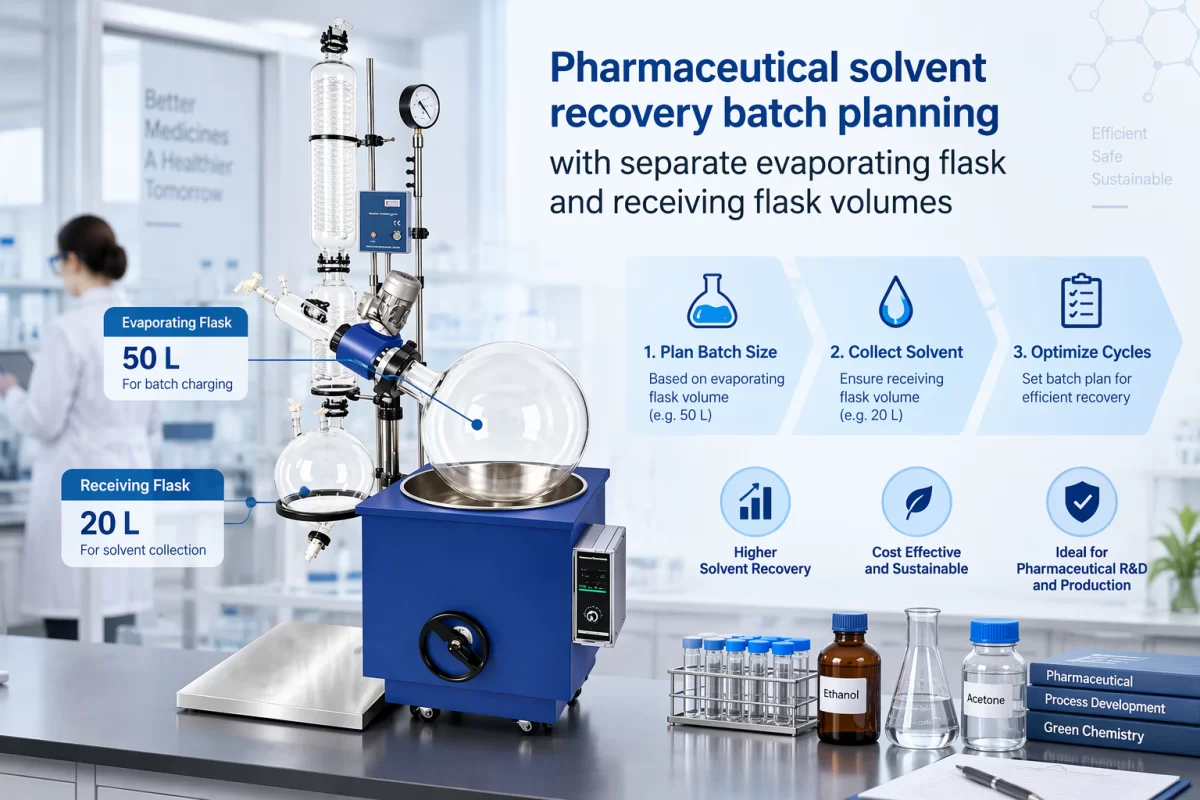
The R1050 is the 50L model in the supplied R-series information. Its nominal evaporating flask and receiving flask provide useful starting points for equipment selection, but neither defines an approved working fill or an hourly recovery rate. When comparing 20L and 50L rotary evaporator configurations, keep the solvent composition, concentration endpoint, temperature limits, and feeding approach the same. A larger nominal flask alone does not establish a proportional increase in usable throughput.
| Item | R1050 specification | Selection relevance |
|---|---|---|
| Evaporating flask | 50 L nominal volume | Not the working charge or recovery rate |
| Receiving flask | 20 L nominal volume | Plan usable collection volume and draining |
| Bath pot dimensions | Ø550 × 320 mm | Diameter × height; relevant to bath layout |
| Lift travel | 0–180 mm | Relevant to immersion adjustment and handling |
| Overall dimensions | 1320 × 770 × 2340 mm | Allow additional access and service clearance |
For a foaming or increasingly viscous research solution, select a working charge that leaves suitable headspace and permits stable rotation. Assess flask support, rotation adjustment, lift operation, and safe access for loading and removal as part of the configuration review. Installation space must also accommodate coolant hoses, vacuum connections, receiver handling, and the external utilities.
Translate the study target into solvent and receiver loads
Describe both the total liquid to be processed and the amount of solvent expected to be removed. A batch loaded once creates a different operating pattern from staged addition. Feeding can extend the quantity handled during a run only if the selected arrangement supports it safely; it does not eliminate condenser limitations or receiver draining requirements. Near the concentration endpoint, increasing viscosity or reduced solvent content may also change evaporation behavior.
Illustrative material-balance calculation—not equipment performance
Assume a research plan contains 12 kg of removable solvent, with 3 kg intended to remain in the concentrate. The planned removal is 12 − 3 = 9 kg. If the collected liquid is assumed to have a density of 0.80 kg/L at the collection condition, with no entrainment or collection losses, its estimated volume is 9 ÷ 0.80 = 11.25 L.
This estimate helps plan collection and weighing. It does not establish a safe receiver fill, operating time, recovery efficiency, or acceptable evaporating-flask charge. Actual balances should account for sampling, retained liquid, mixed-solvent density, and uncollected vapor.
Match heating, condensation, and vacuum to actual vapor load
A useful operating plan begins with the solvent or solvent mixture, its pressure-dependent boiling behavior, and the material’s temperature sensitivity. Bath temperature is not automatically the liquid temperature. Heating settings, immersion, rotation, and vacuum should be adjusted to support controlled boiling rather than simply maximizing heat input. Record conditions throughout the run so that concentration results can be compared meaningfully.
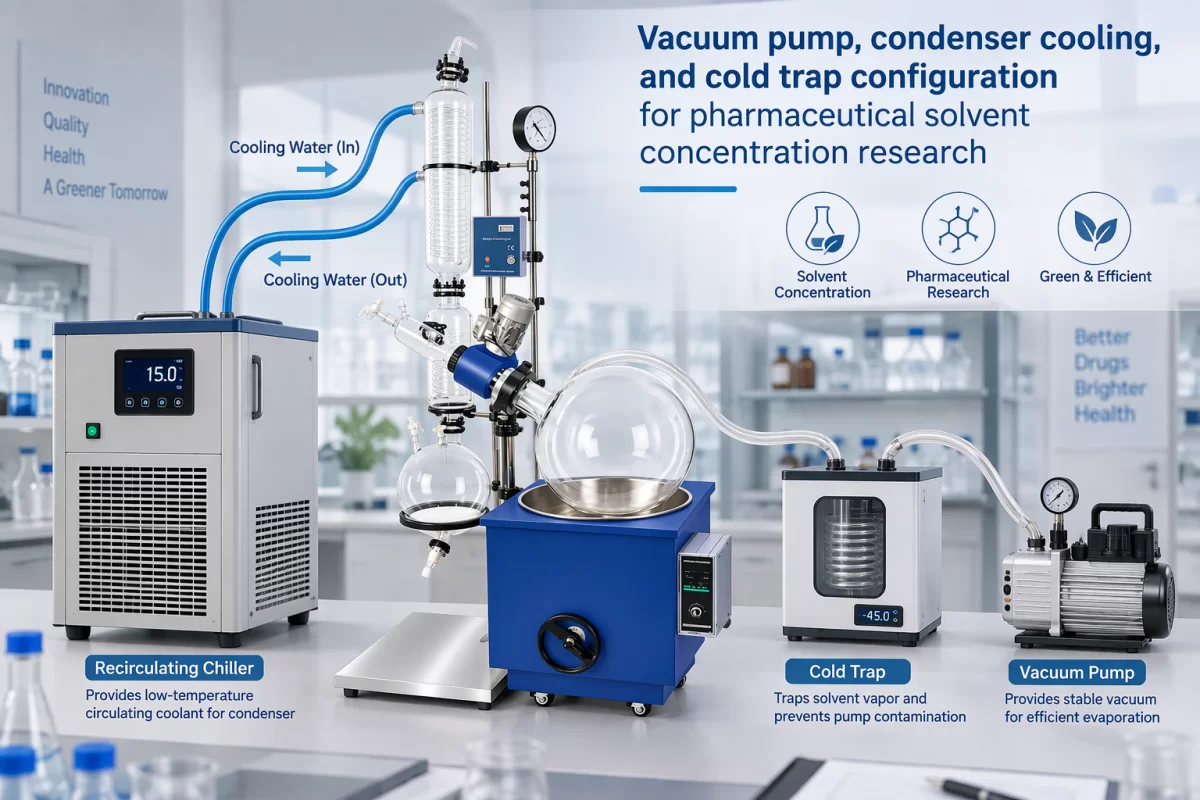
Condenser selection must address the expected vapor load and available coolant conditions. Describe the required condenser arrangement in the quotation, including coolant connections and the vapor path. An external chiller should be evaluated by cooling capacity at the intended supply temperature, coolant flow, and operating conditions—not by its reservoir size alone. Excess vapor generation can overwhelm condensation even when the evaporating flask has ample space.
Vacuum planning should cover solvent compatibility, pumping capacity under load, pressure measurement, regulation, and controlled pressure changes. A pump’s ultimate pressure alone does not demonstrate stable operating pressure during evaporation. Evaluate whether a cold trap is needed to reduce vapor reaching the pump, and include trap cooling and condensate handling in the operating plan. Flammable solvents also require an assessment of ventilation, ignition hazards, and the suitability of the complete installation.
Separate the main unit from accessories and services
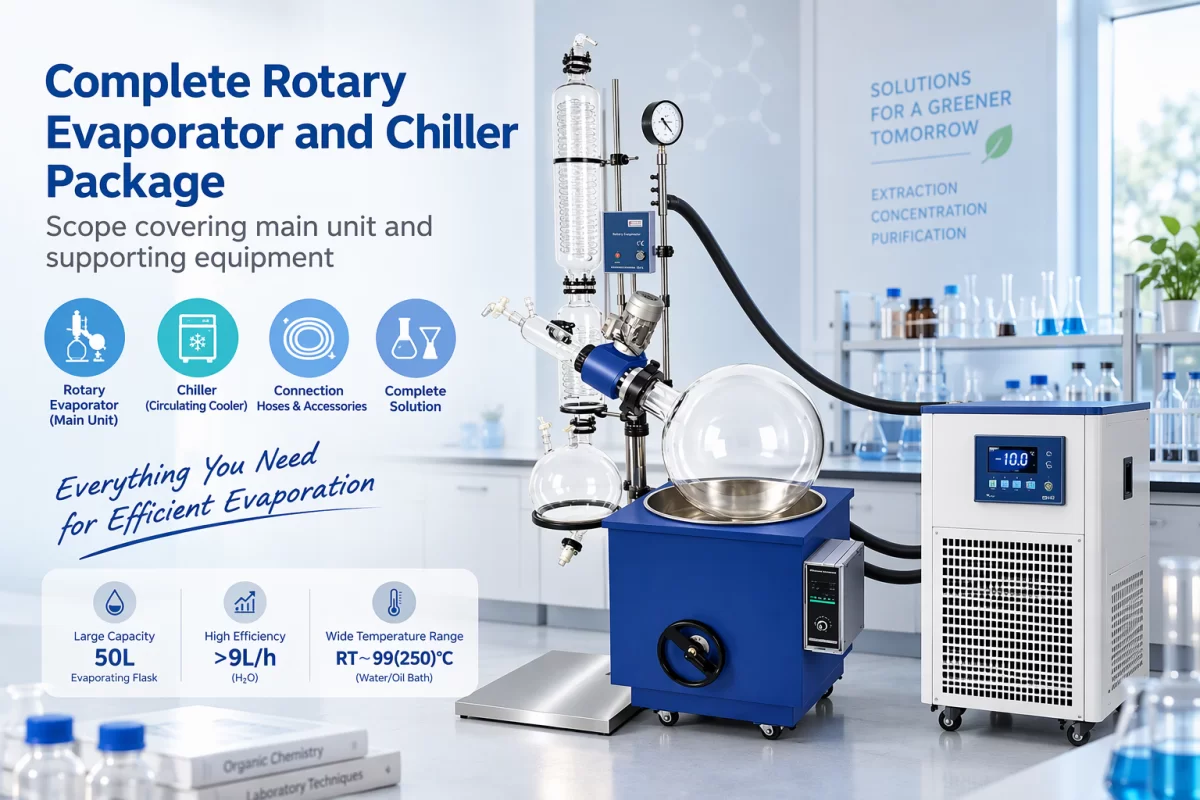
A purchasing specification should identify each supply item explicitly. Do not assume that a rotary evaporator listing includes a pump, chiller, cold trap, or commissioning. For this research application, request an itemized scope:
- Main evaporator: R1050, evaporating and receiving glassware, condenser arrangement, rotation and lift mechanisms, bath, and included controls.
- Vacuum pump and control: pump type, solvent compatibility, pressure measurement, regulation, and exhaust arrangements.
- External chiller: cooling duty at the proposed temperature, coolant, flow requirements, and utility connections.
- Cold trap: whether required, collection arrangement, cooling method, and safe emptying procedure.
- Pipework and fittings: vacuum-rated lines, compatible coolant hoses, connectors, valves, and any proposed feeding hardware.
- Services: delivery, installation assistance, training, spare parts, and the agreed support scope.
Company reference price
Our company’s catalog reference price is US$1,480, selected from the supplied company price listings. This is a catalog-level reference, not a quotation for the R1050 or a complete 50L recovery system. The actual quotation depends on the selected configuration and inquiry results.
Choose a 50L research recovery system by the process—not the label
A 50L rotary evaporator for pharmaceutical solvent recovery studies is worth evaluating when the proposed working batch, collection requirements, and thermal limits fit the selected arrangement. The decisive checks are usable charge, condenser duty, controlled vacuum, external cooling, safe handling, and a clearly itemized supply scope. Flask capacity alone cannot answer those questions or establish final pharmaceutical quality.
To request a configuration assessment and quotation, submit the material and solvent composition, target processing quantity or working batch, concentration endpoint, temperature and pressure requirements, feeding preference, available utilities, and required accessories and services. These details provide a practical basis for evaluating an R&D, trial, or appropriately assessed small-batch solvent recovery solution.