Equipment selection · Process integration
Agitated Filter Dryers: Integration and Cleaning Questions to Ask
An agitated filter dryer should be evaluated as a sequence of connected operations, not simply as a vessel that holds slurry. The purchasing question is whether filtration, washing, dewatering, heated drying and discharge can work with the intended material—and whether the product-contact surfaces remain accessible when the batch ends.
Start with the task, not the equipment name
A filter, a filter reactor and an Agitated Nutsche Filter Dryer have different structural requirements and process responsibilities. A filter separates liquid from solids through a filter medium; that function alone does not establish agitation, reaction or drying capability. A filter reactor combines a reaction duty with filtration, but reaction suitability depends on its defined mixing, materials, temperature and pressure conditions.
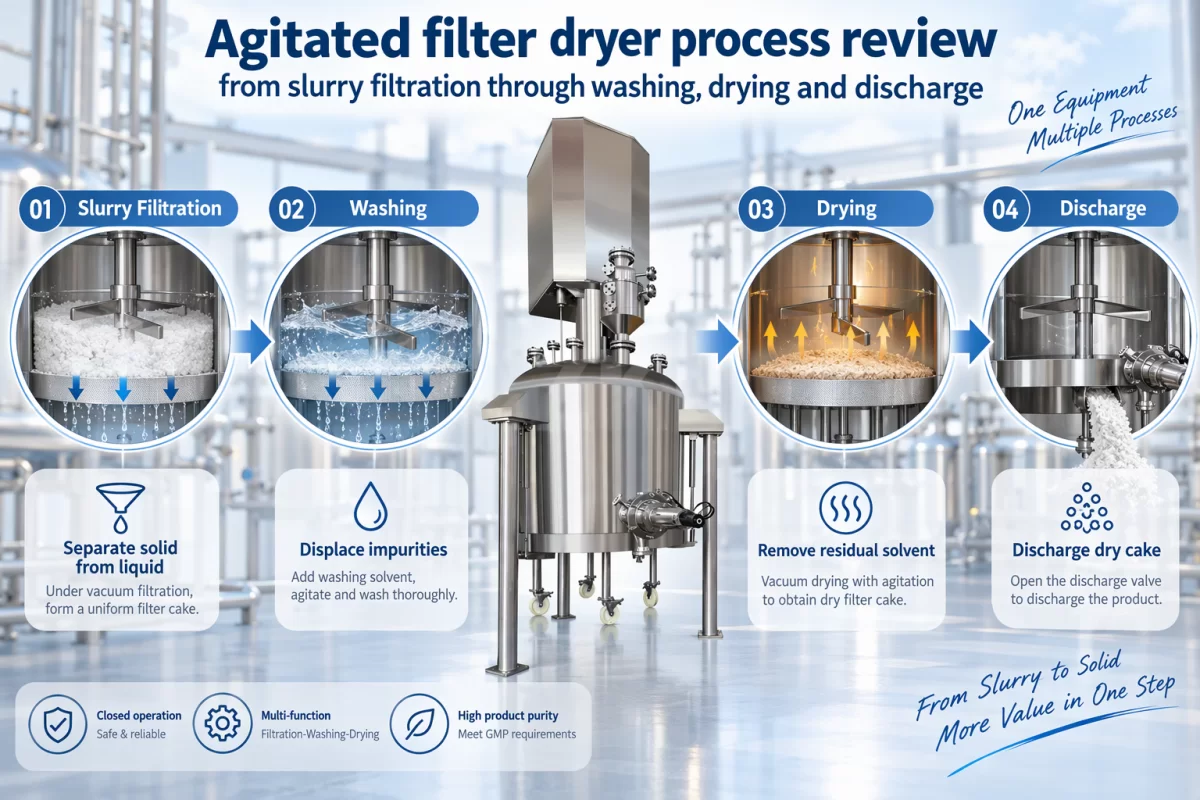
An agitated filter dryer is intended to connect solid-liquid separation with cake handling and drying operations. Even so, the name does not establish a drying rate, a vacuum rating or suitability for a particular reaction. When reviewing agitated nutsche filter dryers, match the proposed configuration to the actual sequence rather than assuming that related equipment categories are interchangeable.
Does integration automatically eliminate intermediate handling?
My answer is no. Integration can reduce transfers when the material can remain in the vessel through the required stages. I would first map sampling, wash-liquid addition, filtrate collection, vapor handling and final discharge. Any step that requires opening the equipment or moving the cake needs to be included in the operating plan.
Separate vessel volume, filtration area and working batch
Nominal vessel volume describes a vessel capacity, while filtration area describes the available separation surface. Neither is a guaranteed batch mass. The working batch also depends on slurry solids concentration, cake bulk density, liquid hold-up, freeboard and the intended cake depth.
The documented 30 L configuration provides a useful starting point for a configuration-specific discussion. The following values describe that configuration only; they should not be transferred to another model or used as production guarantees.
| Parameter | Value | Unit / description |
|---|---|---|
| Nominal volume | 30 | L |
| Full volume | 35 | L |
| Filter area | 0.03 | m² |
| Listed filter cake thickness | 80 | mm |
| Agitator stroke | 100 | mm |
| Stirring speed | 0–25 | rpm |
| Stirring power | 0.55 | kW |
| Shaft seal | Packing seal | Seal type |
| Main pressure-component materials | 316L / 304 | Inside tank / jacket |
| Working temperature | 85 / 85 | °C, inside tank / jacket |
| Jacket working medium | Hot water, thermal oil | Listed heating media |
Listed cake thickness is an equipment parameter, not a guaranteed suitable cake depth for every slurry. Jacket temperature does not establish the product drying endpoint.
A geometry example—not a batch-capacity claim
Assume a uniform cake covering the full 0.03 m² filter area at a depth of 80 mm, or 0.08 m. Its geometric volume would be 0.03 m² × 0.08 m = 0.0024 m³, equivalent to 2.4 L. This calculation excludes uneven cake formation, liquid above the cake and solids-density effects. It is not a guaranteed operating capacity, and it cannot be converted into kilograms without an appropriate cake-density basis.
Check filtration, washing and dewatering under the same conditions
Filter area becomes meaningful only when considered with the slurry and filter medium. Request a medium specification covering material, retention characteristics, support arrangement, attachment and replacement access. Assess chemical compatibility and whether fine particles can blind the medium or pass into the filtrate.
For comparable trials, hold solids concentration, slurry temperature, liquid viscosity, medium specification, cake depth and applied pressure difference constant. Record filtrate clarity, filtration time and residual liquid after dewatering. A larger area alone does not establish the result if the material forms a compressible or poorly permeable cake.
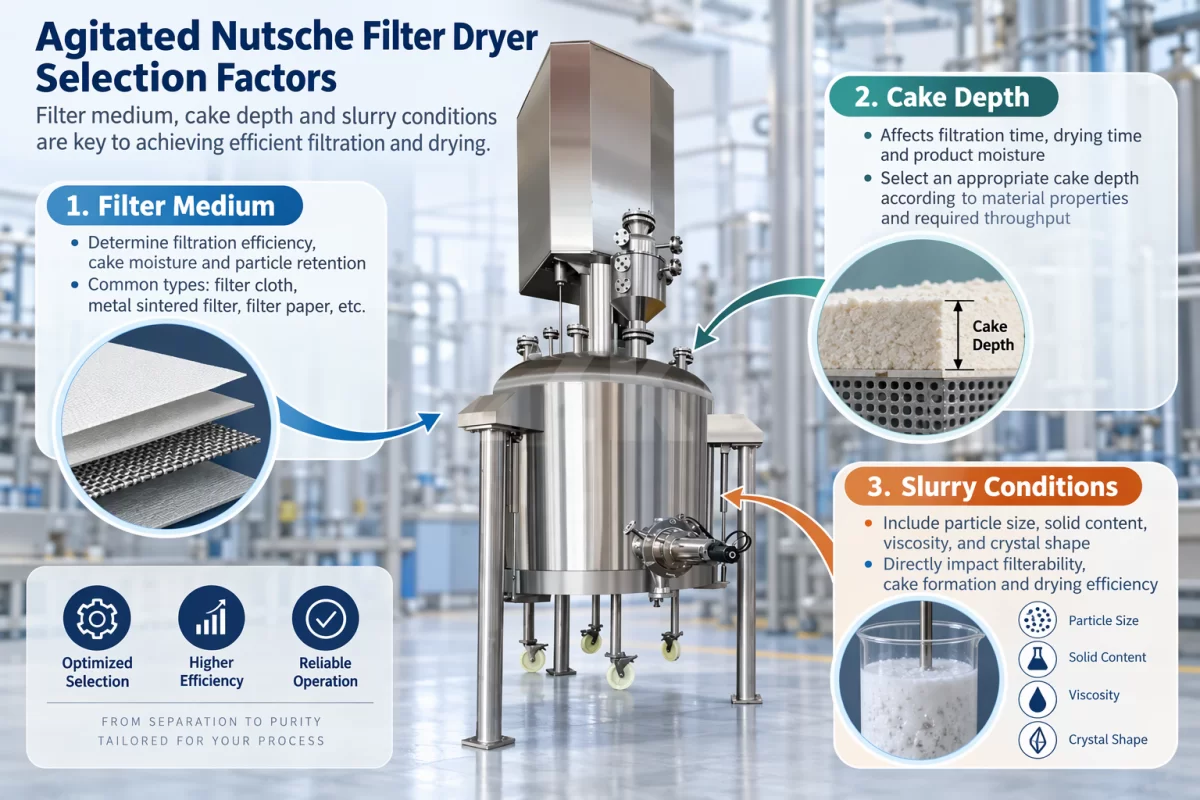
Washing introduces another decision: displacement washing through a retained cake and reslurry washing are different operating approaches. Specify the required impurity removal, wash-liquid compatibility and acceptable liquid consumption. The overview of filtration, washing and drying in an ANFD provides process context, while the proposed configuration still needs a material-specific operating assessment.
Can the listed stirring speed establish washing performance?
I would treat the speed range as a mechanical input, not a washing result. Washing also depends on blade geometry, cake resistance, liquid distribution and whether the selected configuration supports the intended washing method. I recommend trials that measure the wash endpoint while checking for particle damage, cake compaction and uneven flow.
Plan the transition from wet cake to heated drying
The documented jacket media and working temperatures support a discussion of heating integration. They do not establish a drying time, solvent-removal rate or final moisture level. Drying assessment should include retained liquid after dewatering, product temperature limits, heat-transfer behavior and the handling of released vapor.
- Define the dewatering endpoint. Establish the condition of the cake before heating starts, using a consistent residual-liquid measurement.
- Review agitation during drying. Determine whether the material remains movable as it changes from wet cake to drier solids, and assess the required mechanical load.
- Specify vapor handling. Identify the intended operating pressure, condensation arrangement and solvent compatibility. Do not assume vacuum service from the equipment name.
- Define stage-change controls. Agree on how heating, agitation, valves and any connected pressure or vacuum equipment are sequenced.
The packing seal deserves particular attention where solvent emissions or air ingress matter. Its presence does not establish leak-tight containment or aseptic performance. Discuss the allowable leakage criterion, maintenance access and seal compatibility with the actual operating conditions.
Make cleaning access an agitated filter dryer purchase criterion
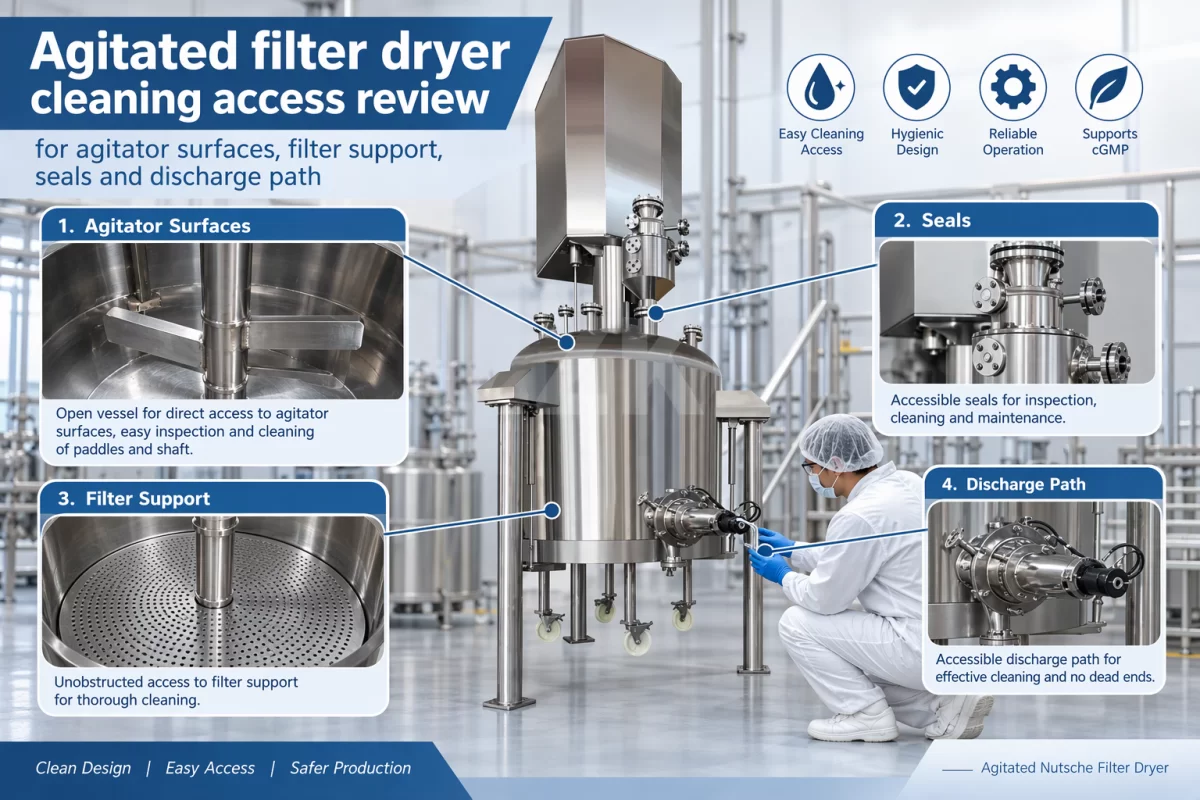
Cleaning should be evaluated against the residue left by the process, not just the apparent openness of the vessel. Inspect access to the underside of the agitator, shaft entry, filter-medium edges, filter support, filtrate space and discharge path. A surface that is visible through an opening may still be difficult to reach, rinse or inspect.
The documented configuration lists one chassis lifting cylinder. That feature should prompt a practical access review, but it does not by itself establish complete filter-plate removal, full drainage or clean-in-place coverage. Ask for a demonstration of the opening sequence, safe support arrangements, medium removal and reassembly.
Does a 316L material specification establish cleanability or sterile operation?
No. I separate material selection from cleaning performance. Surface finish, weld geometry, drainability, seal details and access all influence residue removal. Sterile operation would require its own defined design and validation basis; I would not infer it from stainless steel construction or an integrated process arrangement.
Discharge is also part of cleaning and batch recovery. Request details of the proposed discharge arrangement, retained heel, operator access and collection interface. For product changeover, assess the complete sequence: discharge, opening or dismantling, cleaning, inspection, reassembly and readiness for the next batch. Faster filtration may have limited value if difficult cleaning dominates the overall cycle.
Select an agitated filter dryer around the complete batch cycle
A sound purchase decision links filter area and medium to the slurry, matches agitation to cake behavior, defines the heating and vapor-handling duty, and verifies accessible cleaning after discharge. Vessel volume alone cannot answer these questions, and integrated equipment should not be assumed to provide reaction capability, sterile operation or universal certification.
For a configuration assessment and quotation, submit the material and solvent information, target throughput or working batch, solids concentration, expected cake properties, operating temperature and pressure, required washing and drying endpoints, and discharge and cleaning requirements. These details provide the basis for selecting an Agitated Nutsche Filter Dryer configuration and developing a quotation matched to the intended process.