Spray Dryer • Configuration comparison
Comparing Industrial Spray Dryers: Atomization and Powder Collection
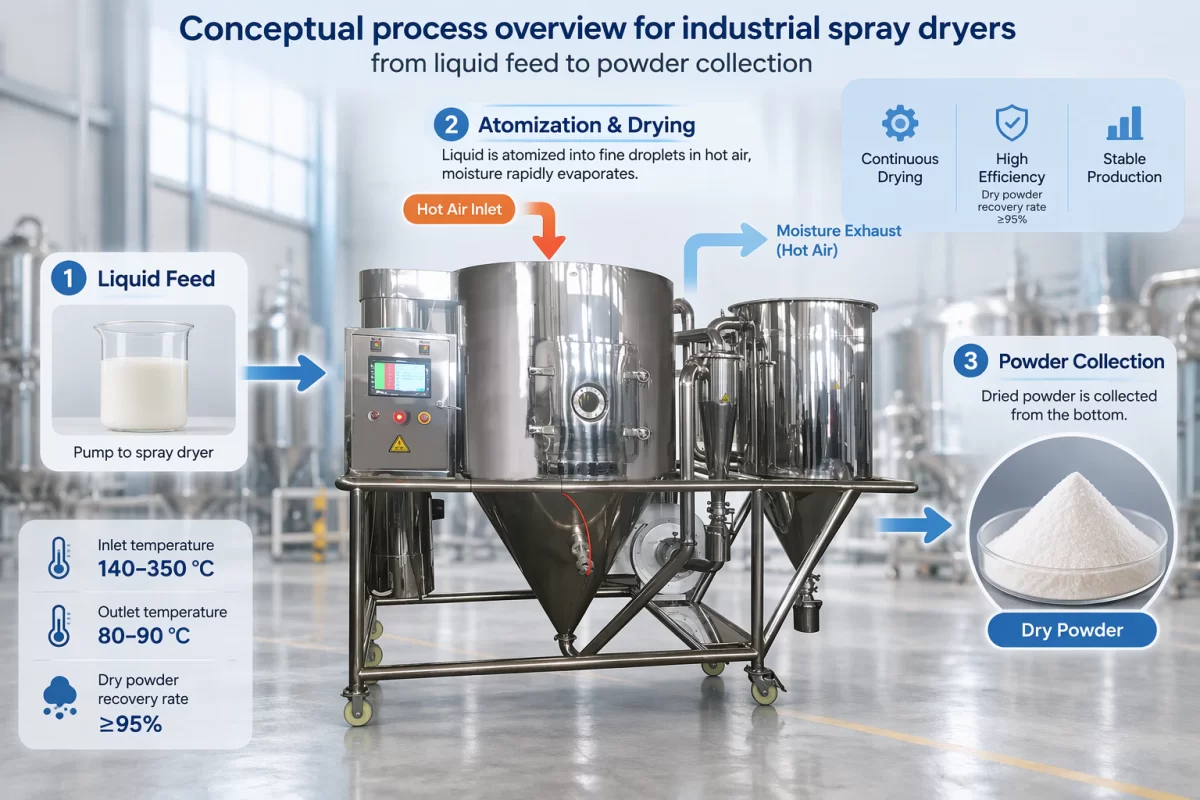
Comparing industrial spray dryers starts with two connected decisions: how the liquid becomes droplets, and how the dried particles are separated from the exhaust air. Neither decision produces an absolute “best” machine. The right configuration depends on the feed, the target powder, the available utilities, and the equipment included in the quotation.
A useful comparison follows the entire process: feed preparation, atomization, heated-air delivery, the drying tower, powder collection, exhaust treatment, and controls. A larger evaporation rating alone does not establish suitability for a viscous feed, a heat-sensitive ingredient, or a chemically hazardous material.
Start with comparable capacity definitions
Feed throughput, water evaporation, and powder output describe different quantities. Feed throughput is the liquid or slurry entering the dryer. Water evaporation is the water removed during drying. Powder output includes retained solids and residual moisture, and the amount actually collected also depends on process losses.
Use mass-based units when comparing equipment. A volumetric feed rate cannot be converted to kilograms per hour without the feed density. Similarly, a model name containing “5” or “10” is not, by itself, a statement of feed volume or finished-powder output.
Does a 10 kg/h evaporation rating mean 10 kg/h of powder?
My answer is no. I use evaporation capacity to estimate the water-removal duty, then calculate the solids balance separately. Feed concentration and the target residual moisture determine the theoretical powder quantity; collection losses determine how much becomes saleable or usable product.
Illustrative comparison under identical assumptions
Assume an aqueous feed of 20 kg/h at 20% solids by mass, with a target powder moisture of 5% by mass on a wet basis. Assume no solids loss, no other volatile components, and steady operation.
Dry solids = 20 kg/h × 0.20 = 4 kg/h
Theoretical powder = 4 kg/h ÷ 0.95 ≈ 4.21 kg/h
Water evaporation = 20 kg/h − 4.21 kg/h ≈ 15.79 kg/h
This water-removal duty exceeds both the LPG-5 and LPG-10 maximum evaporation figures listed below. The example is a mass balance, not a guaranteed operating point, collected-powder rate, or equipment performance test.
Compare atomization against the actual feed
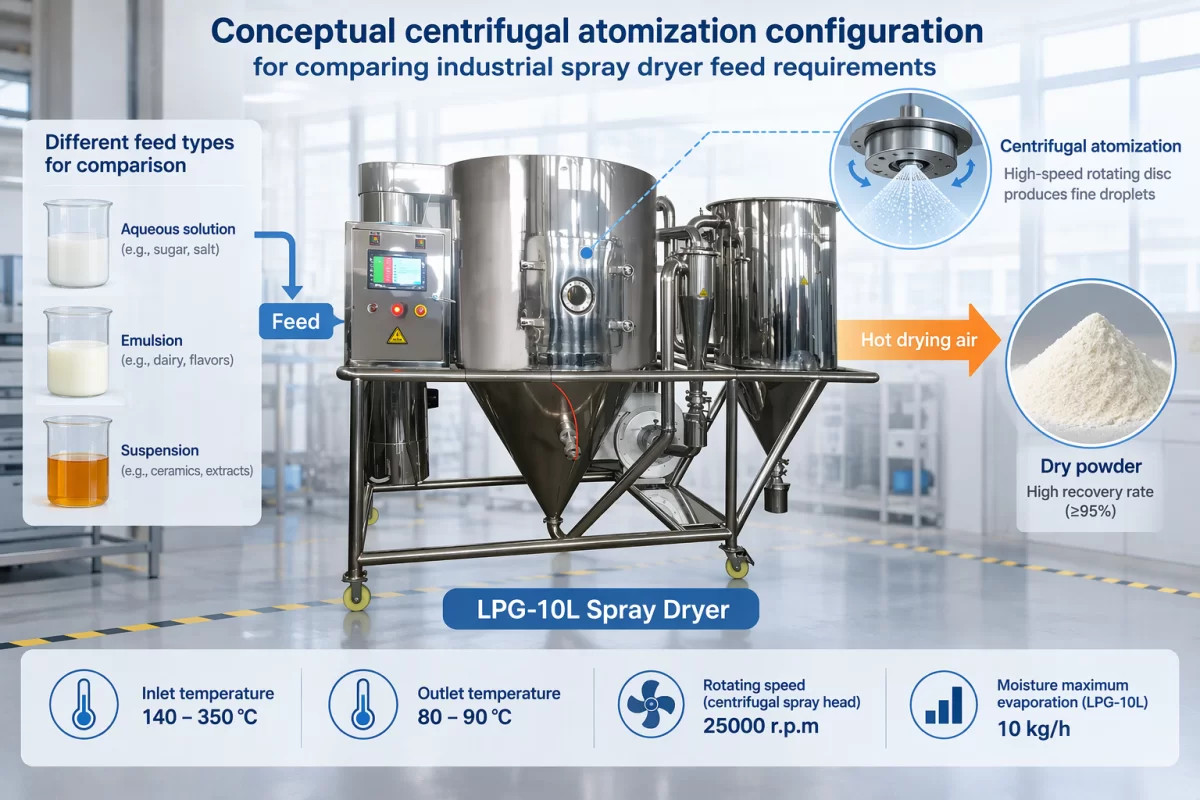
A centrifugal atomizer distributes feed from a rotating disc. A pressure nozzle uses liquid pressure to form the spray, while a two-fluid nozzle uses an atomizing gas. These are different approaches, not interchangeable accessories. Their feed-pressure requirements, utility connections, maintenance tasks, and compatibility with the drying chamber must be evaluated separately.
Begin with composition, solids concentration, viscosity at the intended feed temperature, suspended-particle characteristics, and any tendency to foam, crystallize, or become sticky. For emulsions and suspensions, feed preparation and agitation may be as important as the atomizer. For abrasive materials, wear and replacement access belong in the comparison.
The LPG-5 and LPG-10 provide a specific centrifugal comparison point. Their listed settings below apply to these models only; they do not describe every industrial dryer or establish a pressure-nozzle or two-fluid alternative. Explore centrifugal spray drying equipment when developing a rotary-atomizer equipment shortlist.
| Specification | Unit | LPG-5 | LPG-10 |
|---|---|---|---|
| Maximum moisture evaporation | kg/h | 5 | 10 |
| Centrifugal atomizer rotating speed | rpm | 25,000 | 25,000 |
| Spray disc diameter | mm | 50 | 50 |
| Heat source | Type | Electricity | Electricity |
| Electric heating power | kW | 9 | 20 |
Model-specific equipment figures. Maximum evaporation is not a feed-throughput or powder-output rating; heating power is not total system electricity consumption.
Matching atomizer speed and disc diameter does not make the two models process-equivalent. Feed behavior, heated airflow, chamber geometry, and the collection train still influence the usable operating window. Likewise, SD-2L laboratory specifications should not be substituted for the capacity, utilities, or collection requirements of an industrial system.
Match heated airflow and the drying tower to the material
Atomization must be assessed together with the air distributor and drying tower. The spray needs an appropriate relationship with the airflow and chamber dimensions. A change in atomization method can change droplet trajectories and wall contact, so it should not be treated as a simple component swap.
For heat-sensitive feeds, inlet-air temperature alone does not describe product exposure. Outlet conditions, residence behavior, feed rate, and moisture removal must also be considered. Ask for material-specific trial criteria covering residual moisture, the required functional properties, and acceptable wall deposition rather than assuming that a temperature setting guarantees quality.
The LPG models listed here use electric heating. A plant comparing electric, steam, or fuel-fired proposals should hold the feed and evaporation duty constant, then review the available electrical supply, air-heating arrangement, exhaust routing, and utility connections. Those alternative heat sources are configuration options to evaluate, not stated inclusions in either LPG model.
Can heater power alone establish the lower-cost dryer?
I would not make that judgment from heater ratings. I compare the same material, evaporation duty, product specification, and operating schedule, then include fans, feed equipment, atomizer utilities, and exhaust treatment. Installed heating power cannot independently establish energy consumption per kilogram of powder.
For broader process context, review spray drying applications and limitations. Application background is useful for defining a trial, but results from one formulation should not be transferred directly to another.
Powder collection: compare the complete downstream train
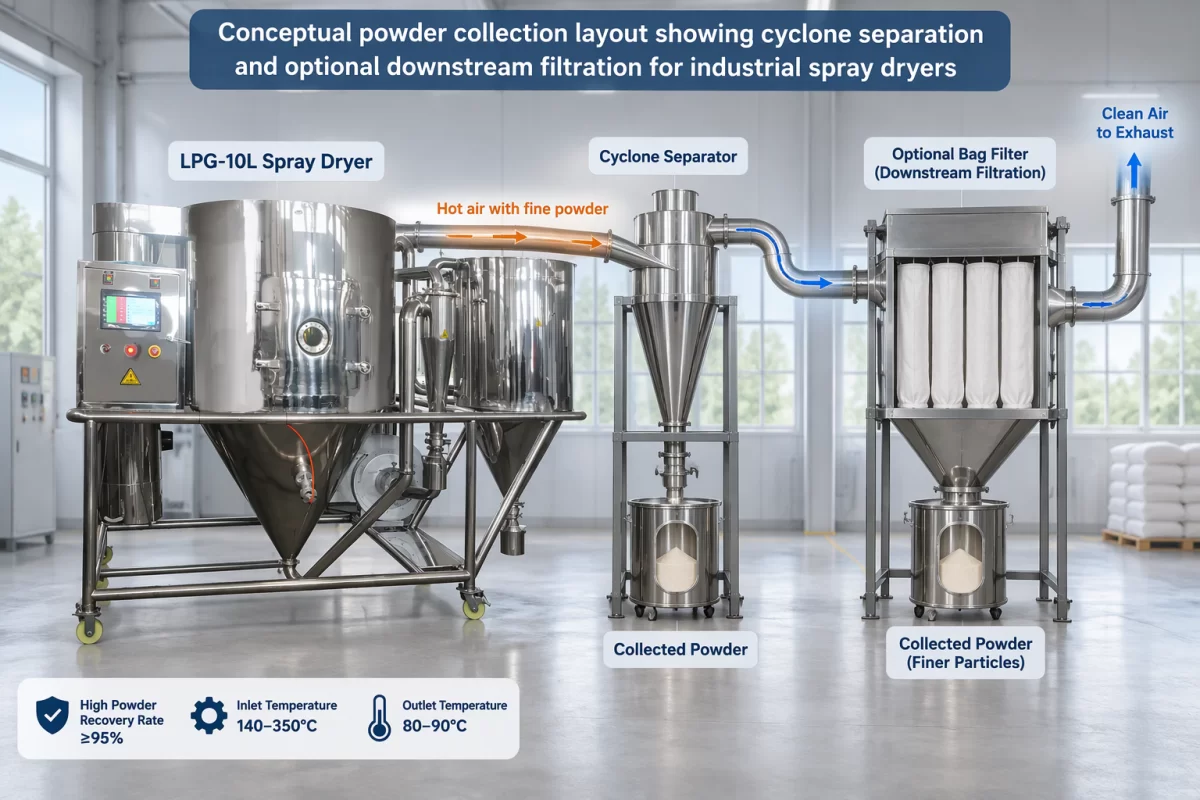
A drying tower forms particles; the downstream equipment separates, transfers, and contains them. A cyclone, a secondary filter, and an exhaust-treatment unit serve different purposes. Their selection depends on the expected particle distribution, stickiness, product value, cleaning needs, and emissions requirements.
| Unit and process position | Purpose and interface | Supply boundary to specify |
|---|---|---|
| Feed preparation and metering Before atomization | Condition and deliver feed; connect the feed tank, pump, piping, and atomizer inlet. | Identify responsibility for tanks, agitation, filtration, pump selection, and wetted connections. |
| Air heating and drying tower Drying stage | Deliver heated air and contain drying; connect heater, air distributor, tower, and outlet duct. | Define heater, fans, ductwork, insulation, tower access, and installation scope. |
| Cyclone Downstream of the tower | Separate entrained powder from gas; connect the tower outlet, gas outlet, and powder discharge. | Specify cyclone inclusion, discharge device, collection vessel, and seals. |
| Secondary dry filter After primary separation, if selected | Capture remaining fines; connect gas ducting and a separate fines discharge. | Assign filter media, cleaning utilities, fines handling, and maintenance access. |
| Exhaust treatment Final gas-handling stage | Address the project’s exhaust requirements; connect treatment equipment, fan, and discharge route. | Define treatment design, site ducting, stack connection, and any liquid-waste handling. |
| Controls and instrumentation Across the process | Coordinate feed, heating, airflow, atomization, and collection operation. | Specify sensors, control panel, alarms, interlocks, wiring, and commissioning responsibilities. |
A cyclone-only proposal and a cyclone-plus-filter proposal should be compared at the same material and duty. Consider fines handling, pressure drop, cleaning workload, and product segregation. Do not assume that adding a filter guarantees a particular recovery percentage. A wet scrubber, if required for exhaust treatment, is not interchangeable with a dry product collector because captured material enters a liquid stream.
Is secondary filtration always the better collection configuration?
My answer depends on the powder and the project boundary. I would evaluate fines value, filter compatibility, cleaning, pressure drop, and emissions needs together. Additional collection equipment can be useful, but it also adds interfaces and maintenance responsibilities.
Separate application suitability from quotation scope
Food processing and chemical processing need different reviews
For food materials, specify product-contact construction, cleanability, cleaning procedures, contamination controls, and handling of collected powder. A food-related product name does not establish hygienic design or certification. For chemical feeds, evaluate corrosion, abrasive solids, solvent content, dust hazards, and exhaust obligations. Solvent-containing feeds require a dedicated safety review; a standard electrically heated arrangement should not be assumed suitable.
A single dryer is not necessarily a complete system
A quotation for the drying unit may exclude upstream preparation, secondary collection, site ducting, utility equipment, installation, or commissioning. Request an equipment list and interface schedule that states whether each item is supplied by the dryer manufacturer, another package supplier, or the purchaser. When reviewing industrial spray drying systems, use that scope-based approach rather than treating a machine price as an installed-project price.
Company reference pricing
The company’s reference price range is US$2,800–3,250 for listed spray dryer offerings. This portfolio reference is not an LPG-5 or LPG-10 quotation and does not represent the price of a complete industrial drying system. The actual quotation depends on the selected configuration and inquiry results.
Choose industrial spray dryers by process fit, not an absolute ranking
The strongest purchasing comparison connects atomization with feed behavior, heated airflow with evaporation duty, and powder collection with the target product and exhaust requirements. LPG-5 and LPG-10 offer model-specific centrifugal reference points, but their listed capacities and heater ratings cannot establish powder quality, collection yield, or operating cost for every material.
For a configuration assessment and quotation, submit:
- Material details: composition, solids content, viscosity, density, heat sensitivity, solvent content, and relevant hazards.
- Capacity basis: target feed throughput or working batch size, operating hours, and expected water-removal duty.
- Powder requirements: residual moisture, particle-size objectives, handling needs, and intended use.
- Operating conditions: utilities, installation space, cleaning requirements, and exhaust constraints.
- Configuration scope: atomization preference, collection stages, controls, auxiliary equipment, and installation responsibilities.
With these inputs, an equipment proposal can distinguish the drying unit from the complete system and compare realistic atomization and powder-collection configurations on a consistent basis.