Jacketed Glass Reactor • Scale-up & Selection
Pilot-Plant Glass Reactor Scale: Nominal Capacity vs Working Volume
Which glass reactor is best for pilot plant scale? The right starting point is the process batch—not the word “pilot” in a product name. A suitable jacketed glass reactor must accommodate the changing material volume while supporting the required mixing, heat transfer, vapor handling, and discharge operations.
Laboratory, pilot plant, and production describe different tasks
Laboratory work typically focuses on chemistry, screening, sampling, and small-batch process development. Pilot-plant work tests whether an operating sequence remains practical as the batch grows: charging, controlled addition, temperature response, mixing, condensation, and product transfer all matter. Production adds requirements for sustained throughput, repeatability, cleaning, utilities, and operating logistics.
These categories do not have universal capacity boundaries. A small reactor may support a pilot study for a high-value material, while a larger vessel may still be used only for development. A product labeled “laboratory” or “pilot plant” therefore does not establish its effective processing capacity.
For background on glass reactors for pilot-plant work, keep the selection anchored to the actual process. The equipment’s role is determined by what must be demonstrated, not merely by its listed vessel size.
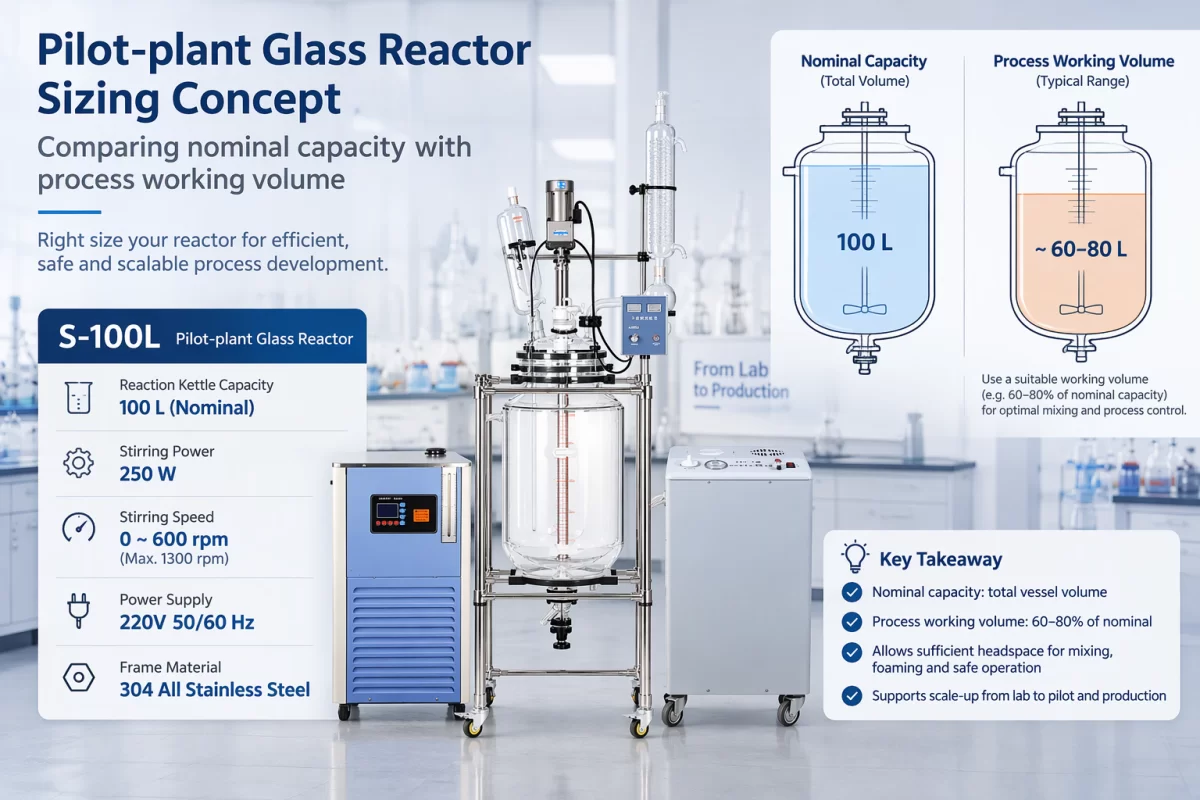
Does a 100 L reactor provide a 100 L working batch?
My answer is no—not on the basis of nominal capacity alone. The batch needs space for its operating behavior, and the initial charge must also be compatible with the agitator and temperature-measurement arrangement. The appropriate working volume is process- and configuration-dependent.
Use listed capacities to build a shortlist—not a throughput promise
The S-series capacity choices below provide a useful starting framework. These are listed reaction-kettle capacities, not validated working batches, jacket volumes, or hourly production rates.
| Model | Listed kettle capacity (L) | Selection meaning |
|---|---|---|
| S-1L | 1 | Nominal vessel capacity only |
| S-2L | 2 | Nominal vessel capacity only |
| S-3L | 3 | Nominal vessel capacity only |
| S-5L | 5 | Nominal vessel capacity only |
| S-10L | 10 | Nominal vessel capacity only |
| S-20L | 20 | Nominal vessel capacity only |
| S-30L | 30 | Nominal vessel capacity only |
| S-50L | 50 | Nominal vessel capacity only |
| S-100L | 100 | Nominal vessel capacity only |
For a larger-capacity shortlist, the product page for 80L and 100L jacketed glass reactors is a relevant next step. Compare the selected model’s complete assembly against the intended batch rather than assuming that a larger nominal vessel automatically offers better pilot-scale performance.
Separate four volume decisions
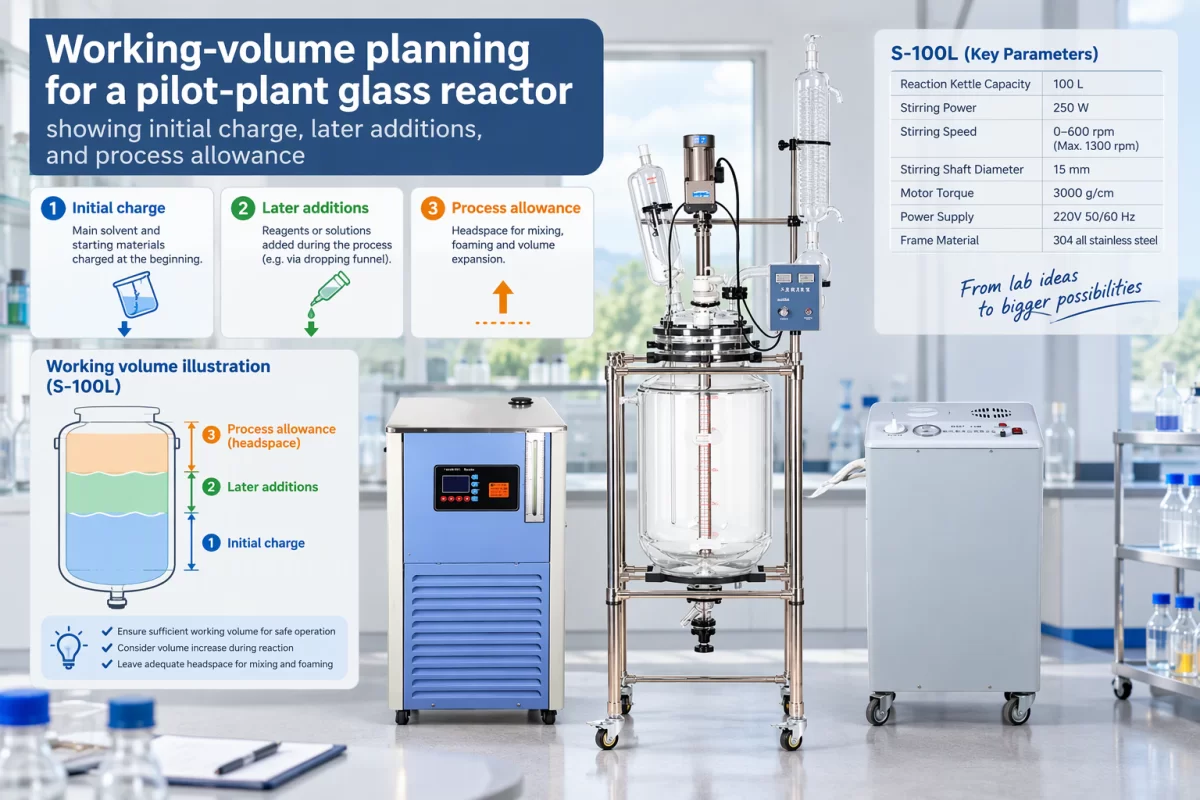
- Initial charge: Record the volume present before additions. Check whether the proposed impeller and probe positions remain effective at that level.
- Addition-driven changes: Identify the highest simultaneous material inventory. Account for feed additions, solvent changes, solids, and any removal steps in their actual sequence.
- Process allowance: Establish space for the specific material’s expansion, foaming, gas evolution, boiling behavior, and mixing-related surface movement.
- Future expansion: Define a separate future batch scenario. Do not hide growth expectations inside an arbitrary allowance for the current process.
A single fill percentage should not be applied to every material. A quiet liquid blend, a foaming reaction, and a crystallizing slurry may require different operating envelopes even in the same nominal vessel.
Compare working volume under the same assumptions
Consider a hypothetical pilot batch with an initial liquid charge of 18 L and subsequent additions totaling 12 L. Assume the volumes are additive, no material is removed before the peak, and there is no net volume change from reaction or temperature. The calculated peak material inventory is therefore 30 L.
For this example only, suppose the process assessment requires 10 L of unoccupied vessel space above that peak inventory. The resulting capacity-screening requirement is 30 L + 10 L = 40 L. This is a hypothetical planning calculation, not an equipment guarantee or a recommended fill rule.
| Candidate capacity (L) | Peak inventory (L) | Arithmetic space remaining (L) | Capacity-only assessment |
|---|---|---|---|
| 30 | 30 | 0 | Does not meet the assumed 10 L allowance |
| 50 | 30 | 20 | Passes this preliminary capacity screen |
| 100 | 30 | 70 | Passes the screen; low-charge operation still matters |
Is the largest reactor always the best pilot-scale choice?
I would not select the largest vessel by default. In this example, both 50 L and 100 L pass the capacity screen, but the 18 L initial charge still needs effective agitation and representative temperature measurement. Extra nominal space does not establish either capability. Future growth should justify the larger option through a separate batch and configuration review.
Which glass reactor is best for pilot plant scale? Check the complete configuration
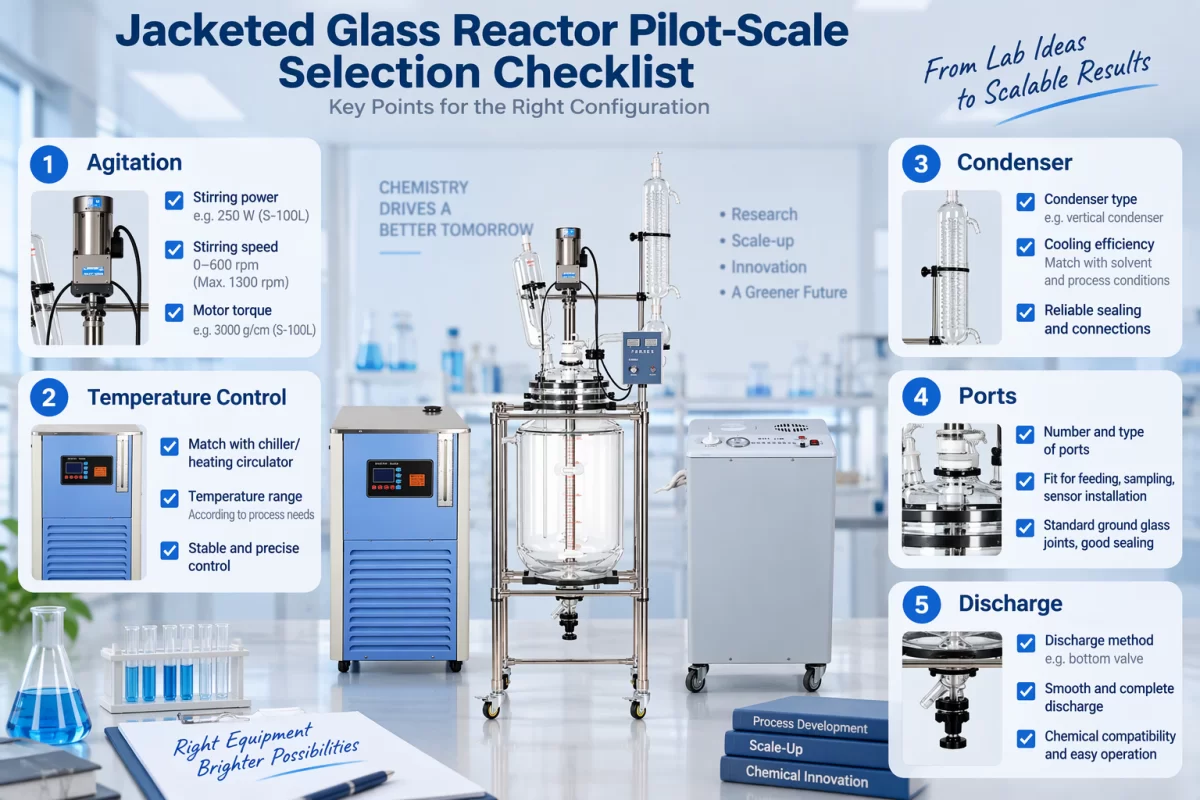
After capacity screening, compare each candidate against the same material, batch sequence, and target conditions. A useful procurement comparison covers the following components rather than transferring specifications from one model to another.
- Vessel and jacket: Evaluate vessel geometry, operating liquid levels, jacket arrangement, and the thermal duty associated with the actual batch.
- Agitation and drive: Match impeller geometry, position, motor power, torque, and operating speed to viscosity, solids loading, and mixing objectives. Matching rpm alone does not establish equivalent mixing at another scale.
- Seals and wetted components: Assess compatibility with all reactants, solvents, intermediates, and cleaning agents across the intended operating conditions.
- Condenser and receiver: Evaluate vapor load, coolant conditions, reflux or collection requirements, and receiver capacity for the intended operation.
- Ports and instrumentation: Provide suitable connections for feeds, sampling, temperature measurement, venting, and any required monitoring.
- Discharge: Consider valve arrangement, solids passage, residual hold-up, transfer destination, and cleaning access.
- Temperature-control system: Assess heating and cooling duty, circulation flow, heat-transfer fluid, and connections as part of the reactor system.
Pressure and temperature are separate selection limits. An ordinary jacketed glass reactor should not be treated as a high-pressure reactor. Vacuum-related descriptions also do not establish a positive-pressure rating. Operating limits must be supported for the selected vessel, seals, fittings, and assembly; hazardous-area suitability requires its own configuration-specific assessment.
Does the circulator setpoint equal the material temperature?
My answer is no. The circulator controls its heat-transfer fluid according to its control arrangement; the reactor contents respond through the jacket and vessel wall. Batch size, mixing, reaction heat, and heat-transfer conditions affect that response. Selection should address measured material temperature and the required heating or cooling profile, not just a circulator setpoint.
Use reference pricing without losing the configuration basis
Our company reference price is US$1,699. This is a reference across our supplied jacketed glass reactor price listings, not a quoted price for every capacity or for a complete pilot-plant package. The actual quotation depends on configuration and the inquiry result.
For a meaningful purchasing comparison, keep the scope consistent: reactor capacity, agitation, sealing, condenser, receivers, instrumentation, temperature-control equipment, and installation requirements should be identified together. A vessel price alone cannot establish the cost of a process-ready system.
Choose the working batch first, then the reactor
The best pilot-plant glass reactor is the model whose supported operating envelope and configuration fit the process—not necessarily the largest vessel or the one named “pilot plant.” Separate initial charge, peak inventory, process allowance, and future expansion before deciding on nominal capacity.
To evaluate a jacketed glass reactor solution and obtain a configuration-based quotation, submit the material composition, target throughput or working batch, charging and addition sequence, viscosity and solids behavior, intended temperature and pressure conditions, and required agitation, condensation, discharge, and temperature-control arrangements. These details turn a capacity shortlist into a practical purchasing decision.