Drying Oven · Laboratory Application Guide
Preparing Pharmaceutical Laboratory Samples for Vacuum Drying
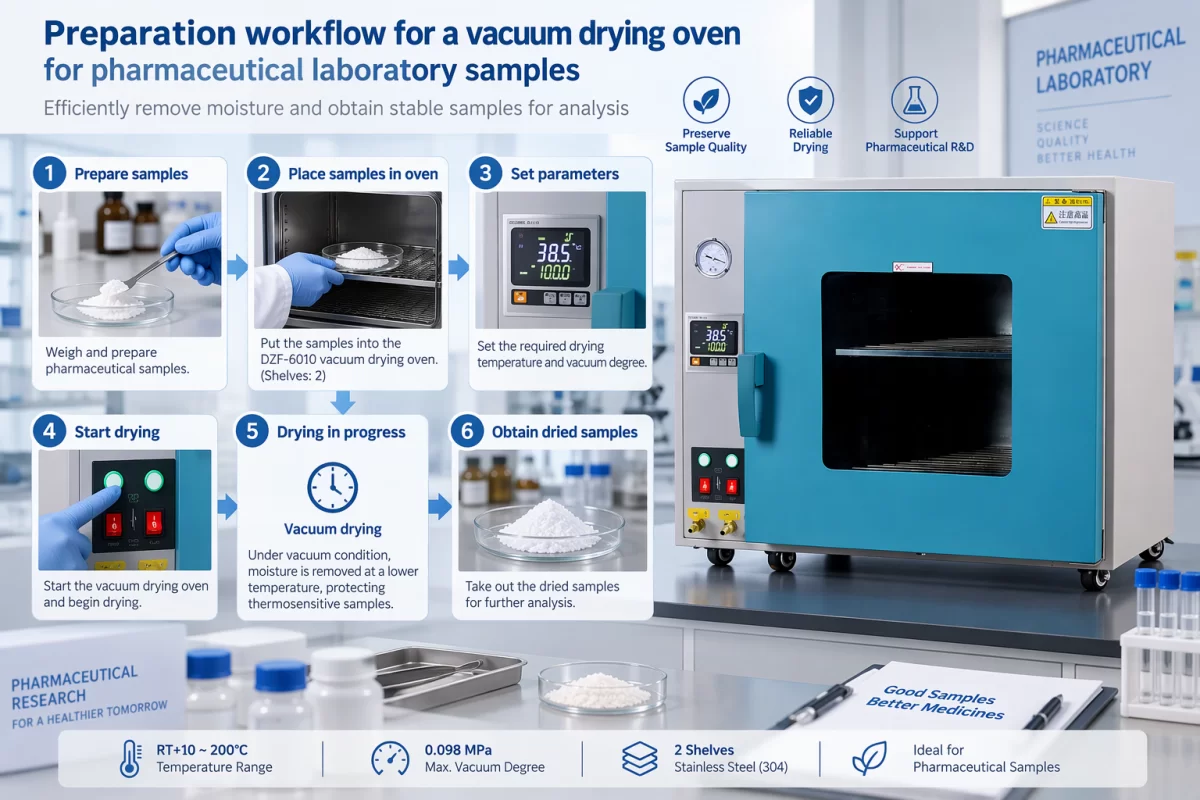
Selecting a vacuum drying oven for pharmaceutical laboratory samples starts with the sample arrangement, not simply the chamber volume. A shallow layer in a suitable container can behave differently from the same mass packed into a deep vessel. Container footprint, sample thickness and batch organization should therefore be defined before comparing DZF models.
Application scope: This guide addresses research, experimental work and evaluated small-batch laboratory tasks. It does not establish commercial pharmaceutical production suitability, sterile processing capability or regulatory qualification.
Define the sample and drying objective first
Begin with the material’s physical form: loose powder, wet filter cake, granules, crystals or a liquid-containing residue. Record the initial wet mass, expected moisture content, temperature sensitivity and tendency to foam, crust or release dust. These characteristics affect how the sample should be spread and how cautiously pressure should be reduced.
Define the endpoint before loading. An exploratory moisture-removal task may use repeated weighing under a documented cooling and handling procedure. A task involving a specific residual solvent needs an appropriate analytical method for that solvent. Loss of mass alone does not identify which volatile component has left the sample.
Vacuum-assisted dehydration should not be treated as proof of organic-solvent removal. Solvent-containing samples also require a separate assessment of vapor handling, pump compatibility, ignition hazards and exhaust arrangements.
Control sample thickness before increasing batch mass
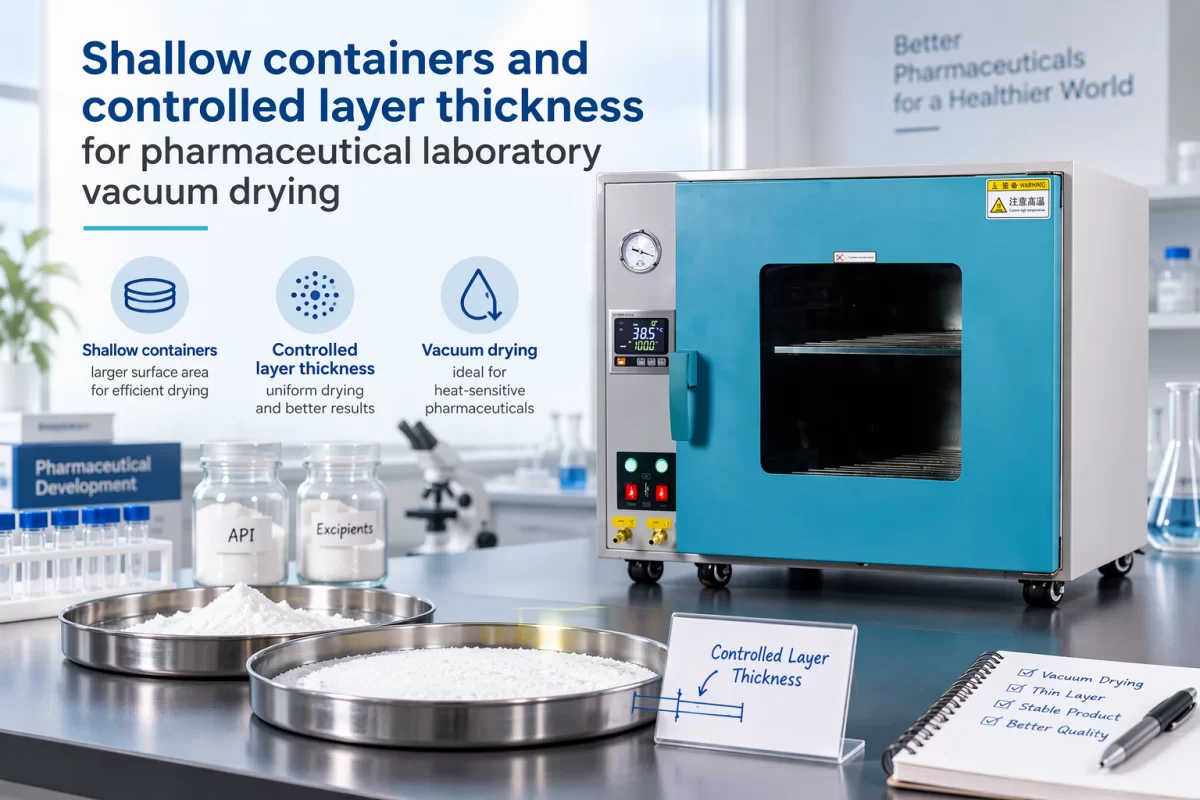
For a stationary sample bed, increasing thickness can lengthen the path through which moisture must escape. Surface drying may occur while the center remains wetter, particularly if the material forms a crust. Rather than assuming that a larger oven permits a proportionally larger batch, first establish a workable layer thickness using representative material.
Spread the sample evenly and record its depth at several points. Keep the container type, starting material condition and loading procedure consistent during comparisons. Where replicate trials are needed, compare equal layer thicknesses under the same temperature program, measured operating pressure and endpoint method.
Loading calculation: an assumed shallow-bed trial
Assume a container has a usable internal base of 200 × 150 mm, an evenly spread sample depth of 5 mm, and an assumed wet bulk density of 0.60 g/cm³.
Sample volume = 20 cm × 15 cm × 0.5 cm = 150 cm³.
Estimated wet mass = 150 cm³ × 0.60 g/cm³ = 90 g per container.
At 10 mm depth, the same assumptions give 180 g, but not a guaranteed drying time or acceptable endpoint. This is a sample-geometry calculation, not a DZF shelf-load rating or equipment throughput guarantee.
Does doubling the sample depth double useful batch capacity?
My recommendation is to treat it as a new trial condition. The loaded mass may double geometrically, but the drying time, center moisture and product behavior can change. Useful capacity should be based on material that meets the defined endpoint within an acceptable cycle, not just the mass initially placed inside.
Select containers for heat transfer, compatibility and handling
A container should tolerate the intended temperature and pressure differential, remain compatible with the sample, and provide a stable footprint on the shelf. Shallow vessels can help control layer depth, but their suitability depends on the material and handling method. Glass, metal and other container materials should not be assumed interchangeable: their thermal behavior, chemical compatibility and cleaning requirements differ.
Avoid tightly sealed sample vessels unless they are specifically engineered for the task. A sealed vessel can prevent vapor removal and create a pressure differential during evacuation. Any cover used to limit powder movement must still allow adequate vapor escape and must be assessed for the process.
The listed DZF chamber liner material is 304 stainless steel. This identifies the liner, not every sample-contact or vapor-contact component. If the sample is held in a separate tray, that tray is the direct contact surface. Include tray material, seals, tubing and pump-side components in the compatibility assessment.
Match DZF chamber geometry to the planned batch
For equipment selection, compare the actual container layout with chamber dimensions and shelf count. The DZF-6090 is one option to review among the available laboratory vacuum drying ovens, particularly when a wider chamber is needed for a planned arrangement. Selection still depends on usable shelf dimensions, vertical clearance and the complete configuration.
| Model | Chamber volume (L) | Internal W × D × H (mm) | Shelves (pcs) |
|---|---|---|---|
| DZF-6010 | 8 | 200 × 200 × 200 | 1 |
| DZF-6020 | 25 | 300 × 300 × 270 | 1 |
| DZF-6050 | 55 | 400 × 400 × 345 | 2 |
| DZF-6090 | 90 | 450 × 450 × 450 | 2 |
Chamber volume is enclosure space. Internal dimensions are not usable tray dimensions, and shelf count does not establish allowable sample mass.
Prepare a layout showing each container’s external footprint, necessary gaps, lid height and handling clearance. Do not calculate usable tray area directly from chamber width and depth: shelf supports, edge clearances and fittings may limit the usable surface. Likewise, a two-shelf arrangement requires sufficient vertical space above each loaded vessel.
Is a 90 L chamber automatically suitable for a larger sample batch?
I would choose it only after checking the container layout and running a representative loaded trial. A larger enclosure offers more space, but actual capacity depends on usable shelf area, acceptable layer thickness, mechanical loading limits and the heating and vapor-removal demands of the batch.
Separate temperature settings from material conditions
The controller setpoint, temperature at the chamber sensor and temperature inside the sample are different quantities. During evaporation, the material may remain cooler than the surrounding heated surfaces. Container contact and sample thickness can also affect the time required for the center of a bed to warm.
The listed temperature stability for DZF-6010, DZF-6020, DZF-6050 and DZF-6090 is ±1.0 °C. This is not a claim of identical temperatures throughout every loaded sample, nor a substitute for temperature uniformity or material-temperature measurements under the intended operating conditions.
For a temperature-sensitive task, specify the permissible material temperature and a suitable measurement method. Any probe feedthrough must be compatible with the chamber and vacuum arrangement; improvised cable routing through the door seal can compromise sealing.
Operating pressure depends on the loaded system
An empty-system ultimate pressure is different from the pressure maintained while wet samples release vapor. Actual drying pressure depends on vapor generation, pump performance, leaks, connecting-line conductance and any vapor trap. An ordinary laboratory vacuum drying oven should not be described as high-vacuum equipment without supporting specifications and test conditions.
Specify whether pressure is reported as absolute pressure or relative vacuum, where it is measured, and whether the measurement represents an empty or loaded chamber. For a pump package, include the vacuum-port connection, hose dimensions, pump type, vapor compatibility, trapping requirements and exhaust destination in the purchasing discussion.
Arrange batches for interpretable drying trials
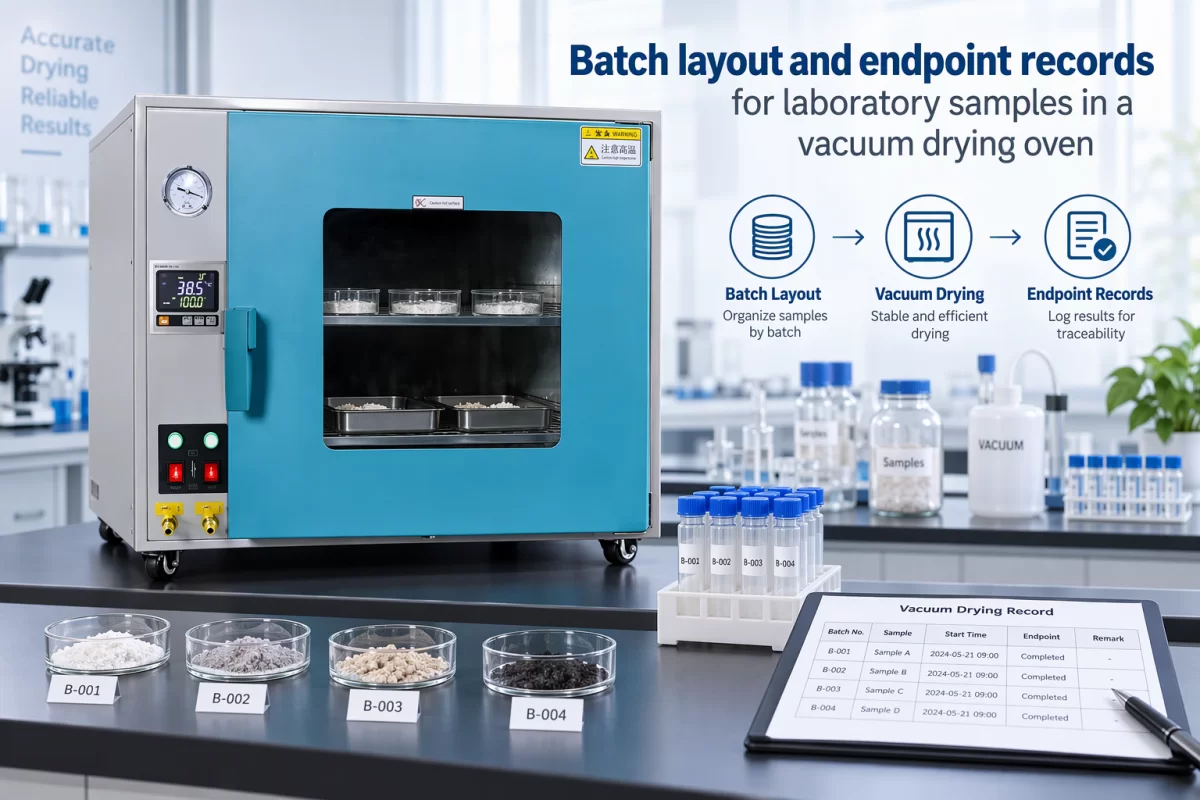
Group samples with compatible drying conditions rather than mixing materials simply to fill available shelves. Separate batches where odors, volatile components or dust could affect other samples. Label each vessel and record shelf position so that drying results can be traced to the arrangement.
- Record empty-container mass and initial sample mass.
- Document usable sample area, average layer depth and container material.
- Record the shelf position, temperature program and measured operating pressure.
- Assess the endpoint using a defined sampling, cooling and measurement procedure.
- Use the accepted trial to plan subsequent batches with comparable loading geometry.
A general guide to using a vacuum drying oven can support operating preparation. The final procedure should follow the selected equipment’s instructions and the laboratory’s material-specific risk assessment.
Can constant mass establish that every residual solvent has been removed?
I would use constant mass only for a task in which that criterion has been shown to be appropriate. It does not identify individual solvents or establish pharmaceutical release suitability. Solvent-specific objectives require suitable analytical testing and a separately assessed drying configuration.
Choose a vacuum drying oven around the working batch
The most useful purchasing comparison for a vacuum drying oven for pharmaceutical laboratory samples is the number of suitable containers that fit at an evaluated layer thickness—not chamber liters alone. Combine chamber geometry with usable shelf area, material-temperature needs, measured drying pressure and compatible vacuum hardware.
Our company’s reference price across the supplied listings is US$610. This is a general reference price, not a model-specific configured offer. The actual quotation depends on configuration and inquiry results.
For a tailored assessment and quotation, submit: the material and volatile components, initial and target moisture or solvent levels, target throughput or working batch mass, container dimensions and layer thickness, intended temperature and pressure conditions, and required pump, trapping, contact-material and safety configuration. These details help identify an appropriate DZF option for the evaluated laboratory task.