Laboratory Explosion-Proof Rotary Evaporators: A Purchasing Checklist
Deciding where to buy an explosion-proof rotary evaporator for lab work begins with the laboratory, the solvent, and the complete equipment package—not simply a flask size or a product label. A useful quotation must connect the evaporation duty to the available space, electrical installation, vacuum arrangement, and external cooling source.
1. Define the laboratory site before selecting equipment
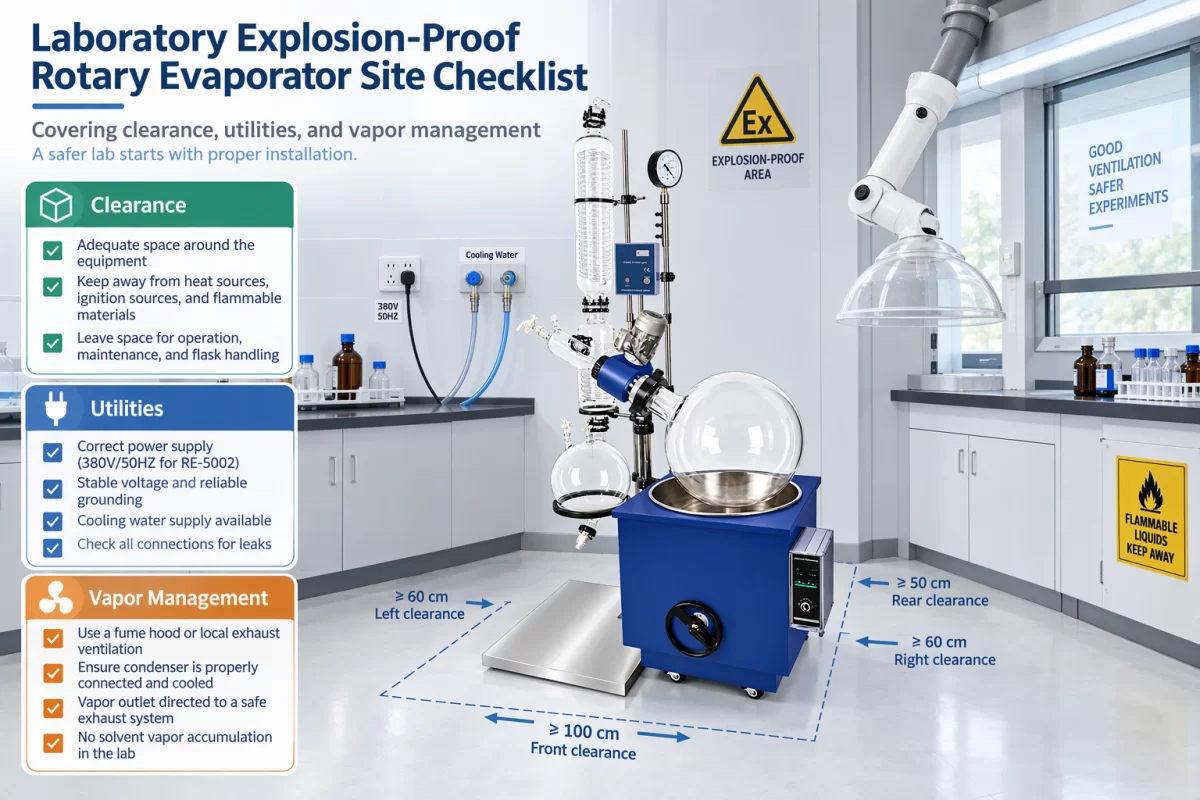
Start with a written site brief. Record the installation location, ventilation arrangement, available electrical supply, access route, and working clearance. Include space for removing the evaporating flask, draining the receiver, raising the assembly, and servicing the condenser. A machine that fits within the bench footprint can still be unsuitable if glassware cannot be handled safely.
Have the laboratory’s responsible safety professional determine whether a hazardous area classification applies and identify the applicable local requirements. Flammable solvents alone do not establish which electrical protection scheme is appropriate. The potential release locations, ventilation, equipment placement, and operating procedures all belong in that assessment.
- Space: Measure the installation envelope, overhead clearance, service access, and support requirements.
- Utilities: Record voltage, phase, frequency, circuit capacity, protective earthing, and available cooling connections.
- Vapor management: Define the route for pump exhaust and any captured solvent, rather than treating the vacuum line as the end of the process.
- Ancillary placement: Identify where the pump and chiller will operate and whether those locations fall within the assessed hazardous area.
Does an explosion-proof motor establish the suitability of the complete system?
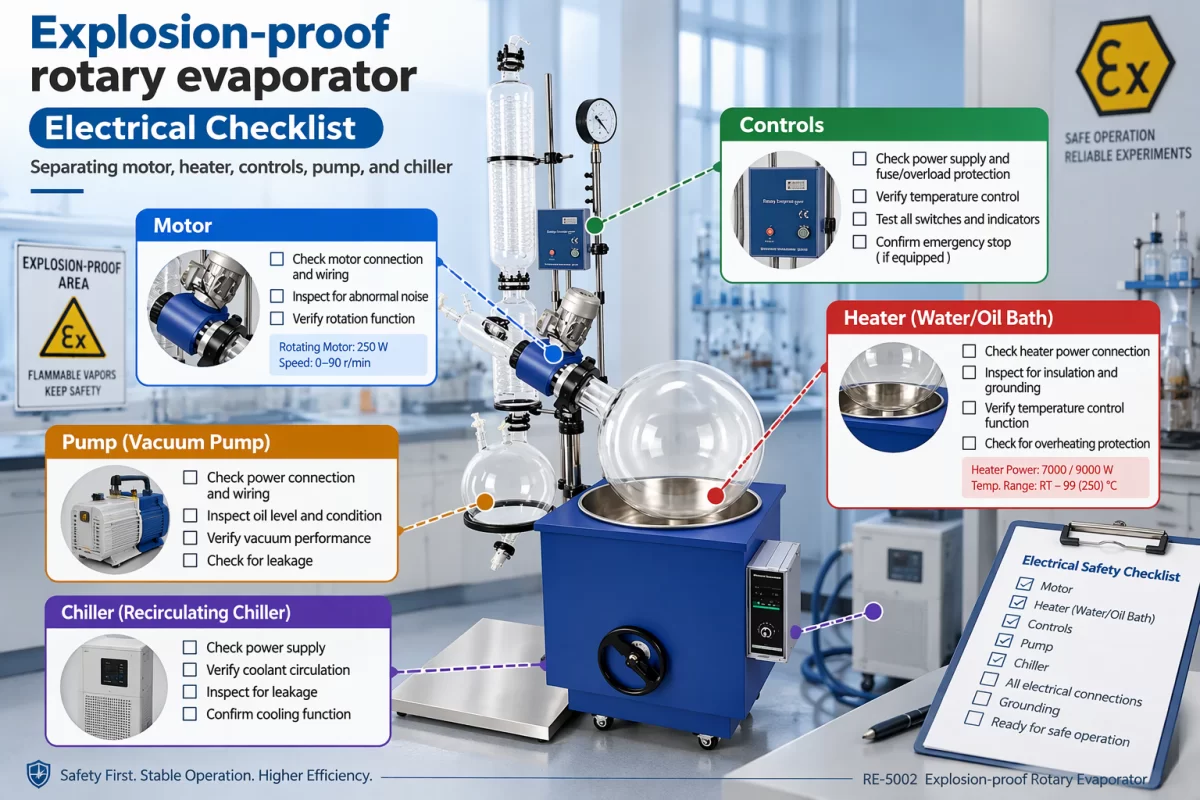
I treat a motor declaration as evidence about that motor only. Heating elements, bath controls, switches, lift drives, vacuum equipment, and the chiller need separate consideration. The complete proposed configuration must be assessed against the installation conditions; a component declaration is not equivalent to certification of the evaporator or the connected system.
2. Translate the solvent and batch into a realistic duty
Provide the solvent identity, mixture composition where known, solids content, viscosity, foaming tendency, and temperature sensitivity. State the starting liquid volume, intended residual concentration, expected solvent removal, and available processing time. These details are more useful for configuration selection than a request for “the largest model within budget.”
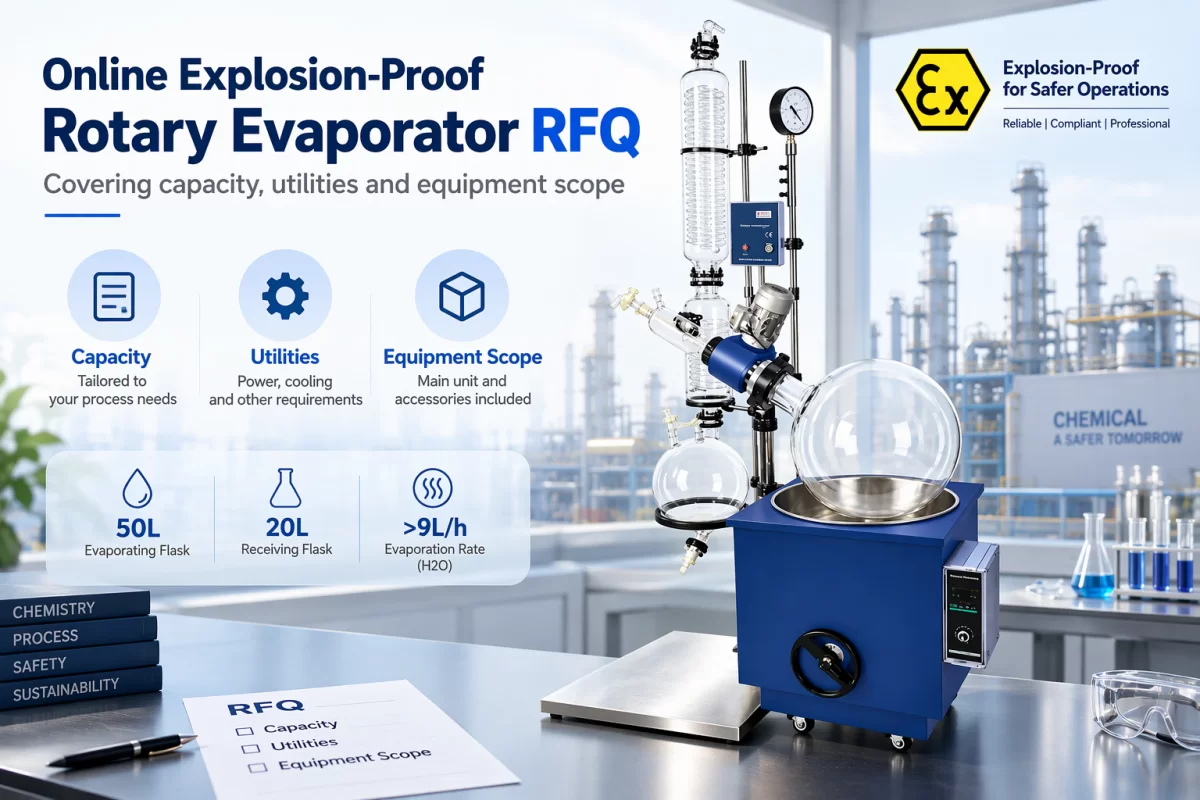
The nominal evaporating flask volume is neither the approved working charge nor an hourly recovery rating. Liquid needs room to rotate and form a film, while foaming or bumping can require additional headspace. The receiving flask also needs a practical collection and draining plan. Any feed-through arrangement or receiver isolation method should be included explicitly in the proposed configuration, not presumed from bottle capacity.
Compare proposed packages using the same solvent composition, starting batch, target endpoint, bath temperature, operating pressure, cooling conditions, and feeding method. A water-based evaporation figure does not establish recovery performance for another solvent or mixture.
For extraction liquids, position the rotary evaporator as equipment for solvent recovery or concentration after the extraction step. That role does not establish direct extraction capability, selective purification of a target compound, or pharmaceutical production-grade suitability.
3. Match flask capacity and mechanical access to the job
Begin a product discussion with the available explosion-proof rotary evaporator options, then request a model-specific configuration proposal. Product selection should remain separate from the determination of electrical protection suitability.
The following nominal glassware capacities provide a starting point for comparing laboratory and larger working arrangements. They do not identify any listed model as explosion-proof or establish a throughput guarantee.
| Model | Evaporating flask (L) | Receiving flask (L) | Purchasing consideration |
|---|---|---|---|
| RE-201D | 2 | 1 | Match working charge and collection schedule |
| RE-301 | 3 | 2 | Allow for foaming and endpoint handling |
| RE-501 | 5 | 3 | Review flask removal and receiver access |
| R1005 | 5 | 3 | Compare the complete configuration, not capacity alone |
| R1010 | 10 | 5 | Define batch or feeding requirements |
| R1020 | 20 | 10 | Coordinate collection with cooling and vacuum duty |
| R1050 | 50 | 20 | Plan handling, installation space, and services |
Rotation and lifting deserve their own checklist. Ask for the speed range of the selected configuration, the adjustment method, lift mechanism, lift travel, and behavior during power loss. Check whether the flask can be withdrawn from the bath and removed without obstructing nearby equipment. For background on the relationship between glassware, motion, heating, and condensation, see rotary evaporator parts and applications.
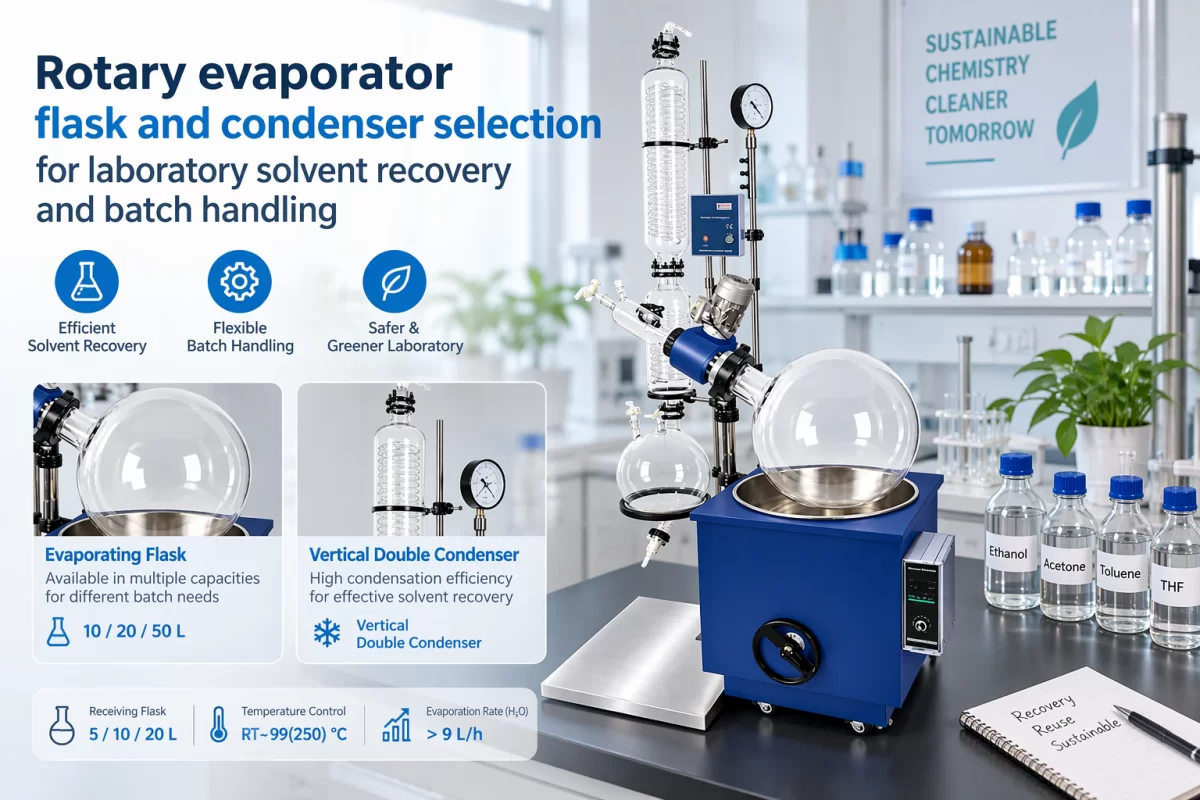
Can a larger evaporating flask guarantee faster solvent recovery?
I would not use flask volume as a recovery-rate guarantee. A larger vessel may accommodate a different working batch, but the achievable rate also depends on heat transfer, solvent properties, vacuum stability, condenser performance, and cooling capacity. I recommend comparing packages at the same duty and endpoint before deciding whether a larger model is worthwhile.
4. Specify heating, vacuum control, and the external cold source
For the bath, request the heating power, compatible bath medium, usable temperature range, temperature-control method, and overtemperature protection for the exact model. Select the operating temperature around the material’s stability and the intended pressure, rather than assuming the highest available setting is the most productive choice.
The vacuum proposal should distinguish pump capability from operating pressure at the evaporator. Specify solvent compatibility, pressure measurement location, control method, regulation valves, exhaust handling, and expected vapor exposure. A pump’s ultimate pressure does not demonstrate stable pressure control during evaporation.
For the condenser, obtain its arrangement, coolant connection requirements, and operating limits. Size the external cold source around the actual vapor load and required coolant temperature. A chiller’s nominal capacity should not be treated as its available cooling duty at every temperature. If a cold trap is proposed, define its location, cooling method, collection capacity, and maintenance procedure.
- Heating: Match bath operation and protective functions to the proposed solvent duty.
- Vacuum: Include measurement and regulation, not only a pump designation.
- Cooling: Request cooling performance at the intended coolant temperature and suitable flow conditions.
- Connections: Specify solvent-compatible vacuum hoses, coolant lines, fittings, and routing.
5. Build a component-by-component explosion-protection checklist
When evaluating where to buy an explosion-proof rotary evaporator for a laboratory, look for a proposal that identifies the supplied electrical components and their applicable protection documentation. A general sales description is not enough to establish the suitability of a particular installation.
- Rotation motor: Record the supplied motor identity, protection marking, and applicable operating conditions.
- Heating assembly: Review the heater, temperature sensors, bath controls, and protective devices independently of the motor.
- Controls and lifting: Include the controller enclosure, switches, wiring entries, and any powered lift mechanism.
- Vacuum pump: Check both electrical suitability at its location and compatibility with the vapor passing through it.
- Chiller: Assess its installation location and electrical requirements separately; do not infer suitability from the evaporator.
The documentation should connect any protection claim to the relevant component or assembly, applicable standard, environmental limits, and installation conditions. Where certification is offered, its scope must match the equipment supplied. Installation design, earthing, ventilation, and operating procedures remain part of the laboratory’s overall safety assessment.
6. Compare quotations with the same supply scope
Ask for an itemized quotation that separates the main rotary evaporator, vacuum pump, chiller, cold trap, connecting pipework, and services. For the main unit, identify the glassware, bath, rotation mechanism, lift, and controls included. Do not assume that a photograph of a connected system establishes what will be delivered.
List accessories and services separately: spare seals, replacement glassware, installation assistance, commissioning, operator training, freight, and after-sales support. Include delivery terms and the proposed acceptance criteria. The discussion of rotary evaporator package costs can help frame a package-level inquiry rather than a main-unit-only comparison.
This is our company’s reference price across the supplied listings, not a quotation for a defined explosion-proof laboratory system. The actual quotation depends on the selected configuration and inquiry results. Pumps, cooling equipment, cold traps, pipework, and services should be priced explicitly.
What makes a supplier quotation useful for purchasing approval?
I look for a named model, a defined solvent duty, an itemized equipment list, applicable electrical documentation, and clear exclusions. The quotation should also state the proposed operating basis and acceptance conditions. Without those details, two prices may describe substantially different packages.
Where to buy an explosion-proof rotary evaporator for lab use: choose by documented fit
The purchasing decision should connect three things: the laboratory site, the solvent recovery duty, and a clearly defined equipment package. Choose flask and receiver capacities around the working batch, assess heating and condensation under the intended conditions, and review protection requirements for the motor, heater, controls, pump, and chiller separately.
For further configuration assessment and a quotation, submit the material and solvent composition, target processing quantity or working batch, desired endpoint, temperature and pressure conditions, site electrical supply, installation constraints, and required accessories. Include the laboratory’s applicable hazardous-area requirements so the proposed equipment and documentation can be evaluated against the intended use.