50L Rotary Evaporator Capacity: Flask Volume, Batch Loading and Workflow
A 50L rotary evaporator has a nominal 50-liter evaporating flask, but that number does not describe a safe initial charge, the amount of feed handled during a campaign, or solvent recovered per hour. A useful purchasing decision separates flask loading, controlled feeding, condensate collection and the time required to complete an entire working cycle.
What 50L rotary evaporator capacity actually means
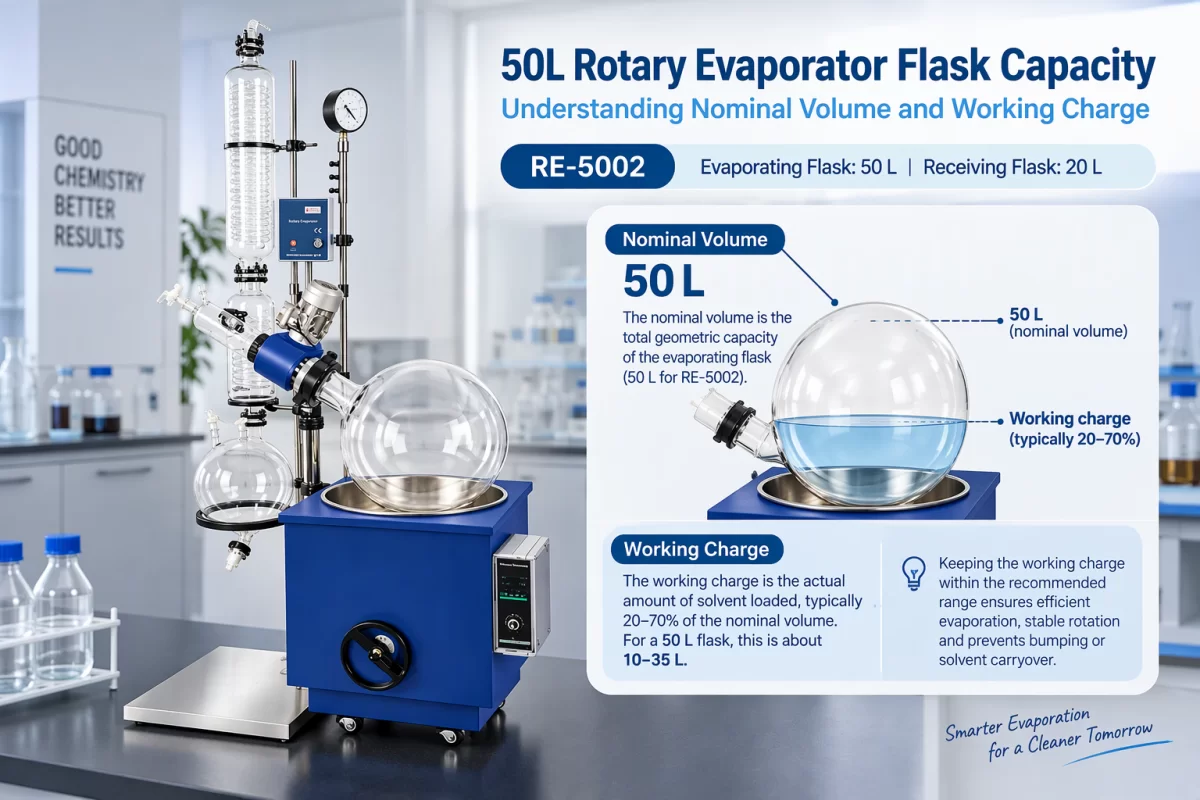
For the R1050, the specified evaporating flask volume is 50 L and the receiving flask volume is 20 L. These describe two different vessels with different jobs. The rotating flask holds the material being concentrated; the receiver collects condensed solvent. Neither vessel should be treated as a promise that its full nominal volume is available as an operating load.
The initial liquid charge needs space for rotation, vapor disengagement and the material’s foaming or bumping behavior. Solvent composition, dissolved solids, viscosity and the required final concentration all influence the practical working load. A liquid that behaves well at the beginning may become more viscous or foam differently near the endpoint.
Does a 50-liter flask mean a 50-liter initial batch?
I would not use the nominal flask size as the loading instruction. I would define a working charge through the operating procedure and material trials, allowing appropriate headspace and accounting for behavior throughout concentration—not only at startup.
When choosing between equipment sizes, compare the same material, solvent removal target, operating temperatures and work schedule. The 20L and 50L rotary evaporator configurations provide a relevant starting point for model selection. A larger flask can reduce loading interruptions for suitable work, but it does not automatically deliver a proportional increase in recovery rate.
R1050 specifications relevant to batch organization
The following model-specific vessel and dimensional data help organize loading, collection and installation. Flask volumes remain nominal capacities, while the bath dimensions describe physical size rather than heating performance.
| Parameter | R1050 specification | Planning relevance |
|---|---|---|
| Evaporating flask | 50 L | Nominal vessel volume, not an initial charge limit |
| Receiving flask | 20 L | Basis for planning condensate handling |
| Water bath dimensions | Diameter 550 × 320 mm | Bath geometry and installation planning |
| Lift travel | 0–180 mm | Movement allowance for operating access |
| Overall dimensions | 1320 × 770 × 2340 mm | Equipment envelope before service clearance |
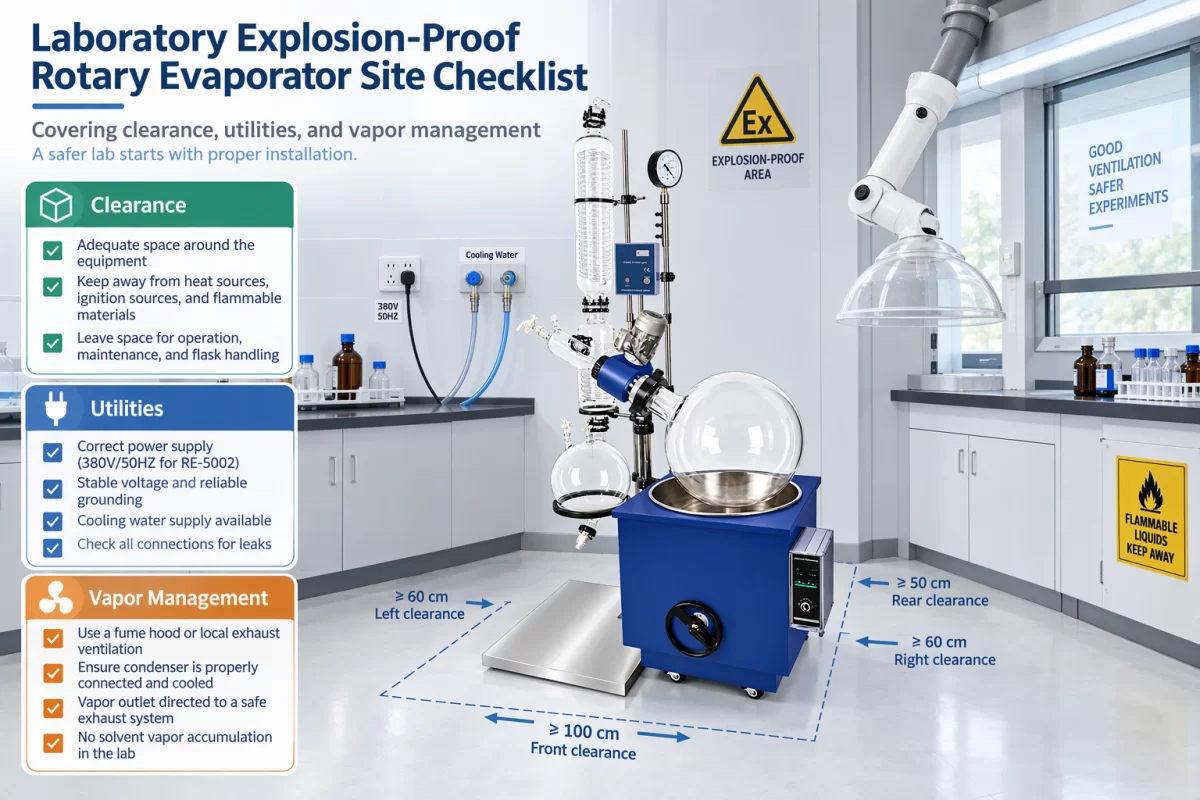
Installation planning should add room for flask handling, glassware removal, bath access, hoses and maintenance. The equipment envelope alone is not a complete workstation footprint. Rotation and lift controls also matter: operators need a suitable rotation setting for stable film formation and a controlled way to position the flask relative to the bath.
Evaluate condenser arrangement, heating control, vacuum regulation and external cooling together. A condenser needs adequate cooling under the actual vapor load; heating must remain compatible with material temperature limits; vacuum control should support stable boiling rather than simply pursue the lowest attainable pressure. These functions determine whether the proposed working load is manageable.
Initial loading and feeding are separate capacity decisions
A closed batch begins with a defined charge and runs toward a concentration endpoint. A fed campaign adds material as solvent leaves, potentially allowing the total campaign feed to exceed the initial liquid charge. That does not make continuous feeding a standard feature of every 50L system. Feed hardware, isolation valves, operating instructions and the ability to maintain stable conditions must be part of the selected configuration.
Feeding should respond to liquid inventory and vapor-handling capacity. Adding cold feed can change boiling behavior and increase heating demand. Feeding too quickly can raise the liquid level, trigger foaming or overload condensation. As nonvolatile material accumulates, the remaining flask volume and fluid behavior also change.
Keep three quantities separate: initial charge in liters, total campaign feed in liters, and recovered solvent in liters. They answer different purchasing and scheduling questions.
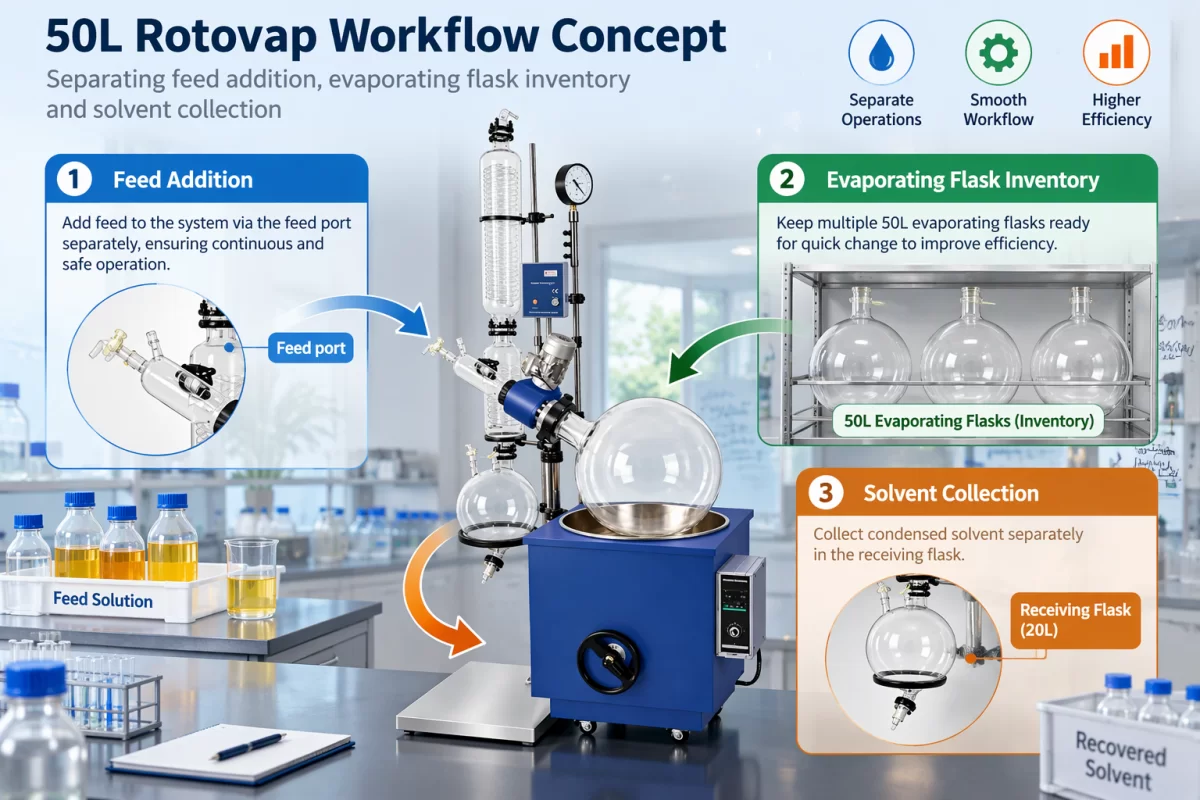
Can feeding continue while the receiving flask is emptied?
I would only plan that workflow when the supplied receiver arrangement and operating procedure support it. A 20 L receiving flask alone does not establish vacuum-isolated draining, dual-receiver switching or uninterrupted operation. Otherwise, collection handling belongs in the planned downtime.
Collection capacity and a transparent planning example
The receiving flask’s nominal 20 L volume is not an instruction to collect 20 L before intervening. The operating collection limit should account for the receiver arrangement, monitoring method and handling procedure. Plan where recovered solvent goes, how it is transferred safely and whether collection requires stopping or venting the system.
Illustrative assumptions only: suppose a process trial establishes a 20 L initial charge, requires 15 L of solvent recovery per batch, and uses a 10 L collection-handling threshold. These are hypothetical planning inputs, not recommended loading limits or R1050 performance values.
Example collection sequence = 10 L followed by 5 L
This example requires handling the first collection portion before completing the remaining recovery. It does not imply that 15 L will evaporate within any specified time. Recovery time depends on solvent properties, pressure, bath temperature, heat transfer, coolant conditions and changing vapor load.
For extract solutions, the relevant application is solvent recovery or concentration. Concentrating an existing extract does not establish direct extraction capability, selective refinement of target compounds or pharmaceutical production suitability.
Daily throughput includes more than evaporation time
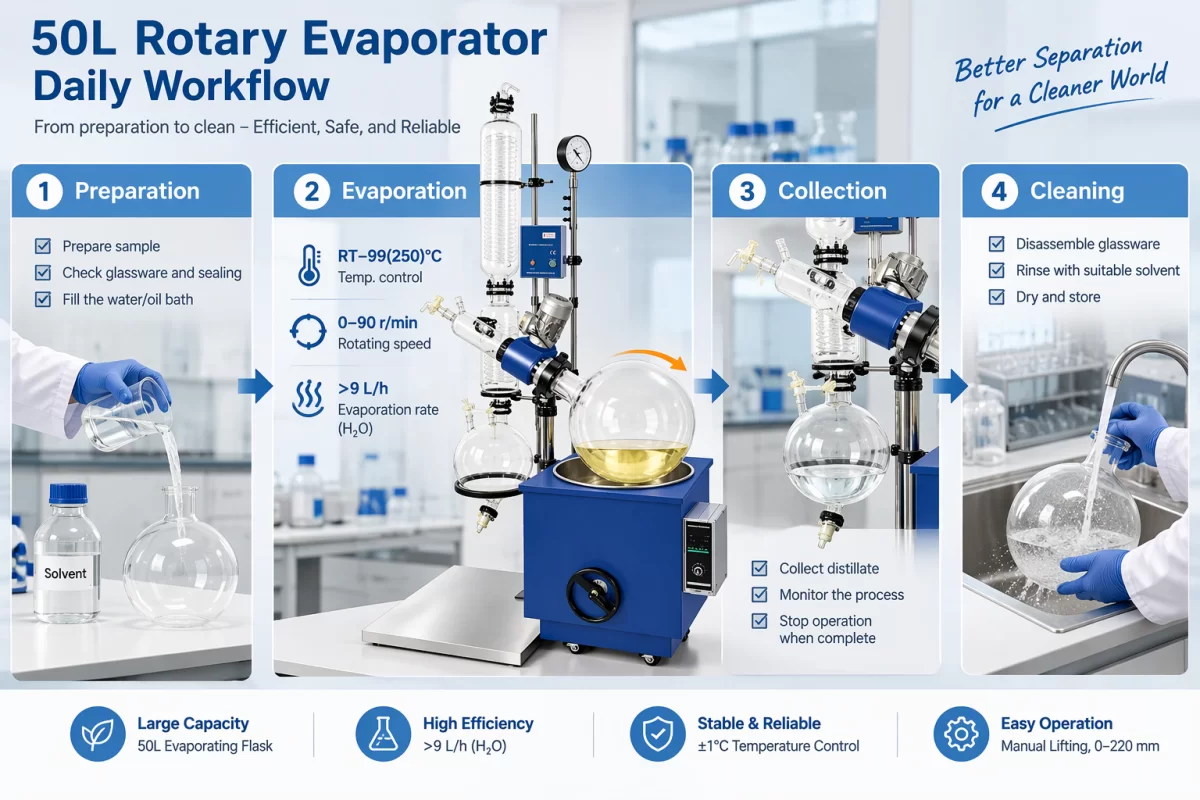
A realistic schedule includes inspection, charging, warm-up, establishing vacuum, active evaporation, collection handling, endpoint checks, unloading and cleaning. Treating only the active evaporation interval as the batch cycle can substantially overstate daily output.
- Prepare and charge: inspect glassware and seals, check connections, prepare cooling and establish the approved initial load.
- Stabilize operation: coordinate rotation, heating and pressure while observing foaming and condensation.
- Manage feed and collection: maintain appropriate liquid inventory and intervene before the defined receiver limit.
- Finish and reset: follow the shutdown procedure, transfer concentrate, handle recovered solvent and clean for the next batch.
What is a useful basis for comparing daily processing capacity?
I would compare completed batches under the same conditions, including handling and cleaning time. Flask size is useful for screening equipment, but measured cycle time and the required solvent removal per batch are more useful for scheduling.
For example, assume an eight-hour shift, one hour reserved for setup and final cleanup, and a hypothetical two-hour complete batch cycle that already includes collection handling. The schedule allows floor((8 − 1) ÷ 2) = 3 completed batches. Using the earlier hypothetical 15 L recovery target gives 45 L recovered per shift. This is scheduling arithmetic, not a guaranteed device output.
For laboratories moving from small development batches to larger campaigns, large-scale and mini rotary evaporators compared offers additional selection context. Keep the solvent, concentration endpoint and operating assumptions consistent when assessing the change in scale.
Specify the supply boundary before comparing prices
A usable quotation should identify the main unit and supporting equipment separately. Do not assume that a pump, chiller, cold trap or complete installation service is included simply because the equipment is described as a rotary evaporator system.
- Main unit: identify the model, evaporating and receiving glassware, condenser, rotation and lift arrangement, bath and supplied controls.
- Vacuum pump and regulation: specify solvent compatibility, operating pressure requirements, vapor protection and the pressure-control method.
- External chiller: select cooling capacity at the intended coolant temperature and ambient conditions, with suitable flow and connections.
- Cold trap: assess whether additional vapor capture is needed to protect the vacuum system; list it separately when required.
- Pipework and accessories: identify hoses, valves, adapters, feed components and collection-transfer hardware.
- Services: distinguish delivery, installation, commissioning, training and spare-parts support from equipment supply.
Our company’s catalog reference price is USD 1,480. This catalog-level reference is not a quotation for a configured R1050 or a complete 50L package. The actual quotation depends on the selected configuration and inquiry results. For related purchasing considerations, see 50L rotary evaporator features and price factors.
Choose a 50L rotary evaporator around the working batch
The R1050’s nominal 50 L evaporating flask and 20 L receiver provide a starting point—not a batch-loading instruction or hourly recovery guarantee. The stronger selection approach defines a practical charge, decides whether feeding is necessary, plans collection interruptions and matches heating, vacuum and cooling to the actual solvent load.
A suitable 50L rotary evaporator configuration should support the required complete-cycle workload, including concentrate handling and cleaning, rather than simply offer the largest flask.
Request a configuration and quotation assessment
Submit the material and solvent composition, initial working batch or total campaign feed, target daily processing quantity, required concentration endpoint, temperature limits, intended pressure and cooling conditions. Include feeding and receiver-handling needs, site utilities, and requirements for the pump, chiller, cold trap, pipework and services so the proposed scope and quotation can be evaluated together.