How to Order a Rotary Vane Vacuum Pump for Your Lab
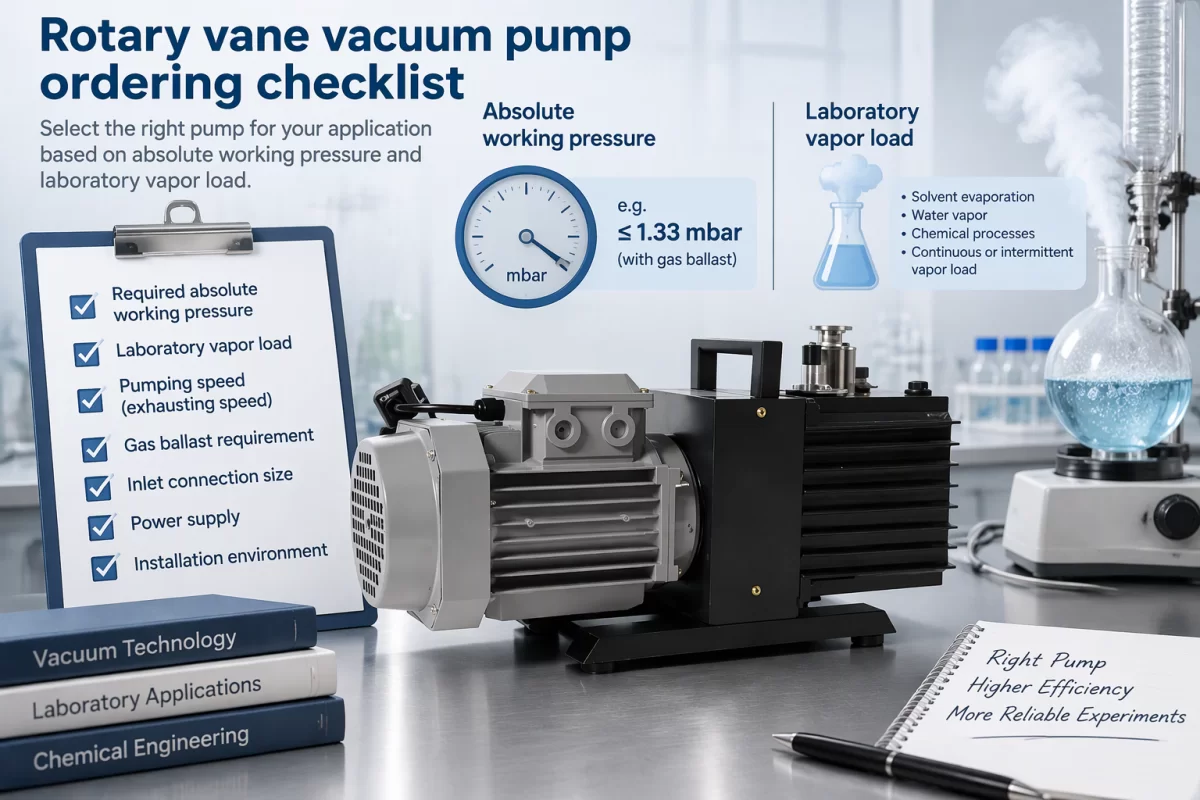
Learning how to order a rotary vane vacuum pump for lab use starts with a process specification, not simply a model number. A useful purchase request connects the required working pressure with vapor load, effective pumping speed, vacuum connections, electrical supply, and maintenance consumables.
This guide turns those requirements into a checklist that can be sent to a supplier. The objective is to obtain a pump and supporting configuration suited to the actual laboratory duty, rather than choose by flask capacity or the lowest advertised ultimate pressure.
1. Define working pressure before selecting a pump
Start by naming the application: rotary evaporation, vacuum drying, reactor evacuation, or another process. Specify the material, solvent composition, operating temperature, batch size, and target processing rate. A vessel’s volume helps describe the installation, but it does not establish how much vapor the pump must handle.
Write the pressure requirement as an absolute pressure, with units and a measurement location. For example, a requirement at the vessel is different from a reading at the pump inlet when a condenser, cold trap, valves, and tubing create flow resistance. Gauge pressure is referenced to local atmospheric pressure; absolute pressure is referenced to a perfect vacuum. A negative gauge reading must not be treated as the same numerical value in absolute pressure.
Ultimate vacuum and working pressure describe different conditions. Ultimate pressure is a limiting result under the stated test conditions, with very little incoming gas. Working pressure during solvent evaporation depends on vapor generation, leaks, condensation, gas ballast operation, and the available pumping speed at that pressure.
Does a lower ultimate pressure guarantee faster solvent evaporation?
My answer is no. I would compare the speed available at the required process pressure and the vapor remaining after condensation. A low ultimate pressure alone does not establish evaporation throughput or stable pressure under a continuous solvent load.
2. Compare pumping speed on the same basis
The 2XZ series provides several listed pumping-speed options. The table below pairs each model with its stated exhausting speed and motor power. These values are a starting point for discussing rotary vane vacuum pumps; they are not a prediction of performance at the laboratory vessel.
| Model | Listed exhausting speed (L/s) | Motor power (kW) |
|---|---|---|
| 2XZ-0.5 | 0.5 | 0.18 |
| 2XZ-1 | 1 | 0.25 |
| 2XZ-2 | 2 | 0.37 |
| 2XZ-4 | 4 | 0.55 |
| 2XZ-8 | 8 | 1.1 |
| 2XZ-15 | 15 | 1.5 |
Compare pressure-dependent pumping curves using the same gas, inlet conditions, gas ballast setting, and measurement method. Listed speed is not automatically effective speed at the vessel.
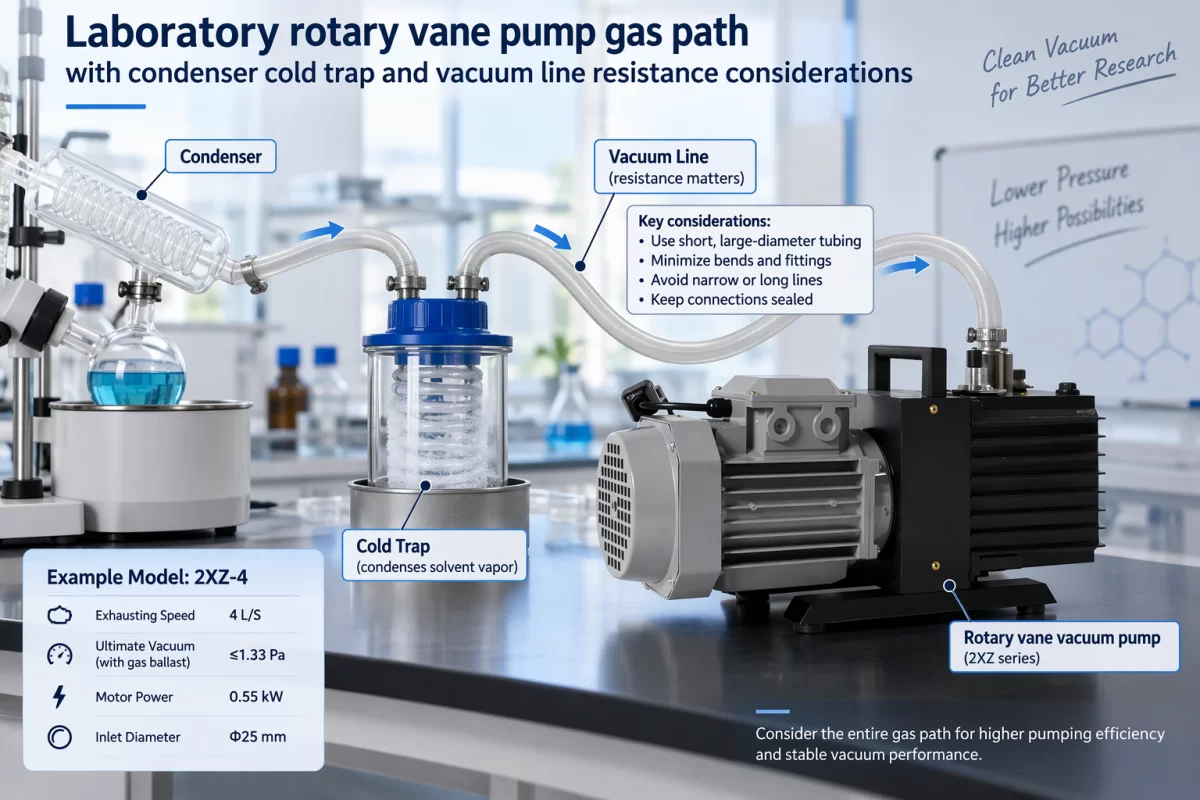
Ask for the selected model’s pumping-speed curve and the conditions used to obtain it. Pipe diameter, hose length, restrictions, and accessories can reduce effective pumping speed. A larger pump connected through a restrictive gas path may not deliver the expected improvement at the process.
A clearly defined sizing example
Assume a steady residual gas throughput of 2 Pa·m³/s reaches the evacuation system after condensation, and the target vessel pressure is 1,000 Pa absolute. For an idealized steady-state balance at the same location, using Q = p × S:
S = Q ÷ p = 2 ÷ 1,000 = 0.002 m³/s = 2 L/s
This is an illustrative effective-speed requirement, not a guarantee for any 2XZ model. It excludes transient loads and any leakage not already included in the assumed throughput. The selected pump must be evaluated at the target pressure, with the installed gas-path resistance included.
Do not compare a water-circulating pump’s vacuum-degree figure directly with an oil-sealed rotary vane pump’s absolute ultimate pressure. Establish the pressure reference, operating medium, temperature, and test conditions first. Different pump types cannot be ranked reliably from unlike headline figures.
3. Specify solvent handling, condensation, and pump protection
List every vapor or gas that may enter the pump, including water, organic solvents, corrosive components, and possible entrained droplets or particles. Describe concentrations and temperatures where known. Compatibility must be assessed for the pump oil, seals, wetted materials, and exhaust arrangement—not inferred from the general name “vacuum pump.”
For evaporation duties, document condenser coolant temperature and capacity, expected solvent recovery, and the remaining vapor load. Include a cold trap where appropriate to the material and process. Its operating temperature, collection capacity, and flow resistance all matter. Neither a condenser nor a cold trap should be assumed to remove every vapor under every operating condition.
Review the advantages and limitations of rotary vane pumps when deciding whether an oil-sealed design suits the duty. Gas ballast can help manage condensable vapors in suitable applications, but its operation affects achievable pressure and must be included in the proposed operating conditions.
Can a larger rotary vane pump replace a condenser or cold trap?
I would not treat extra pumping speed as a substitute for vapor management. Removing vapor upstream can reduce the load entering the pump and help protect the oil. The appropriate arrangement depends on solvent properties, throughput, cooling conditions, and acceptable pressure loss.
Identify flammable or hazardous materials explicitly. An ordinary rotary vane pump must not be described or selected as explosion-proof without applicable equipment documentation. Electrical area classification, exhaust handling, ventilation, and any required protective measures need a separate safety assessment.
4. Put connections, voltage, and controls in writing
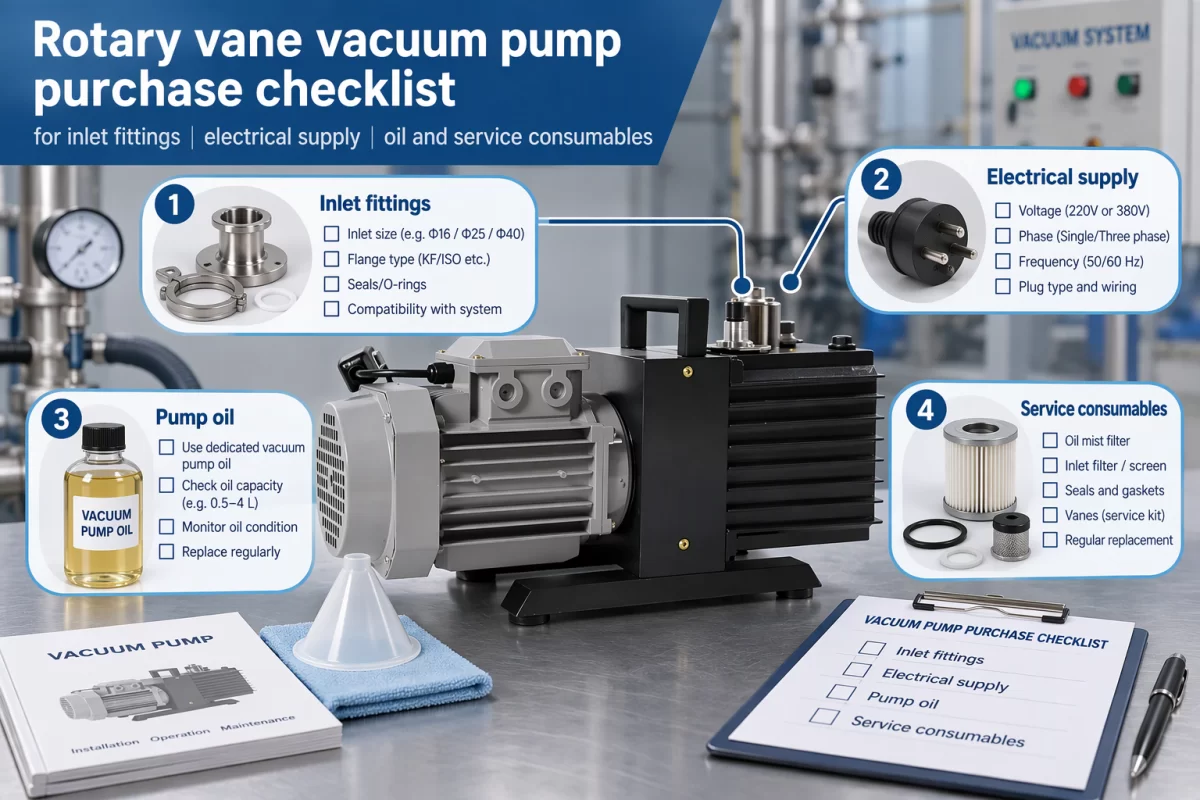
Specify the existing vessel outlet and the required pump inlet connection separately. Include connection type, mating dimensions, hose internal diameter, hose length, adapter requirements, and seal material. A diameter alone does not define a complete connection standard. Request vacuum-rated tubing and a clear list of supplied fittings.
For the electrical supply, state available voltage, frequency, phase, plug or terminal requirements, and local installation constraints. The quotation should identify the selected motor configuration rather than assume that every model uses the same supply.
Define how pressure will be controlled and measured. Requirements may include a compatible vacuum gauge, pressure controller, isolation valve, controlled venting, and shutdown protection. Distinguish pump start/stop control from active process-pressure regulation, and identify which accessories are included in the proposed package.
Is matching the inlet diameter enough to complete an order?
My recommendation is to specify the entire connection path. Matching diameter does not establish fitting compatibility, seal suitability, hose conductance, or the presence of isolation and venting components. Those details should appear in the configuration list.
5. Include maintenance consumables and service requirements
An oil-sealed pump order should include the approved oil specification, the selected model’s fill requirement, and a suitable initial spare-oil quantity. Ask for operating and maintenance instructions covering oil inspection, oil changes, gas ballast use, and handling of oil contaminated by the actual process materials.
Request a model-specific service-parts list. Depending on the configuration, relevant items may include seals, gaskets, inlet protection components, and exhaust filtration consumables. State expected operating hours, whether use is intermittent or continuous, and any restrictions on maintenance downtime. Service intervals should follow the manufacturer’s instructions and actual contamination conditions, not a universal schedule.
6. Send a supplier-ready rotary vane pump requirement list
Use the following format to make quotations easier to evaluate on equal terms. Replace each descriptive field with the laboratory’s actual requirements and request a written configuration breakdown.
Subject: Laboratory rotary vane vacuum pump quotation request
- Application and materials: Process, solvents, composition, corrosive or hazardous constituents, and possible liquid or particle carryover.
- Production duty: Working batch size, target processing rate, operating temperature, daily run time, and expected peak vapor load.
- Pressure: Target absolute working pressure, permitted variation, measurement location, and required evacuation time.
- Pumping performance: Required effective speed or estimated gas throughput; provide the proposed model’s pressure-dependent curve and test conditions.
- Vapor protection: Condenser conditions, cold-trap requirements, gas ballast operating needs, and exhaust treatment.
- Connections: Vessel outlet, pump inlet fitting, hose dimensions and length, adapters, valves, and seal compatibility.
- Electrical supply: Available voltage, frequency, phase, connection method, and installation environment.
- Controls: Gauge, pressure regulation, isolation, venting, and required shutdown behavior.
- Maintenance: Approved oil, fill quantity, spare consumables, service instructions, and model-specific replacement parts.
- Commercial scope: Itemized pump and accessory pricing, delivery schedule, warranty terms, and shipping requirements.
Compare quotations for the same material duty, working pressure, gas ballast condition, connections, and accessory scope. Request a configuration-based quotation; a bare-pump price and a protected, controlled vacuum package are not equivalent purchase options.
Order for the working duty, not just the model label
The practical answer to how to order a rotary vane vacuum pump for lab use is to connect five requirements: absolute working pressure, effective pumping speed, complete inlet connections, compatible electrical supply, and maintenance consumables. Solvent handling, cooling, gas-path resistance, and controls determine whether the proposed configuration can meet that duty.
Submit the materials, target throughput or working batch size, operating conditions, and required accessories to ZZKEDA for evaluation of a suitable pump configuration and quotation. A detailed requirement list provides a stronger basis for selection than flask volume or ultimate vacuum alone.