Equipment selection guide
Nutsche Equipment Terminology: Filters, Filter Reactors and Filter Dryers
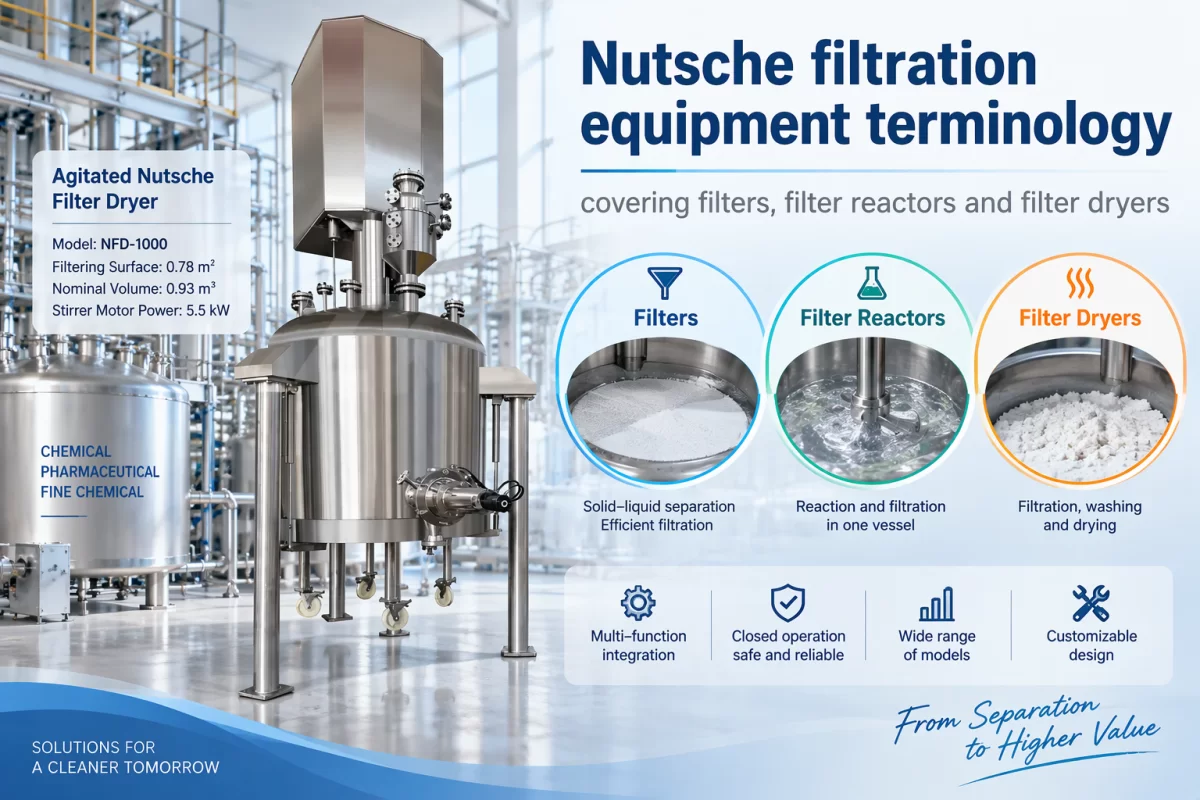
Understanding Nutsche filtration equipment terminology helps buyers specify the right process—not just choose a familiar equipment name. A nutsche filter, a nutsche filter reactor and an Agitated Nutsche Filter Dryer share a filtration concept, but they do not automatically perform the same tasks.
The useful distinction is whether the equipment must separate a slurry, carry out a defined reaction, or remove residual liquid through a specified drying stage. Filtration area, filter medium, cake behavior, agitation, heating, sealing and product recovery determine which structure fits that duty.
What does “nutsche” actually describe?
In this equipment family, “nutsche” refers to a batch filtration arrangement in which a slurry contacts a supported filter medium. Liquid passes through the medium while retained solids form a cake. The term identifies the separation arrangement; by itself, it does not specify an agitator, a reaction capability, a drying system or a particular pressure rating.
A basic nutsche filter centers on solid–liquid separation. Depending on its construction, it may also support cake washing and further liquid removal. An agitated version adds a mechanism for working the slurry or cake. However, agitation alone does not turn a filter into a reactor or prove that it can dry a product to a required moisture endpoint.
Does every agitated nutsche filter also function as a filter dryer?
My answer is no. I distinguish mechanical agitation from drying capability. A filter dryer needs an appropriate heat-transfer arrangement and a defined route for removing vapor, together with suitable operating limits and controls. A stirring motor or a heated jacket, considered alone, is not evidence of a complete drying process.
Filters, filter reactors and filter dryers: different tasks
Nutsche filter: separation and cake handling
Select a nutsche filter when the central requirement is recovering solids from a slurry. The filter medium must suit particle retention, liquid chemistry and the tendency of the solids to blind the medium. Cake compressibility and permeability matter because a larger nominal vessel does not necessarily resolve slow filtration.
Washing may be possible through liquid distribution over a cake or through reslurrying where the equipment supports it. These methods have different mixing and filtrate-handling requirements. The purchase specification should state the intended washing method rather than treating “washing” as an identical operation across all filters.
Nutsche filter reactor: a reaction duty plus filtration
A filter reactor combines filtration with a separately specified reaction duty. Selection therefore extends beyond the filter plate: mixing, reaction temperature, heat removal, reagent addition, wetted materials and operating pressure must fit the chemistry. Reaction suitability cannot be inferred from the word “reactor” without evaluating the actual configuration.
For projects requiring a reaction stage before solids recovery, the nutsche filter reactors category is relevant to the equipment discussion. The required chemistry and conditions should still define the scope; it should not be treated as interchangeable with a dedicated filter dryer.
Agitated Nutsche Filter Dryer: filtration followed by a drying duty
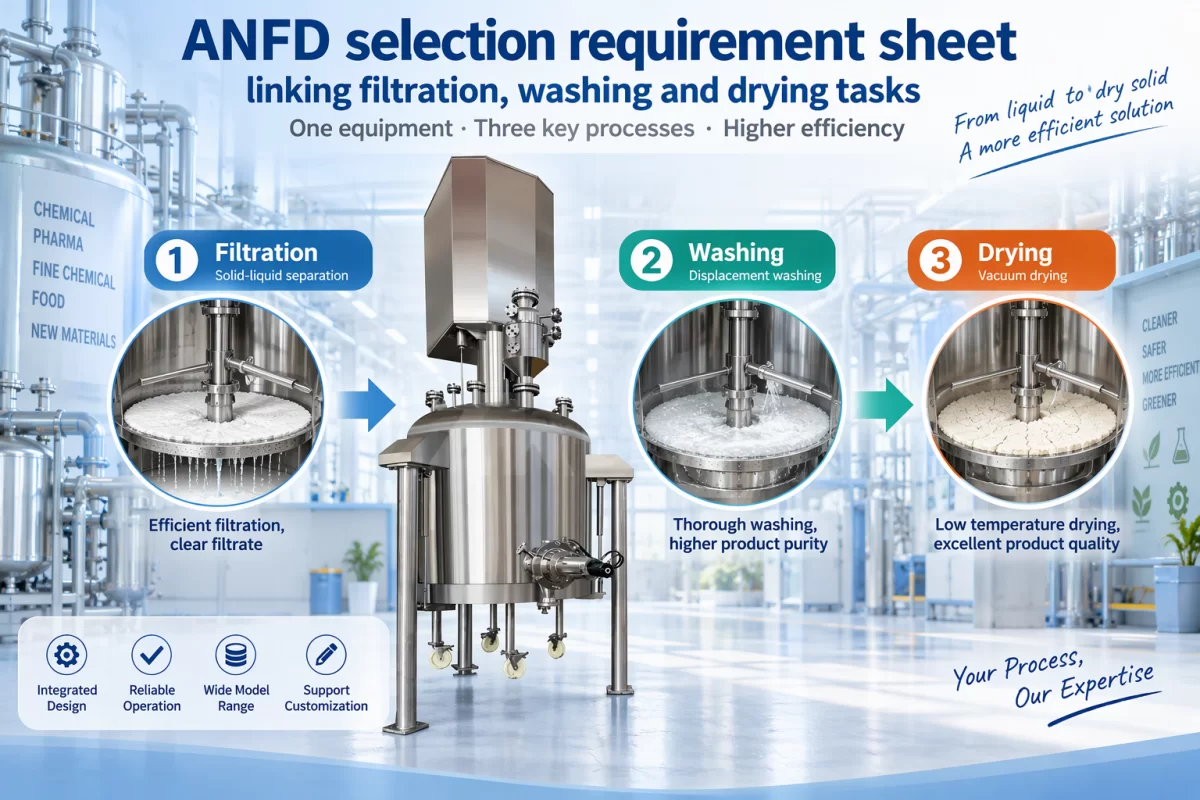
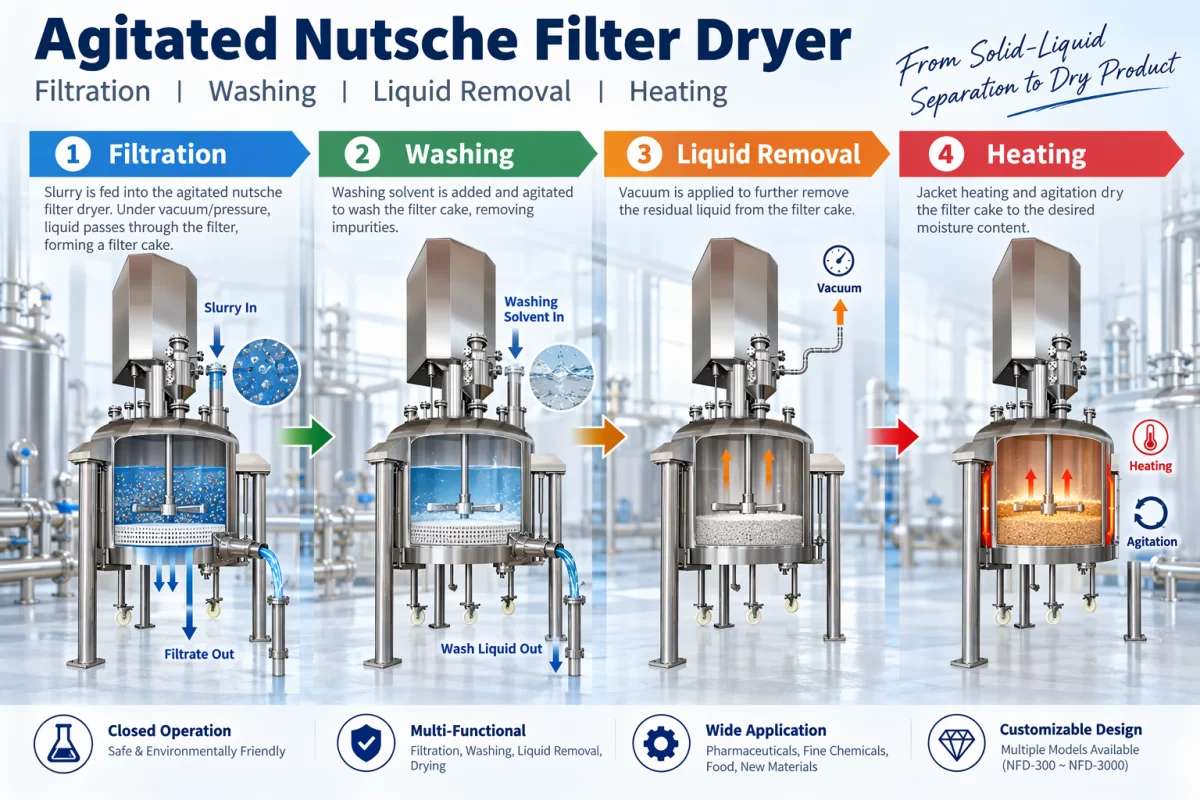
An ANFD is intended to combine filtration, washing and drying within an integrated equipment arrangement. Its agitation system may serve different purposes at different stages, including slurry mixing and cake working. The drying duty additionally depends on heat delivery, vapor removal, material behavior and the specified residual-liquid target.
When integrated solids processing is the objective, compare agitated nutsche filter dryers by the required sequence and configuration. A useful process overview is filtration, washing and drying in an ANFD. Neither the category name nor a model number establishes drying time, solvent compatibility or final moisture performance.
| Equipment category | Primary task | Key selection evidence |
|---|---|---|
| Nutsche filter | Slurry separation and cake recovery | Filter area, medium, cake behavior, driving pressure and washing arrangement |
| Nutsche filter reactor | Defined reaction duty with filtration | Reaction conditions, mixing, heat transfer, materials and filtration arrangement |
| Agitated Nutsche Filter Dryer | Integrated filtration, washing and drying | Cake handling, heating, vapor removal, sealing, drying endpoint and discharge |
Filtration area, vessel volume and batch size are not synonyms
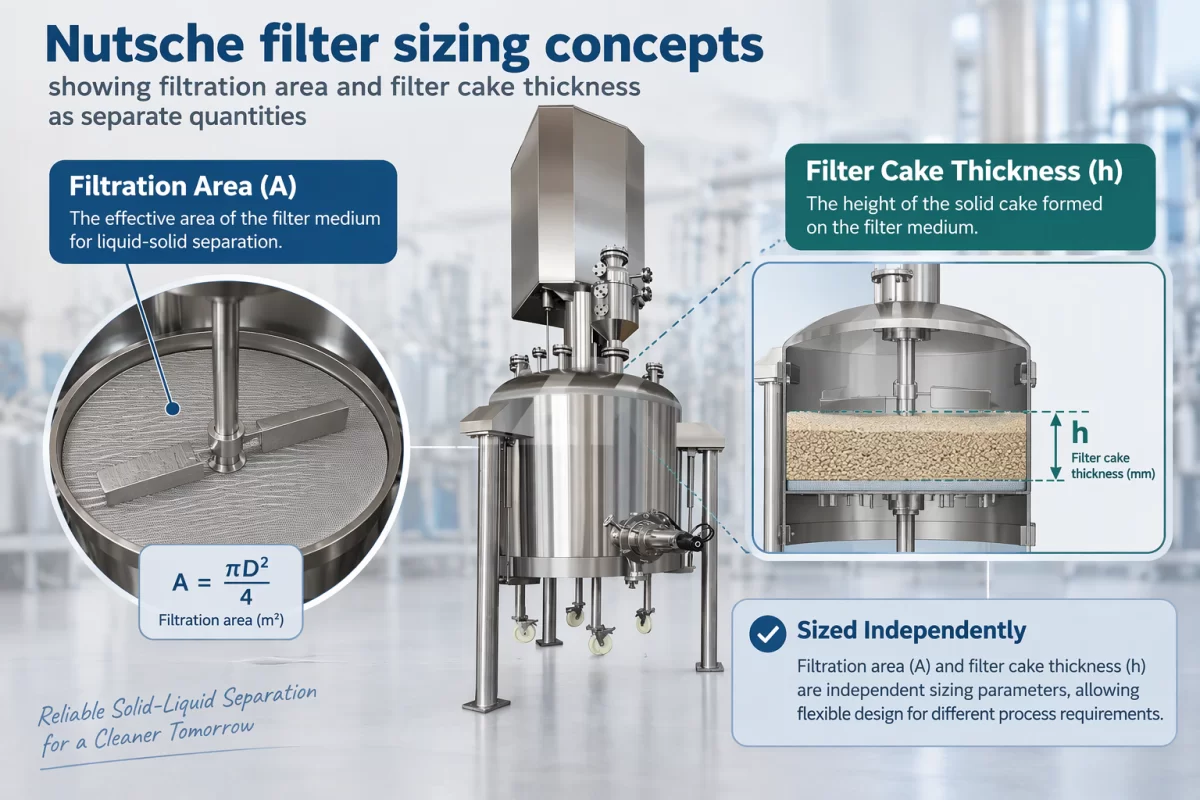
Filtration area is the active surface available for liquid passage, expressed in square meters. Vessel volume describes an internal volume, normally expressed in liters or cubic meters. Working batch size describes the actual charge under defined process conditions. These quantities answer different questions and should appear separately in an inquiry.
For solids recovery, cake loading is particularly important. A slurry with a low solids concentration can occupy substantial vessel volume while producing a relatively small cake. A concentrated slurry may create a thicker cake from a smaller liquid charge. Particle properties and cake resistance then influence filtration and washing behavior.
Can nominal volume be used directly as the working batch capacity?
I would not use it that way. Working capacity also depends on the slurry charge, required headspace, mixing conditions and the cake loading limit. My recommendation is to specify both the liquid charge and expected solids quantity, then assess them against filtration area and the intended operating sequence.
Selected model data for an initial comparison
The following values provide a configuration-specific starting point. They compare filtration surface, listed cake height, paddle lift and motor power without treating any of these values as a guaranteed production rate.
| Model | Filtering surface (m²) | Listed cake height (mm) | Paddle lifting height (mm) | Stirrer motor power (kW) |
|---|---|---|---|---|
| NFD-500 | 0.19 | 140 | 160 | 2.2 |
| NFD-1000 | 0.78 | 220 | 250 | 5.5 |
| NFD-1600 | 2 | 300 | 350 | 15 |
Geometry example—not a capacity guarantee: assume a uniform cake covers the NFD-500’s listed 0.19 m² filtration surface to an assumed thickness of 0.10 m. The geometric cake volume is 0.19 m² × 0.10 m = 0.019 m³, or 19 L. This is cake volume, not slurry charge, dry product mass or hourly throughput. The example assumes complete surface coverage and excludes local variations in cake thickness.
Even at equal area and cake thickness, two materials can filter differently. A meaningful comparison should hold slurry concentration, temperature, filter medium, pressure difference and endpoint criteria constant, rather than comparing unrelated cycle times.
Read agitation, heating and sealing as configuration details
A separately specified small-unit configuration has a nominal volume of 30 L, a full volume of 35 L and a filtration area of 0.03 m². Its listed stirring speed is 0–25 rpm, stirring power is 0.55 kW and agitator stroke is 100 mm. These details describe that configuration; they should not be transferred to another model in the range.
For this same configuration, the main pressure-component materials are 316L on the tank side and 304 on the jacket side. The jacket media are hot water or thermal oil. The listed maximum working pressure is 0.2 MPa for both tank and jacket, and the working temperature is 85 °C for both. Its shaft seal is a packing seal.
These details help frame an engineering discussion, but they do not establish a drying rate, vacuum rating, sterile capability or certification. Jacket heating must be assessed alongside the material’s thermal sensitivity, the necessary evaporation conditions and the vapor-handling arrangement. A packing seal must likewise be evaluated against the required operating conditions and containment objective.
Does liquid removal after filtration mean the product is already dried?
I separate these endpoints. Further liquid removal reduces liquid retained in the cake through a suitable filtration driving force. Drying removes residual volatile liquid through evaporation. A cake can be mechanically deliquored and still require a substantial drying stage, so the inquiry should state the required final moisture or solvent content.
Discharge and cleaning belong in the selection decision
Discharge should be evaluated for the actual cake: free-flowing powder, sticky solids and cohesive cake present different handling problems. Specify the intended recovery method, acceptable retained product and exposure constraints. Do not assume automatic discharge merely because the equipment has an agitator.
Cleaning requirements should cover access to the filter medium, filter-plate underside, agitator, seal region and discharge connection. For multiproduct service, define how residues will be removed and how cleanliness will be assessed. Material grade alone does not establish cleanability, and an enclosed vessel does not automatically establish aseptic operation.
From terminology to a purchase specification
Choose the nutsche equipment by its required duty
The practical lesson in Nutsche filtration equipment terminology is straightforward: specify a filter for separation, a filter reactor for a defined reaction-plus-filtration task, and a filter dryer when integrated drying is required. Then assess filtration area, medium, cake loading, agitation, washing, liquid removal, heating, sealing, discharge and cleaning as separate selection criteria.
To evaluate an Agitated Nutsche Filter Dryer solution and obtain a configuration-based quotation, submit the material and solvent details, particle and slurry characteristics, target processing quantity or working batch, expected solids loading, operating temperature and pressure requirements, washing sequence and drying endpoint. Include utility availability, containment, discharge and cleaning needs so the proposed equipment can be matched to the complete process.