Spray Dryer · Procurement & Process Planning
Industrial Spray Dryer Suppliers for Food and Chemical Production
Choosing an industrial spray dryer supplier for food and chemical production starts with three separate checks: whether the contact materials suit the formulation, whether the equipment can be cleaned appropriately, and whether representative trials support the proposed process. A capacity label alone cannot answer these questions.
Define the production duty before selecting a Spray Dryer
Food and chemical feeds may both enter a drying tower as liquids, but their purchasing requirements can differ substantially. Record the raw material composition, solids content by mass, viscosity at the intended feed temperature, suspended particles, solvent content and sensitivity to heat. Define the target powder through measurable acceptance criteria, such as moisture, particle size distribution and any application-specific functional tests.
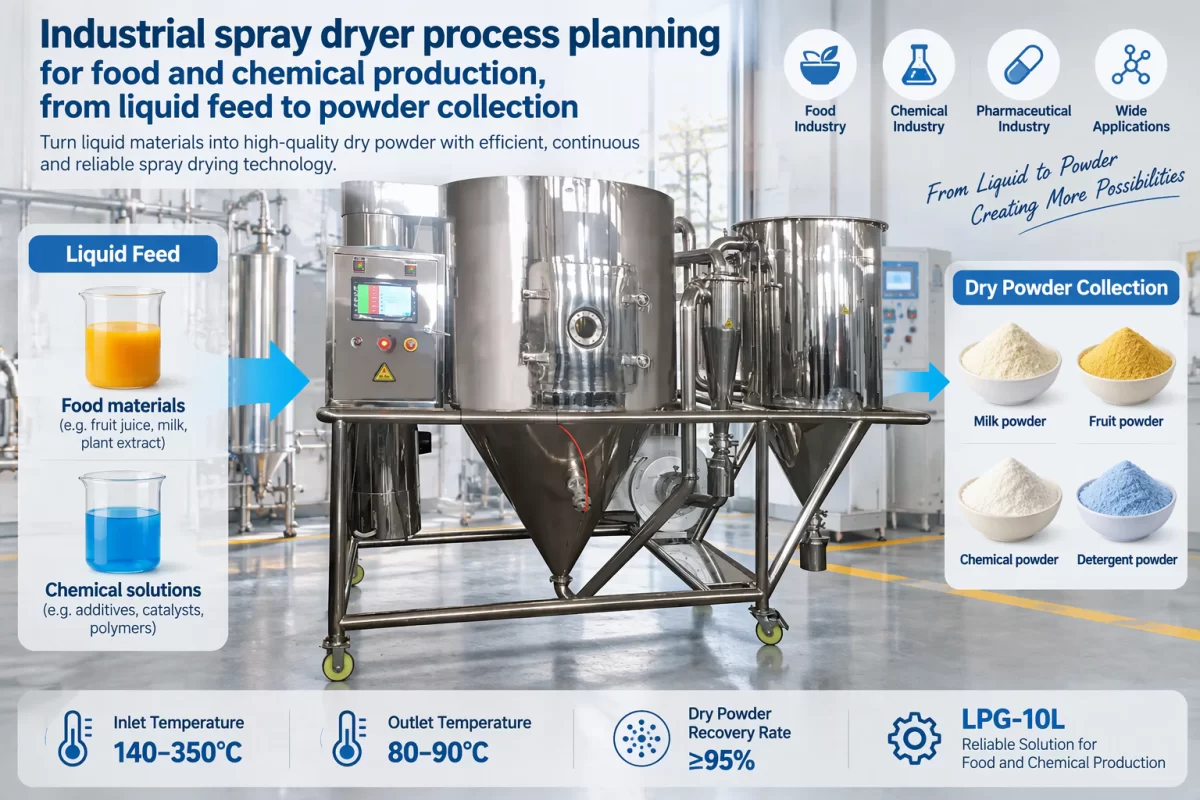
For a centrifugal configuration, evaluate the feed delivery arrangement, rotary atomizer, heated air supply and tower as a connected process. The supplied LPG-5 and LPG-10 specifications offer a starting point for comparing smaller centrifugal candidates; they do not establish the capacity of a larger industrial production line. Explore centrifugal spray drying equipment with a clearly stated process duty rather than treating every spray dryer as interchangeable.
Does water evaporation capacity equal liquid feed capacity?
My answer is no. Water evaporation is the mass of water removed per hour; feed capacity is the total incoming liquid mass or volume per hour; powder output includes solids and retained moisture. I compare these quantities separately because feed concentration changes the relationship between them.
A mass-balance example with explicit assumptions
Assume an aqueous feed of 20 kg/h containing 25% solids by mass. Assume no solids loss and a final powder containing 5% moisture on a wet basis. At steady state, the incoming solids are 5 kg/h and the incoming water is 15 kg/h.
Theoretical powder output = 5 ÷ (1 − 0.05) = 5.26 kg/h
Retained powder water = 5.26 × 0.05 = 0.26 kg/h
Required water evaporation = 15 − 0.26 = 14.74 kg/h
This calculation describes a hypothetical process requirement, not an equipment guarantee. It also shows why neither a 5 kg/h nor a 10 kg/h maximum evaporation rating should be interpreted as sufficient for this example. Feed volume in L/h additionally requires the feed density; it cannot be inferred from the mass balance alone.
Compare the LPG centrifugal candidates on the same basis
The following model-specific figures distinguish maximum water removal from liquid throughput and powder output. Electric heater power is a component rating, not measured energy consumption per kilogram of powder or the total connected load of a complete installation.
| Specification | Unit | LPG-5 | LPG-10 |
|---|---|---|---|
| Maximum moisture evaporation | kg/h | 5 | 10 |
| Centrifugal atomizer rotating speed | rpm | 25,000 | 25,000 |
| Spray disc diameter | mm | 50 | 50 |
| Heat source | Type | Electricity | Electricity |
| Electric heating power | kW | 9 | 20 |
Matching atomizer speed and disc diameter do not establish identical droplet size or powder performance. Viscosity, solids loading, feed distribution and operating conditions still matter. Compare proposals using the same formulation, feed temperature, moisture target and available utilities.
The SD-2L is a separate laboratory trial option, not a substitute source of industrial machine specifications. Its results can help screen formulations, but production equipment must be evaluated with its own atomization, airflow, tower and collection arrangement. For broader purchasing context, review industrial spray drying systems while keeping each proposed configuration tied to its own documented scope.
Food production: check contact materials and cleaning access
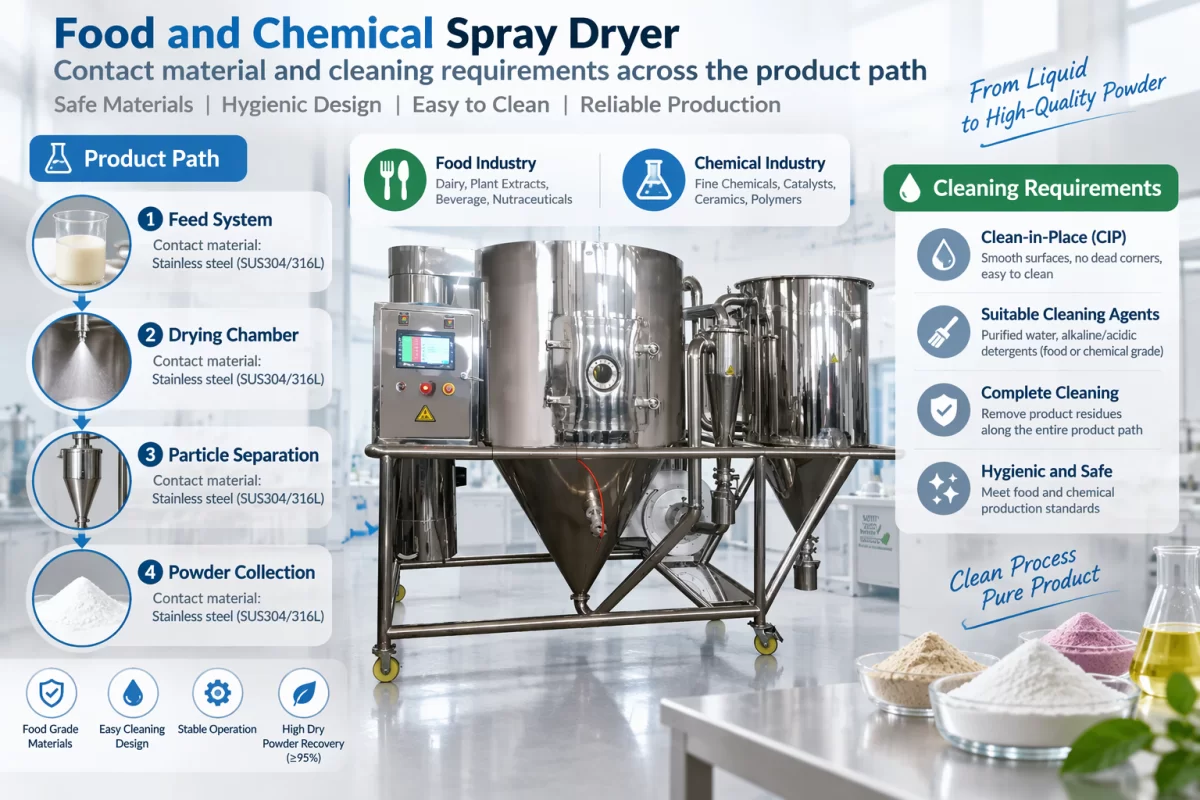
For food ingredients, specify the complete product-contact path: feed vessel, pump, pipework, atomizer, tower surfaces, powder separator, discharge valve and receiving container. Identify the required metal grade, surface finish, gasket and seal materials for each location. A general stainless-steel description is not enough to establish compatibility with the ingredient or cleaning chemicals.
Cleaning assessment should include access to the atomizer and tower, drainage, powder accumulation points, inspection openings and the treatment of seals and flexible connections. Define whether the process requires manual dismantling, cleaning in place, or a combination. Food suitability must be established for the quoted construction and cleaning arrangement rather than assumed from the product name.
- Composition: Record proteins, fats, sugars, salts and any carriers or processing aids used in the actual recipe.
- Changeovers: Establish allergen separation, cleaning verification and acceptable downtime between products.
- Trials: Test the intended formulation, including its normal concentration and handling history, rather than relying only on a water run.
Can one cleaning specification cover food and chemical feeds?
I would not assume so. Food projects may prioritize allergen removal and hygienic access, while chemical projects may require removal of reactive, corrosive or toxic residues. I recommend defining separate residue limits, cleaning agents and verification methods before considering shared equipment.
Chemical production: separate compatibility from safety
Chemical feed evaluation begins with the solvent system, pH, corrosive species, abrasive solids and behavior during concentration and drying. Material compatibility must cover both the feed and the cleaning solution at their intended temperatures. Include the atomizer's wetted parts and downstream powder-contact surfaces in this assessment.
Flammable solvents and combustible powders require a project-specific hazard assessment. An electrically heated centrifugal dryer should not be presumed suitable for solvent service. Likewise, a listing that mentions an explosion-proof motor does not establish that the entire drying system is suitable for a hazardous process.
Where the assessment requires inert gas operation, solvent condensation, containment or protective devices, define these as distinct engineering requirements. Their suitability, interfaces and inclusion in the quotation must be established for that project. A cooling-water circulating pump supports a cooling duty; it does not replace a condenser, exhaust-treatment package or solvent recovery system. A spray drying line is also not interchangeable with a freeze dryer or a drying oven.
For temperature-sensitive materials, compare the acceptable thermal exposure with the proposed operating method and trial results. Do not select solely by inlet temperature: outlet conditions, feed behavior and the time-temperature history also influence the evaluation.
Distinguish a standalone dryer from a complete system
A useful quotation identifies what each unit does, where it sits in the process and who supplies and integrates it. The items below are procurement requirements to define, not a claim that every listed unit is included with either LPG model.
| Unit and process position | Purpose and interfaces | Supply responsibility to assign |
|---|---|---|
| Feed preparation and delivery — upstream | Hold, condition and meter the feed; define piping, pump capacity, pressure and cleaning connections. | Specify whether vessels, pumps and filtration are supplied by the dryer vendor or the purchaser. |
| Centrifugal atomizer — tower inlet | Distribute liquid into droplets; define feed connection, drive services and maintenance access. | Identify the atomizer, drive package and controls included in the dryer scope. |
| Heating and air supply — before the tower | Provide conditioned drying air; define filtration, heater, fan, ducting and electrical interfaces. | Allocate equipment supply, utility connection and duct installation. |
| Drying tower — evaporation stage | Provide the drying space; define construction, access, supports and cleaning interfaces. | Assign tower supply, site erection and structural support responsibilities. |
| Powder collection — downstream | Separate and discharge powder; define separator arrangement and receiving or conveying connections. | State whether collectors, discharge devices and downstream handling are included. |
| Exhaust treatment — final gas path | Address dust or other emissions; define gas flow, pressure drop, discharge point and treatment needs. | Assign exhaust equipment, stack, permitting and site connections. |
| Controls — across the system | Coordinate feeding, atomization and airflow; define sensors, alarms, interlocks and data recording. | Identify panel supply, instrument scope, integration and commissioning duties. |
Use this scope map during spray dryer manufacturer selection. It helps distinguish the cost of a machine from the cost of an installed process with feed handling, exhaust treatment and controls.
Use representative trials to support the purchasing decision
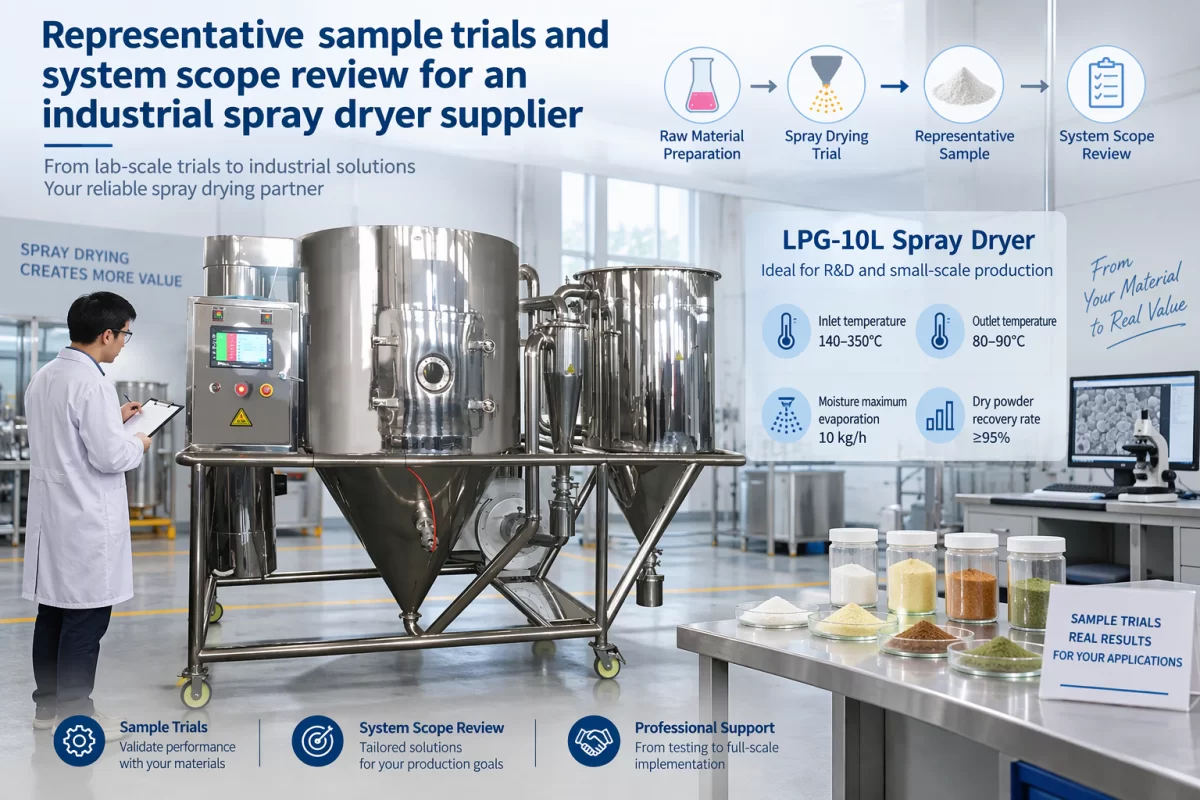
A trial plan should state the material identity, batch preparation, solids fraction, viscosity measurement conditions and available sample quantity. Agree on the operating variables to record and the powder tests needed for acceptance. Keep food and chemical acceptance criteria separate even when the same centrifugal drying principle is being evaluated.
What makes a spray drying trial relevant to production?
I look for a representative feed, recorded operating conditions and agreed acceptance tests. I also check whether the trial's atomization and collection arrangements are relevant to the proposed production system. A successful small-sample run is useful evidence, but it is not an automatic guarantee of production throughput or powder quality.
Reference pricing without confusing equipment categories
Our company's catalog reference price range is US$2,800–3,250. This is a catalog-level reference across the listed equipment, not a quoted price for LPG-5, LPG-10 or a complete industrial food or chemical production system. The actual quotation depends on the selected configuration and the inquiry outcome.
For a meaningful comparison, ask proposals to identify the dryer, auxiliary units, contact materials, controls, installation responsibilities and trial or commissioning services separately. Compare total project scope under the same process assumptions rather than comparing unrelated laboratory and production equipment prices.
Choose an industrial spray dryer supplier around the material and system duty
The strongest purchasing decision combines three findings: compatible contact materials, a workable cleaning method and representative trial evidence. Food projects need a defined hygienic and changeover strategy; chemical projects need compatibility and hazard requirements addressed independently. In both cases, keep feed processing rate, water evaporation and powder output separate, and match the proposed equipment to the complete process scope.
Request a configuration assessment and quotation: Submit the material composition, solvent information, solids content, viscosity, target processing rate or working batch size, desired powder properties, operating conditions and available utilities. Include contact-material, cleaning, powder collection, exhaust-treatment and control requirements so the proposed Spray Dryer solution can be evaluated against the actual application.