Vacuum Oven Drying of Pharmaceutical Laboratory Samples: Process Limits
Selecting a vacuum drying oven for laboratory pharmaceutical sample dehydration starts with a process question: is the task to remove water, remove organic solvents, or reduce both to separately defined limits? Chamber size alone cannot answer that question. Sample temperature, exposed loading area, working pressure, and analytical endpoints determine whether a drying trial is useful.
Dehydration and organic solvent removal are different tasks
Water removal may be required before weighing, stability testing, formulation screening, or another laboratory operation. Organic solvent removal introduces additional questions about vapor flammability, pump compatibility, exhaust handling, and solvent-specific residual limits. A method that reduces moisture does not automatically establish acceptable residual solvent content.
Reduced pressure can promote evaporation, but the rate still depends on heat transfer and the movement of liquid or vapor through the sample. Bound water, a dense powder bed, or a crust-forming paste can behave differently from a shallow aqueous residue. The discussion of vacuum drying principles provides useful background; the actual method must remain specific to the material and analytical objective.
Does a stable final weight prove that both water and organic solvents have been removed?
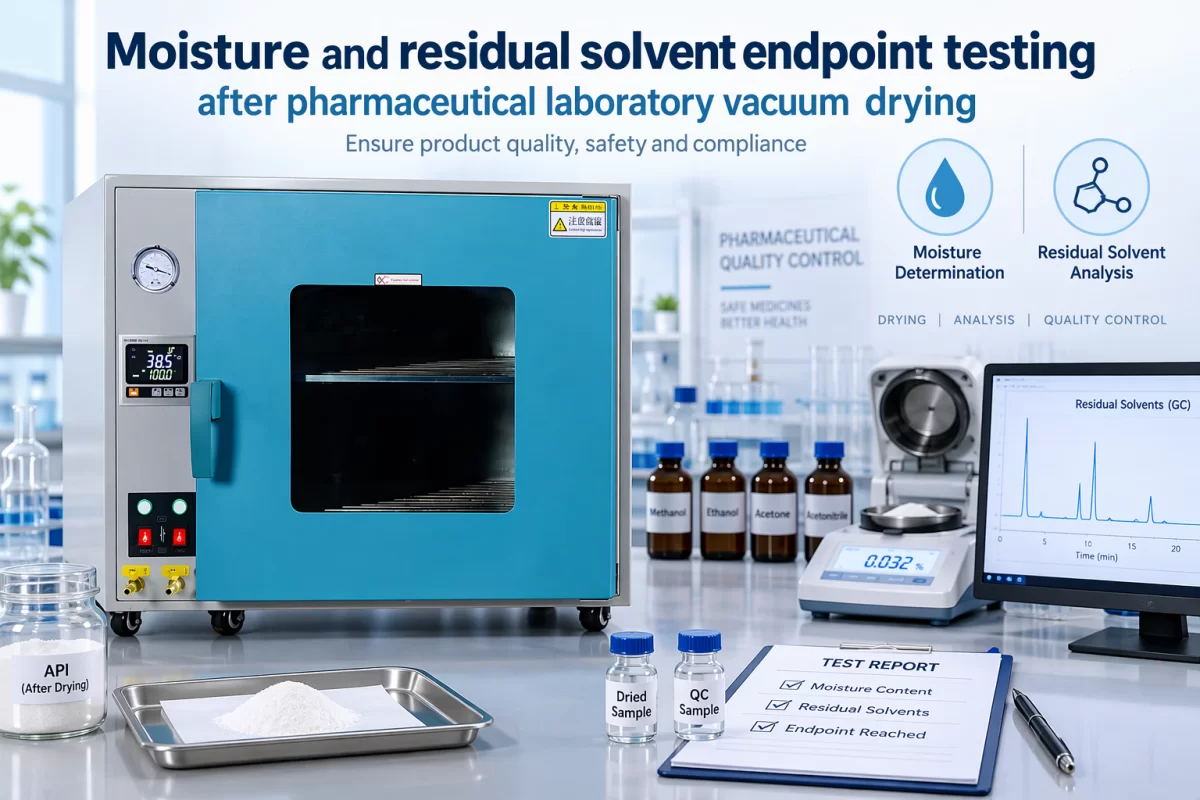
My recommendation is to treat stable weight as a screening observation, not a universal endpoint. Mass loss may include water, solvents, or degradation products. A suitable water-specific method, such as Karl Fischer analysis, and an appropriate residual-solvent method, such as gas chromatography, address different questions. Each method needs suitability assessment for the sample matrix.
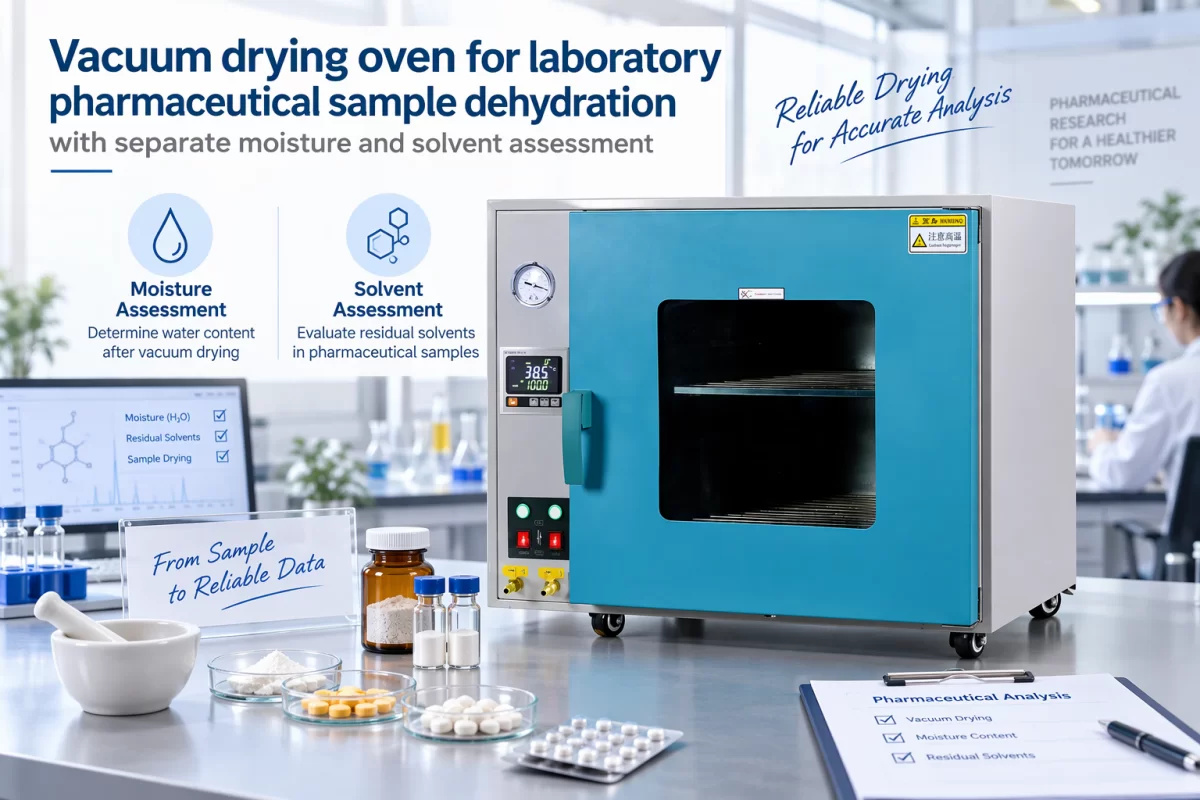
The application scope here is pharmaceutical research, experimental work, and small-batch tasks that have undergone an appropriate assessment. An oven specification does not establish commercial drug-production validation, sterile processing capability, or pharmaceutical compliance status.
DZF selection: chamber volume is not usable sample capacity
The DZF-6090 is a relevant starting point when comparing laboratory vacuum drying ovens for multiple containers or shallow sample beds. Its listed chamber capacity, internal dimensions, shelf count, and input power are shown alongside two smaller models. These figures describe equipment geometry and electrical input, not guaranteed drying throughput.
| Model | Chamber capacity (L) | Internal W × D × H (mm) | Shelves (pcs) | Input power (W) |
|---|---|---|---|---|
| DZF-6020 | 25 | 300 × 300 × 270 | 1 | 700 |
| DZF-6050 | 55 | 400 × 400 × 345 | 2 | 1,400 |
| DZF-6090 | 90 | 450 × 450 × 450 | 2 | 2,000 |
All three models list a 304 stainless steel liner. That identifies the chamber lining, not every product-contact surface. A sample held in a dish primarily contacts that dish; shelf surfaces, seals, tubing, and any components exposed to condensate require separate compatibility consideration. Chamber material alone does not demonstrate cleanability for a particular pharmaceutical residue.
Usable tray area must account for tray dimensions, clearances, container footprints, and vapor access. Shelf count does not establish shelf load rating. A larger chamber can accommodate more containers while still requiring a low loading depth for a difficult material.
Loading calculation: an assumed trial, not an oven rating
Assume a trial uses a total exposed sample area of 0.10 m², a uniform bed thickness of 5 mm (0.005 m), and a wet bulk density of 600 kg/m³. The estimated wet load is 0.10 × 0.005 × 600 = 0.30 kg. At 10 mm thickness, the calculated load becomes 0.60 kg, but drying time cannot be assumed to stay unchanged or simply double. These are sample-loading calculations, not guaranteed DZF capacity values or stated tray dimensions.
For a meaningful model comparison, keep the material, container type, bed depth, temperature limit, pressure target, and endpoint criterion the same. Increasing available loading area is a different change from making the sample bed thicker.
Sample temperature sets the dehydration limit
The controller setpoint is the requested operating condition. Chamber temperature is a measurement at a particular sensor location. Material temperature is the temperature within the sample being dried. These values can differ, particularly during initial heating and active evaporation.
Under reduced pressure, convection is diminished, so vessel contact, radiation, sample depth, and shelf position become important to heat transfer. Evaporation can cool a wet sample; later, as evaporation slows, the material temperature may rise toward its surroundings. A process that appears gentle early in the cycle can therefore become more demanding near the endpoint.
Can the controller display substitute for a sample temperature measurement?
I would not use the display alone to establish a heat-sensitive sample’s exposure. During method development, a suitable calibrated sensor in a representative sample or justified surrogate provides more relevant evidence. Its placement and vacuum feedthrough arrangement must be assessed so the measurement does not create leaks, contaminate the sample, or substantially change drying behavior.
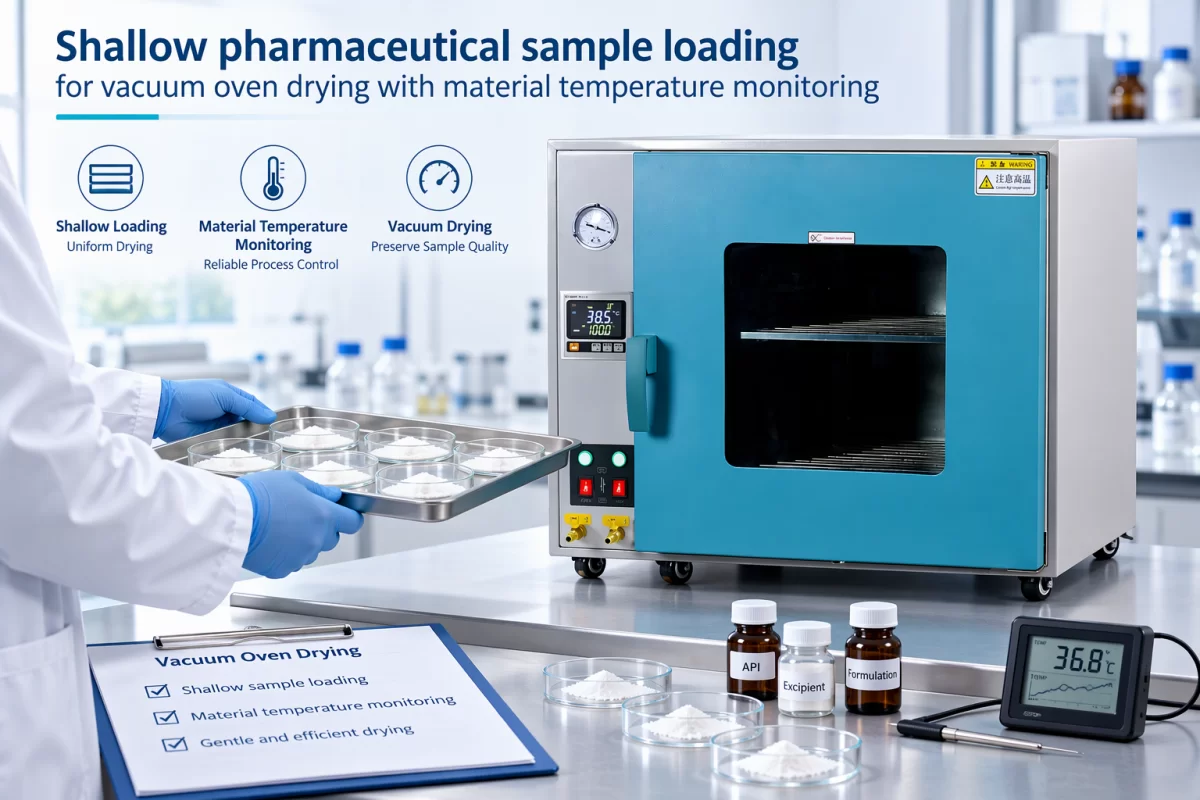
The DZF-6090 lists nominal temperature stability of ±1.0 °C. This is not a statement of sample temperature accuracy, spatial uniformity, or performance during a wet loaded cycle. A useful purchase evaluation therefore includes sensor location, control behavior, loaded temperature mapping where needed, and a compatible route for independent measurement.
Set an acceptable material-temperature ceiling from the sample’s stability information, then investigate a drying schedule within that boundary. Record any evidence of discoloration, caking, melting, or changes in the relevant assay rather than judging success only from apparent dryness.
Working pressure, vacuum connections, and pump configuration
An empty-chamber ultimate-pressure result and pressure during active drying describe different conditions. Water or solvent vapor adds a gas load, while leaks, tubing conductance, pump condition, and vapor trapping affect the pressure reached at the chamber. Ordinary laboratory vacuum drying ovens should not be described as high-vacuum equipment without supporting evidence.
A useful pressure specification states whether the reading is absolute or relative to atmospheric pressure. Any performance test should identify the pump, chamber temperature, loading condition, gauge location, and measurement method. For process development, a recorded absolute pressure near the chamber is more informative than an unexplained maximum-vacuum figure.
- Vacuum interface: specify the port connection, tubing compatibility, isolation arrangement, and any required sensor feedthroughs.
- Pump package: define pumping speed and vapor compatibility for the intended load; do not assume a pump is included with every oven quotation.
- Vapor handling: evaluate whether a condenser or trap is needed and how collected liquid and pump exhaust will be handled.
- Solvent safety: assess the entire system, including the pump and exhaust path, rather than relying on an oven option alone.
An explosion-proof option is listed for the DZF models discussed here, but that listing alone does not establish a certified protection level or suitability for a particular flammable solvent. Organic-solvent tasks require a separate hazard and configuration assessment before operation.
Build the drying endpoint into the laboratory trial
A timed cycle becomes meaningful only when it has been linked to a measurable result for the intended sample and loading arrangement. Establish the endpoint before increasing batch size, and keep the sampling and cooling procedure consistent so moisture uptake after drying does not obscure the result.
- Define the target: identify the moisture limit, any residual-solvent limit, and acceptable changes in sample quality.
- Standardize loading: record wet mass, bed thickness, container material, exposed area, and shelf position.
- Track the conditions: record setpoint, chamber measurements, representative material temperature, and working pressure over time.
- Test representative samples: include locations likely to dry slowly, not just easily accessed surface material.
- Check repeatability: repeat the trial at the proposed working load before treating the schedule as a routine laboratory method.
What makes a laboratory drying trial sufficient for an evaluated small batch?
My criterion is evidence at the proposed load: acceptable material temperature, reproducible working pressure, representative endpoint results, and a suitable handling and safety procedure. Passing one lightly loaded trial does not establish performance for deeper beds, different containers, or a different formulation, and it does not constitute commercial production validation.
Purchase judgment: match the oven to the endpoint
A vacuum drying oven for laboratory pharmaceutical sample dehydration is best selected by the usable area needed at an acceptable bed depth, the material-temperature limit, achievable pressure under vapor load, and the required endpoint test. The DZF-6090’s 90 L chamber and two shelves offer a geometry to evaluate for multi-container laboratory work; they do not by themselves guarantee a batch mass or drying duration.
Our company’s reference price: US$610. This is a reference across the supplied company price listings, not a model-specific DZF-6090 quotation or a complete pump-and-vapor-handling package price. The actual quotation depends on the selected configuration and inquiry results.
For a suitable equipment proposal and quotation, submit the material identity, water and organic-solvent content, target processing quantity or working batch mass, proposed containers and loading depth, material-temperature limit, desired working pressure, endpoint criteria, and pump, trapping, interface, and safety configuration requirements. These details help determine whether the proposed task fits a laboratory DZF oven or requires a different drying arrangement.