Equipment selection • Supplier requirements
ANFD Dryers: What to Include in a Supplier Requirement Sheet
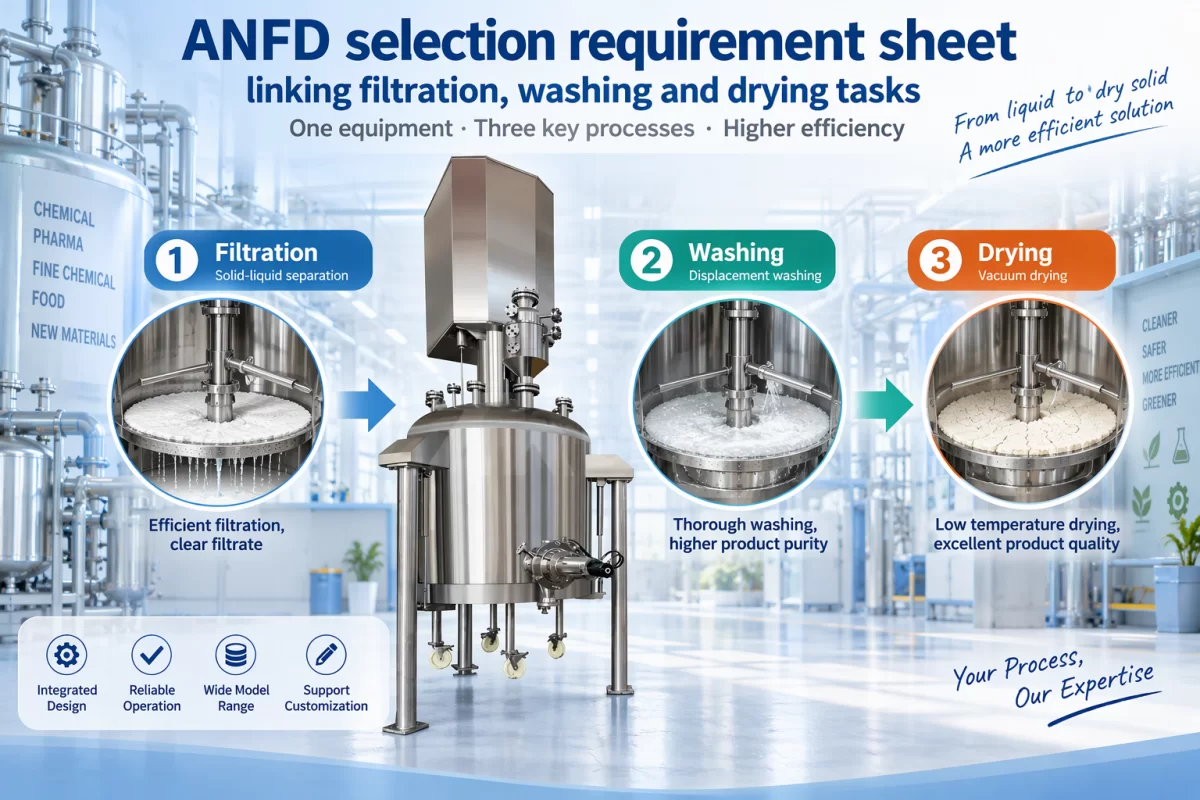
ANFD stands for agitated nutsche filter dryer. Effective ANFD (agitated nutsche filter dryer) selection starts with a supplier requirement sheet that connects the material, working batch and required process steps—not simply a vessel size or model name.
The purchasing objective is to establish whether a proposed configuration can accommodate the slurry, form and wash the intended cake, remove liquid, and support the specified drying and handling requirements. Each stage needs its own acceptance criteria.
1. Define the equipment task before selecting an ANFD
A nutsche filter, a filter reactor and an agitated nutsche filter dryer are not interchangeable purchasing descriptions. A nutsche filter primarily separates solids from liquid through a filter medium. Washing may be part of the specified filtration duty, but drying should not be assumed.
A filter reactor combines a reaction-oriented vessel arrangement with filtration. Reaction requirements involve chemistry, heat removal, mixing and compatible construction. Those requirements must be documented independently; filtration equipment does not acquire reaction capability merely because it has an agitator or jacket.
An ANFD is intended to integrate filtration with agitation and drying operations in an appropriately configured vessel. When reviewing agitated nutsche filter dryers, identify which operations the quotation actually covers, including auxiliary equipment and controls. A jacketed construction alone does not establish a drying rate, final moisture level or vacuum operating limit.
2. Keep vessel volume, filtration area and batch output separate
Record the slurry charge in liters per batch, the solids concentration with its measurement basis, and the required dry-solids output in kilograms per batch. Add the target batches per shift or day. These quantities describe different constraints and should not share a single “capacity” field.
Nominal volume is not filtration area, and neither is a guaranteed working batch. Working fill must leave room for the specified operations. Solids loading also depends on cake thickness, cake structure and the quantity of liquid retained after dewatering.
Does a larger nominal vessel volume guarantee a larger solids batch?
I would not use nominal volume as a solids-output guarantee. I compare slurry charge against the intended working fill, then check filtration area and the expected cake volume. A dilute slurry and a concentrated slurry can produce very different cake loads in the same vessel.
The documented 30 L configuration provides a useful specification example. These values describe that configuration only; they are not family-wide ratings or a production-capacity guarantee.
| Specification | Documented value | Selection relevance |
|---|---|---|
| Nominal / full volume | 30 L / 35 L | Separate vessel volume from working charge. |
| Filtration area | 0.03 m² | Basis for evaluating cake loading and filtration duty. |
| Filter cake thickness | 80 mm | Compare with the material-specific cake requirement. |
| Agitator stroke | 100 mm | Relate vertical travel to cake handling. |
| Stirring speed / power | 0–25 rpm / 0.55 kW | Evaluate against slurry and cake resistance. |
| Shaft seal | Packing seal | Assess compatibility and containment requirements. |
| Main pressure-component materials | Vessel: 316L; jacket: 304 | Keep vessel and jacket material specifications distinct. |
| Maximum working pressure | Vessel: 0.2 MPa; jacket: 0.2 MPa | Specify process-side and utility-side duties separately. |
| Working temperature | Vessel: 85 °C; jacket: 85 °C | Compare with the proposed operating conditions. |
| Jacket working medium | Hot water or thermal oil | Define the utility selected for the proposed duty. |
Calculation example: geometric cake volume
Assume a uniform cake covers the full 0.03 m² filtration area at a thickness of 80 mm, or 0.080 m. The geometric cake volume is 0.03 m² × 0.080 m = 0.0024 m³ = 2.4 L.
This is an illustrative geometric calculation, not a guaranteed batch capacity. It does not establish dry-solids mass, retained liquid, filtration time or usable loading. Those require material-specific data.
3. Specify slurry, filter medium and washing requirements
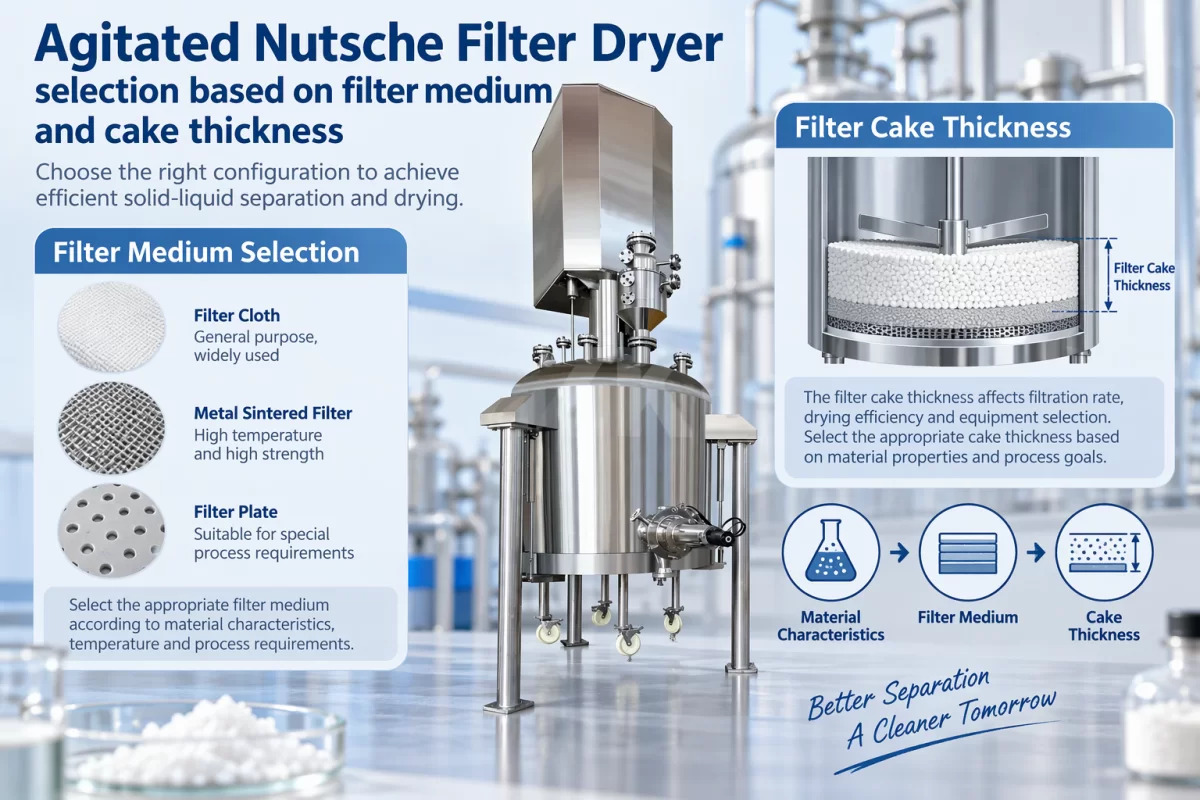
Describe the solvent system, solids concentration, particle-size distribution, temperature, viscosity and any tendency to settle, blind the medium or form a compressible cake. Identify whether the product is sensitive to shear or prolonged contact with the mother liquor.
The filter-medium requirement should state the proposed material, retention specification, chemical compatibility, support arrangement and replacement access. Define the acceptable filtrate clarity or solids carryover. Filtration area alone cannot establish separation quality or cycle time.
For washing, state the wash liquid, quantity per batch, addition sequence and endpoint. Distinguish displacement washing through a cake from washing that involves reslurrying and agitation. For more process context, review filtration, washing and drying in an ANFD, while keeping the supplier sheet specific to the actual material.
Which test information makes filtration proposals easier to compare?
I prioritize representative slurry tests that record the medium, filtration area, cake thickness, temperature, pressure differential, filtrate volume and elapsed time. I also want wash consumption and cake condition recorded. Comparisons are meaningful only when the test conditions and endpoints match.
4. Define agitation, dewatering and drying as separate duties
Agitator speed and motor power are starting specifications, not proof of adequate cake handling. Ask the supplier to describe the blade arrangement, permitted movement, drive capability and operating sequence for leveling, washing and handling the cake. Relate these to the expected wet and partially dried material conditions.
Dewatering removes liquid from the cake through the separation process. Thermal drying removes remaining liquid by evaporation. The requirement sheet should give separate endpoints: for example, the retained-liquid criterion after dewatering and the final moisture or residual-solvent criterion after drying, each with a defined test method.
For drying evaluation, provide the solvent identity, initial retained-liquid load, maximum allowable product temperature and required endpoint. Specify the proposed jacket utility and available utility conditions. Where reduced-pressure drying is required, include the required process pressure and request documented suitability, together with the vacuum, condensation and vapor-handling scope.
The listed hot-water or thermal-oil jacket medium supports discussion of heat supply. It does not, by itself, establish evaporation capacity, drying duration or a guaranteed final product condition.
Can suppliers compare drying time without a shared endpoint?
I would treat that comparison as incomplete. I ask for the same initial cake load, retained-liquid content, temperature limit, operating conditions and final analytical endpoint. Otherwise, a shorter quoted cycle may describe a different duty rather than better performance.
5. Include sealing, discharge, cleaning and quotation scope
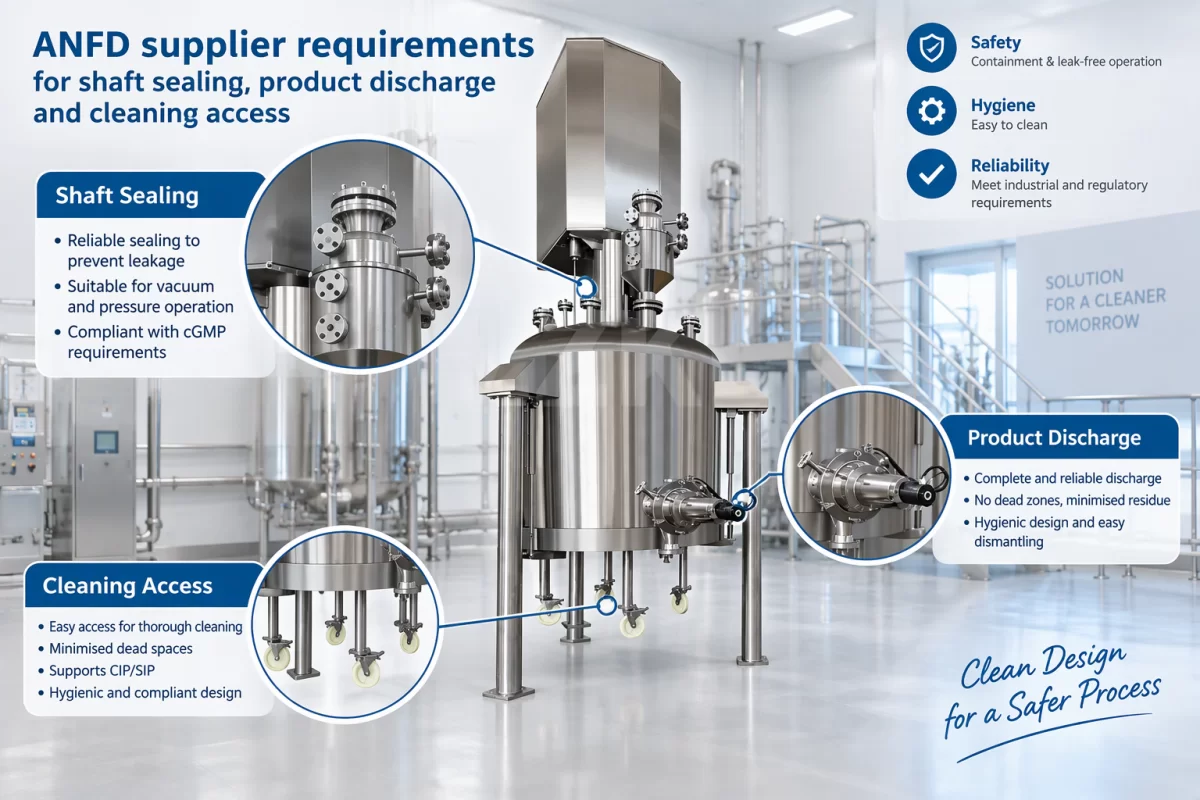
The documented packing seal should be evaluated against the solvent, temperature and containment needs of the proposed process. Specify acceptable leakage criteria, seal-material compatibility, maintenance access and any required containment arrangement. Do not infer sterile operation, emissions performance or certification from stainless-steel construction or a model designation.
Discharge and cleaning deserve their own acceptance criteria. State whether the final material is free-flowing, cohesive or prone to adhesion, and define the desired discharge method, acceptable retained product and receiving-container arrangement. Request a description of the discharge hardware rather than assuming it from the equipment name.
For cleaning, identify the cleaning agents, required access to the filter medium, drainability expectations and changeover procedure. If clean-in-place equipment or validated cleaning performance is required, make it an explicit part of the proposed configuration and acceptance plan.
Use the same basis for every supplier quotation
- Material and batch: slurry composition, charge volume, solids mass and required production schedule.
- Process sequence: filtration, washing, dewatering and any required drying, with measurable endpoints.
- Equipment configuration: filtration area, filter medium, agitation, sealing, discharge and cleaning provisions.
- Utilities and auxiliaries: heating supply, any required vacuum and condensation systems, instrumentation and controls.
- Acceptance and commercial scope: test conditions, documentation, included accessories, installation responsibilities and quotation exclusions.
Assess daily throughput using the complete batch cycle, including charging, washing, discharge and cleaning—not filtration time alone. Evaluate pricing against the same configuration and supply scope; the actual quotation depends on the selected requirements and inquiry results.
Make ANFD selection a documented process match
A useful supplier requirement sheet keeps vessel volume, filtration area and batch output distinct. It connects slurry and cake behavior to filtration and washing, then separately defines agitation, dewatering, heating, drying, sealing, discharge and cleaning requirements.
The strongest purchasing decision is the configuration supported by documented specifications and representative process evaluation—not the largest nominal volume or the most comprehensive equipment label.
Submit the material details, target throughput or working batch, operating conditions and required configuration to ZZKEDA for further equipment evaluation and a configuration-specific quotation.