Equipment purchasing guide · Solvent recovery
Buying a 50L Rotary Evaporator for CBD Extract Concentration
Buying a 50L rotary evaporator for CBD extract concentration starts with the solvent load and production schedule—not the number printed on the evaporating flask. For a 50 L lot of solvent-bearing extract, the purchasing decision should connect safe working charges, receiver handling, condensation capacity, and the concentration endpoint required by the next process.
What a 50L rotary evaporator contributes to a CBD workflow
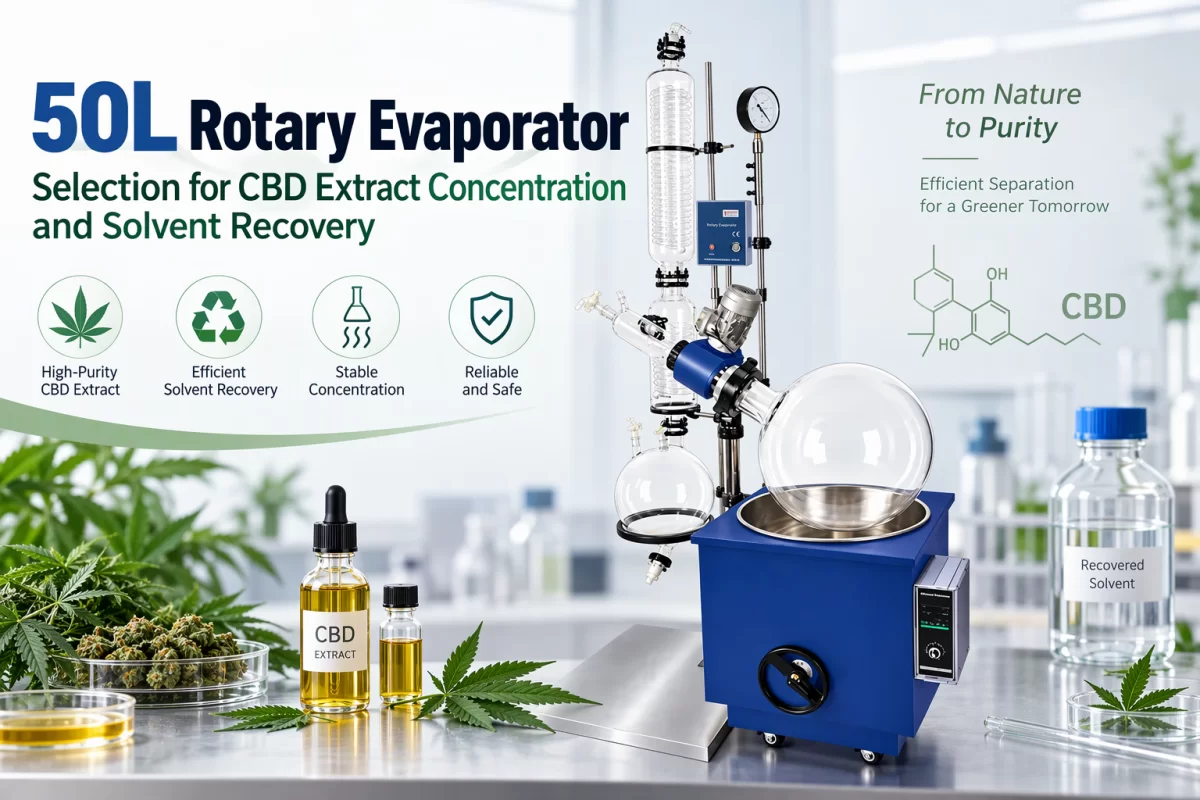
A rotary evaporator is a solvent-removal and concentration stage for an already prepared extract. Reduced pressure lowers the solvent’s boiling temperature, while flask rotation spreads the liquid over the heated glass surface. Vapor then passes to the condenser, and condensed solvent collects in the receiving flask. The process overview explains how rotary evaporators remove solvents.
For CBD-containing material, this role is distinct from extracting compounds from biomass or selectively purifying cannabinoids. The purchase should therefore be based on a defined feed: solvent identity, approximate solvent fraction, suspended solids, viscosity, foaming tendency, and the desired concentrate condition. A clear, filtered extract and a viscous, particle-bearing feed can behave differently even when their starting volumes are identical.
Can a 50 L extract lot be loaded into a 50 L flask in one charge?
I would not plan on that basis. The nominal flask volume is not an approved working charge. Space is needed for rotation, vapor release, and possible foaming or bumping. The working charge must be established for the actual feed and operating procedure; a 50 L lot may require several charges or a specifically configured replenishment arrangement.
R1050 dimensions and capacities that affect the purchase
The R1050 is the 50 L model in the supplied R-series information. Its evaporating flask and receiving flask serve different purposes: the first holds the material being concentrated, while the second collects condensed solvent. Compare 20L and 50L rotary evaporator configurations when evaluating vessel size against the intended working batch.
| Parameter | Value | Purchasing significance |
|---|---|---|
| Evaporating flask | 50 L | Nominal vessel capacity; not a working-charge limit |
| Receiving flask | 20 L | Plan safe collection levels and solvent transfer |
| Bath dimensions | Ø550 × 320 mm | Allow access for bath operation and maintenance |
| Lift travel | 0–180 mm | Evaluate flask immersion and operating access |
| Overall dimensions | 1320 × 770 × 2340 mm | Check room height, delivery route, and service clearance |
For rotation and lifting, the practical questions are stable movement at the intended charge, controllable film formation, and convenient removal of the flask from the bath. Increasing rotation is not automatically a remedy for slow recovery: thickening extract, foam, insufficient heat transfer, or inadequate condensation may instead set the limit.
Bath size also does not establish the solvent recovery rate. Heating selection should address the solvent, acceptable material temperature, warm-up time, and the rising viscosity near the endpoint. Provide the site’s electrical supply requirements and request an explicitly matched electrical configuration.
Plan the processing rhythm for a 50 L extract lot
A useful batch schedule separates loading, warm-up, bulk solvent removal, final concentration, receiver handling, concentrate discharge, and cleaning. Solvent removal often slows as the extract becomes more concentrated. Consequently, a recovery rate observed early in the run should not be applied to the entire lot without validation.
For a batch-only arrangement, establish the working charge first and calculate how many charges are needed. For replenishment, specify whether feeding is manual or controlled, how vacuum is maintained, and how accumulation of nonvolatile extract is managed. Do not assume continuous feeding or receiver draining under vacuum is included.
Hypothetical scheduling example—not an equipment rating
Assume a 50 L feed lot contains 40 L of recoverable solvent on a simplified volume-accounting basis. Assume an independently established average collection rate of 8 L/h under the chosen solvent, temperature, pressure, cooling, and feeding conditions.
Solvent collection time = 40 L ÷ 8 L/h = 5 h.
If combined loading, warm-up, receiver handling, discharge, and cleaning take another 1.5 h, the illustrative lot cycle is 6.5 h. Neither the 8 L/h rate nor the 6.5 h cycle is a guaranteed R1050 performance value. This simplified example excludes volume contraction and detailed composition changes; production planning should use measured mass balances and trial results.
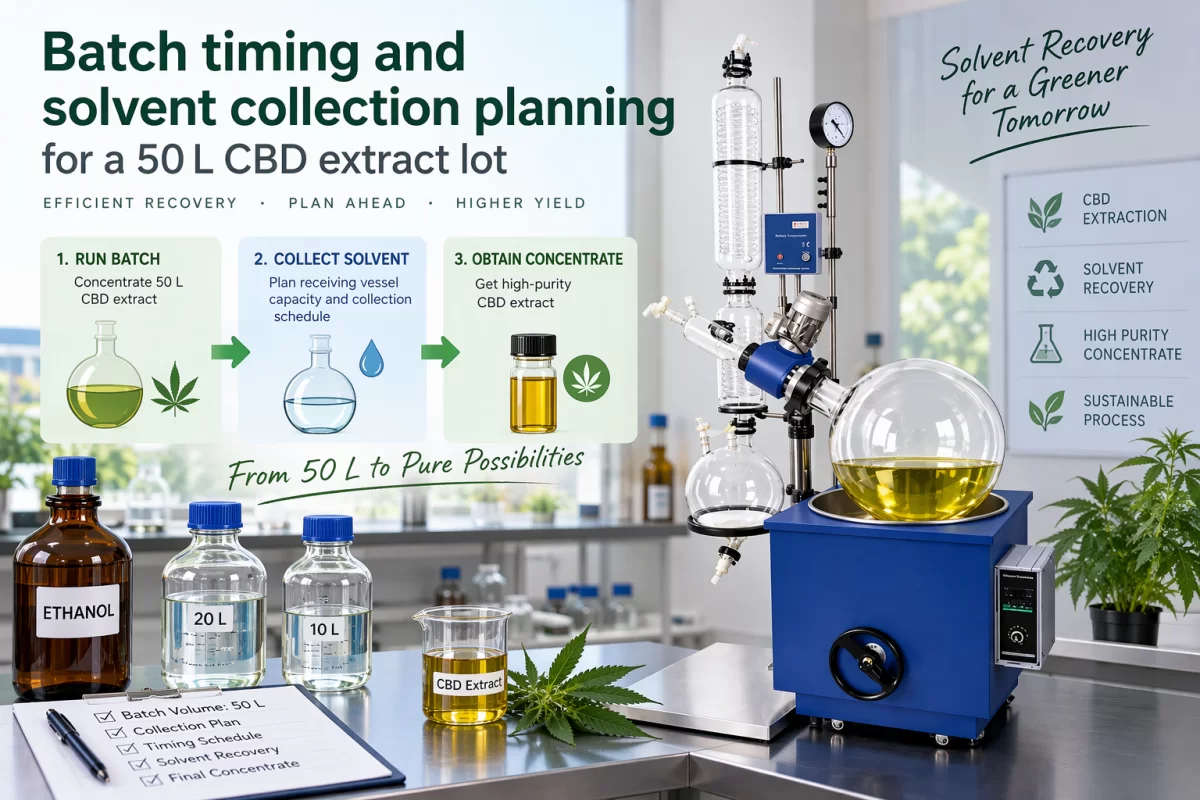
Does a 20 L receiving flask eliminate interruptions during solvent recovery?
I treat 20 L as nominal collection capacity, not permission to fill the receiver completely. In the example above, 40 L of collected solvent requires multiple collection stages unless a suitable transfer arrangement is supplied. Safe working levels, valves, pressure equalization, and the draining procedure determine the actual interruption time.
Match the condenser, vacuum control, and external cooling
The condenser must handle the actual vapor load generated at the chosen bath temperature and operating pressure. Request the offered condenser arrangement, heat-transfer area, coolant connection details, and performance information at the proposed duty. A condenser description alone does not establish an hourly ethanol recovery capacity.
Select the external chiller using cooling capacity at the required coolant temperature—not simply its lowest attainable temperature. Coolant flow, ambient conditions, hose pressure losses, and solvent vapor temperature also affect condensation. An undersized cold source can allow vapor to reach the vacuum system even when the evaporating flask has ample capacity.
Vacuum selection should consider chemical compatibility, pumping performance at operating pressure, and controlled pressure reduction. A pump’s ultimate vacuum is not the same as stable pressure during evaporation. A gauge and suitable control arrangement help operators manage boiling behavior as the feed composition changes.
A cold trap may be appropriate between the condenser and pump to reduce solvent carryover, but it is not a substitute for adequate primary condensation. For ethanol or other flammable solvents, include ventilation, compatible collection containers, spill controls, and a site-specific electrical and fire-safety assessment. Do not infer explosion protection or pharmaceutical production suitability from vessel size.
Define where concentration ends and refinement begins
The discharge specification should describe a manageable concentrate for the next operation. Relevant criteria can include residual solvent, transfer viscosity, solids content, and maximum product exposure temperature. Visual thickness alone is not a reliable residual-solvent measurement; appropriate sampling and analytical testing are needed.
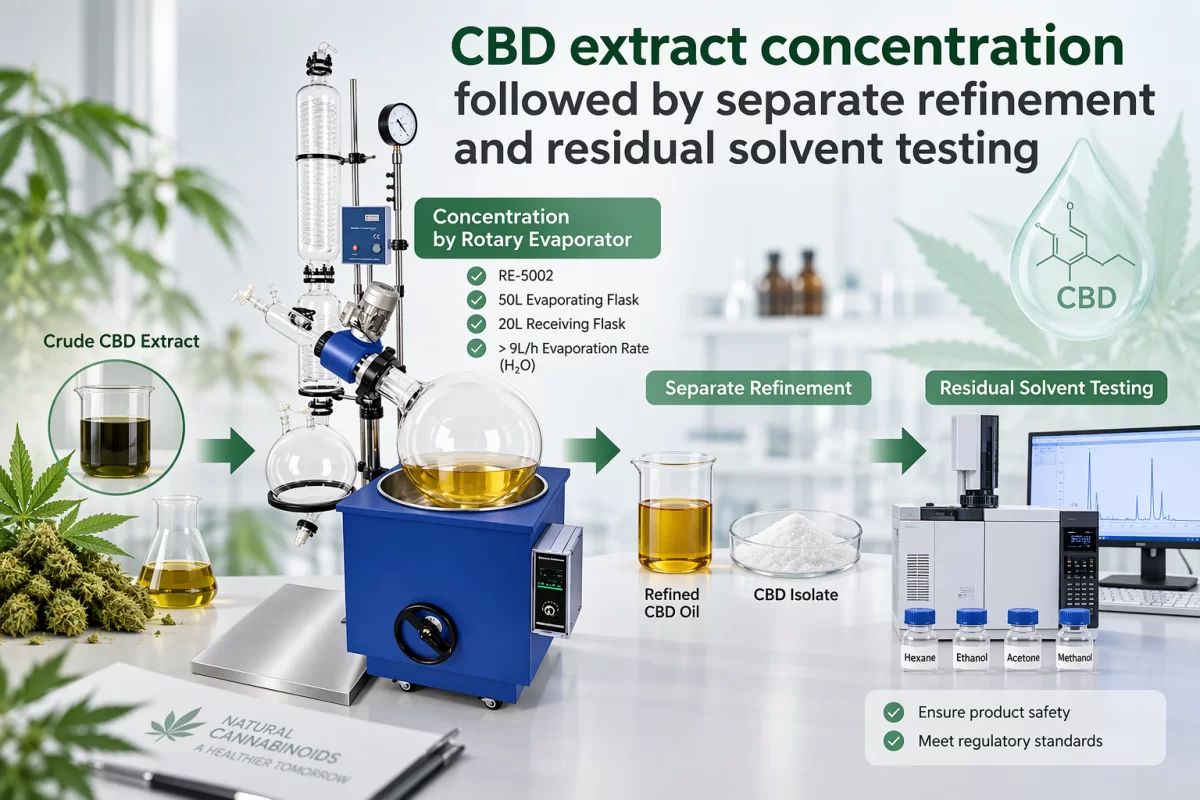
Depending on the feed and finished-product objective, later operations may include filtration, winterization, decarboxylation, cannabinoid distillation, or chromatography. Their order and necessity depend on the process. Rotary evaporation does not by itself establish CBD purity, selectively remove unwanted cannabinoids, or demonstrate compliance with a medicinal-product specification.
Does solvent recovery prove that the CBD concentrate is sufficiently refined?
No. I regard solvent recovery and cannabinoid refinement as separate acceptance questions. The rotary evaporator can reduce solvent content, but purity, cannabinoid composition, and final residual-solvent compliance require their own process steps and testing.
Request an itemized supply scope and configuration-based quote
Our company’s reference price is US$1,700. This is a catalog-level budgeting reference, not a confirmed price for an R1050 or a complete 50 L solvent-recovery package. The actual quotation depends on configuration and the inquiry result.
A useful purchase quotation should separate the following items rather than treating every accessory as standard:
- Main evaporator: identify the model, glassware, condenser arrangement, bath, rotation controls, lifting mechanism, seals, and supplied valves.
- Vacuum pump: specify the pump separately, including solvent compatibility, operating-duty suitability, and exhaust handling.
- Vacuum measurement and control: identify the gauge, controller, regulation method, and supplied connections.
- External chiller: state the selected cooling duty, coolant temperature, flow requirements, and utility requirements.
- Cold trap: list separately when required, including its cooling method and maintenance needs.
- Pipework and connections: identify vacuum hoses, coolant hoses, adapters, clamps, receiver-transfer components, and installation limits.
- Services: distinguish packing, shipping, installation support, commissioning, operator training, warranty terms, and spare-parts support.
Compare equivalent duties. Quotations are meaningful when they use the same solvent, feed composition, working charge, feeding method, temperature and pressure targets, collection arrangement, and concentration endpoint.
Buying a 50L rotary evaporator: the practical decision
For CBD extract concentration, the R1050 should be evaluated as part of a matched solvent-recovery system. Its 50 L evaporating flask establishes nominal vessel size; the working charge and complete lot cycle must be established from the material and operating conditions. Receiver handling, condenser duty, vacuum control, and external cooling determine whether the proposed arrangement fits the processing schedule.
Choose a configuration that reaches a defined, transferable concentrate endpoint while leaving cannabinoid refinement and final product qualification to their appropriate downstream operations.
Submit the solvent and extract composition, target daily throughput or working batch, concentration endpoint, proposed operating conditions, site utilities, and required accessories and services to request a suitable configuration assessment and quotation.