A 50L Reactor Requirement Checklist for Chemistry Pilot Work
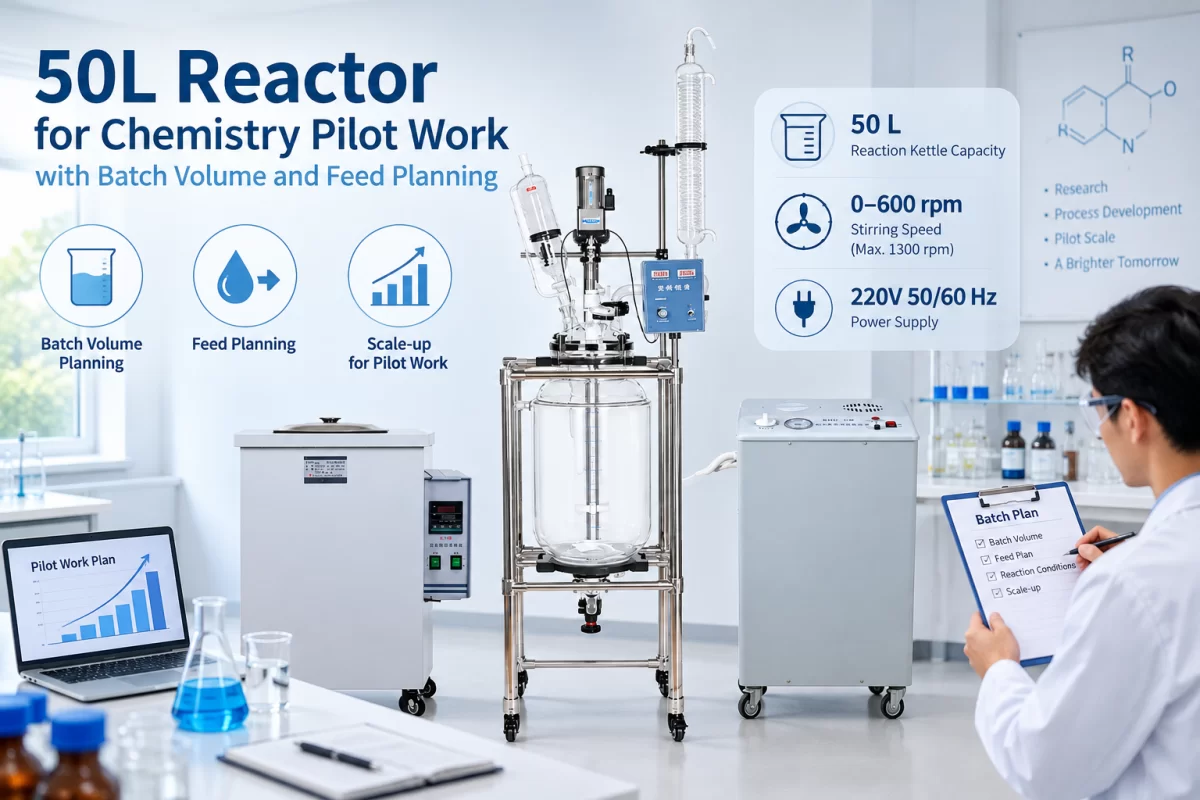
Selecting a 50L reactor for chemistry pilot work means specifying a chemical processing system—not simply buying a vessel with a 50-liter label. The useful purchasing questions concern working batch volume, wetted materials, heat removal, mixing, sealing, vapor handling, and reliable discharge.
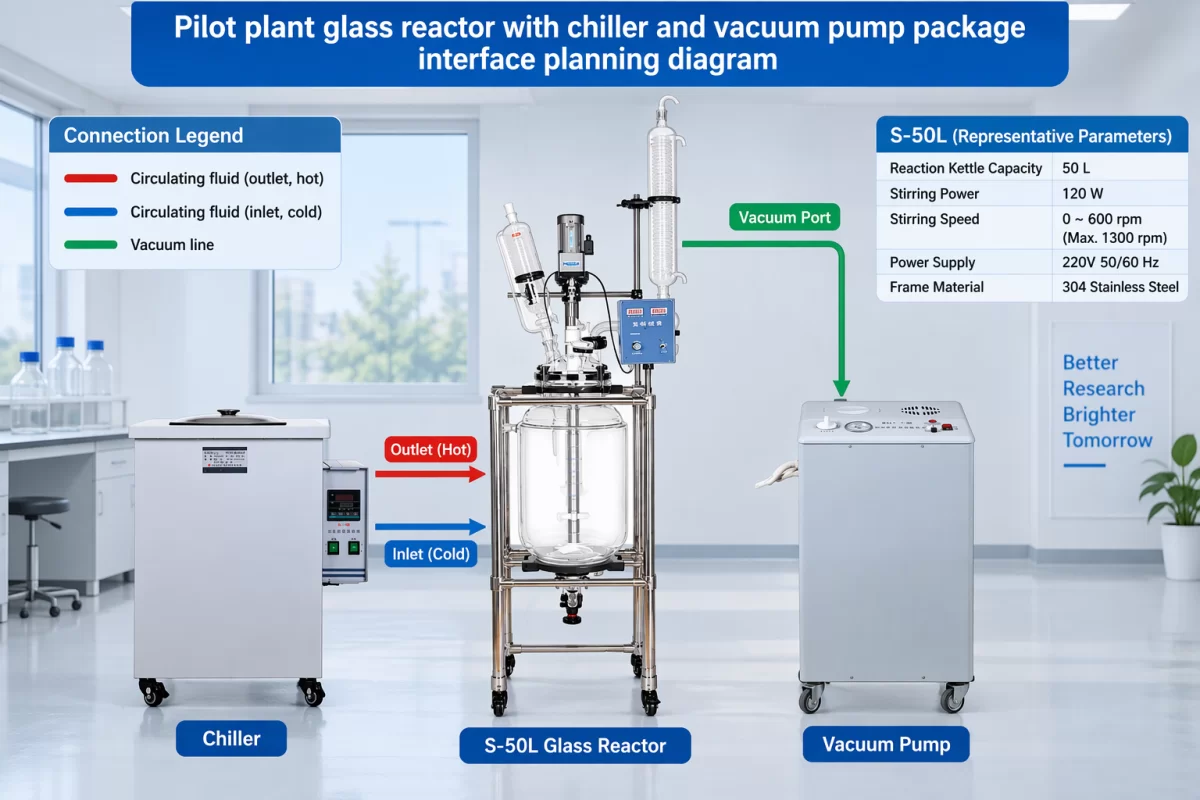
A Jacketed Glass Reactor is a configuration to evaluate when a pilot process needs a separate heat-transfer circuit around the reaction vessel. Its suitability depends on the chemistry and the documented configuration, rather than nominal capacity alone.
1. Define the chemistry pilot task before choosing capacity
Start with a process description: reaction, controlled addition, reflux, solvent removal, crystallization, or a sequence of operations. Record the materials present at each stage, anticipated viscosity changes, solids formation, vapor generation, and the required sampling schedule. These details determine whether a particular reactor arrangement can support the intended pilot campaign.
The S-series capacity schedule identifies S-10L, S-20L, S-30L, S-50L, and S-100L vessels with nominal capacities of 10, 20, 30, 50, and 100 L respectively. These labels help organize an initial comparison, but they do not establish usable batch volumes or equivalent mixing and thermal performance.
For equipment selection, review the 10L to 50L jacketed glass reactors against the same process requirements. Moving to another capacity requires a fresh assessment of vessel geometry, jacket duty, agitation, seals, condenser arrangement, connections, and discharge—not just a larger volume figure.
Does a nominal 50 L vessel support a 50 L working batch?
My recommendation is to treat 50 L as the nominal vessel capacity, not an automatic charge allowance. A suitable working batch depends on additions, foaming, boiling behavior, suspended solids, mixing coverage, and the free space needed for the process.
Separate four volume decisions
- Initial charge: Record the starting liquid volume and any solids displacement under the initial operating conditions.
- Addition changes: Track feeds, solvent additions, withdrawals, and the estimated peak occupied volume throughout the batch.
- Process allowance: Reserve space appropriate to gas evolution, foam, reflux, thermal expansion, and agitation behavior.
- Future expansion: Specify a future batch separately. Do not assume that unused nominal volume is available for production growth.
Planning example—not an equipment guarantee: Assume an initial liquid charge of 24 L, a subsequent liquid feed of 8 L, additive liquid volumes, and no evaporation or withdrawal. The estimated final liquid inventory is 24 + 8 = 32 L. Compared with a nominal 50 L vessel, the arithmetic difference is 18 L. That difference is not a validated process allowance; foam, expansion, solids, geometry, and agitation still govern acceptability.
2. Build a wetted-material and mechanical checklist
Glass construction does not, by itself, establish compatibility with every chemical. Assess all wetted components against the complete formulation, including cleaning agents and intermediate mixtures. The vessel, stirrer, shaft covering, seals, gaskets, probes, feed fittings, condenser, and discharge valve may have different material requirements.
For the proposed S-50L configuration, request an itemized wetted-material schedule and documented operating limits. A material named for a different capacity or accessory is not evidence that it is installed on the selected reactor.
| Assembly | Requirement to specify | Basis for acceptance |
|---|---|---|
| Vessel and jacket | S-50L nominal capacity: 50 L; define working batch separately | Selected vessel geometry, wetted materials, and separate vessel/jacket limits |
| Agitation and drive | Viscosity range, solids loading, and mixing objective | Matched impeller, shaft, drive, and usable speed/torque data |
| Seal assembly | Chemical exposure and intended pressure or vacuum conditions | Seal materials, operating limits, and maintenance access |
| Condenser and ports | Vapor duty, feed method, sampling, and instrumentation | Condenser duty and a connection schedule with sizes and quantities |
| Bottom discharge | Slurry behavior, product recovery, and receiving arrangement | Valve materials, passage geometry, drainability, and cleaning access |
| Temperature-control package | Product temperature profile, ramp time, and heat load | Circulator duty at operating conditions, fluid compatibility, and sensor location |
Define agitation by its purpose: blending miscible liquids, dispersing a feed, suspending solids, or maintaining heat transfer. Motor power alone does not demonstrate that these tasks will be achieved. Drive selection should account for the most demanding batch stage, including any viscosity increase during cooling or crystallization.
An ordinary jacketed glass vessel should not be treated as a high-pressure reactor. Pressure and vacuum service require documented limits for the selected assembly. Likewise, a hazardous-area requirement needs an appropriate drive and electrical package supported by relevant documentation; it cannot be inferred from a general product description.
3. Specify temperature control around the product—not the setpoint
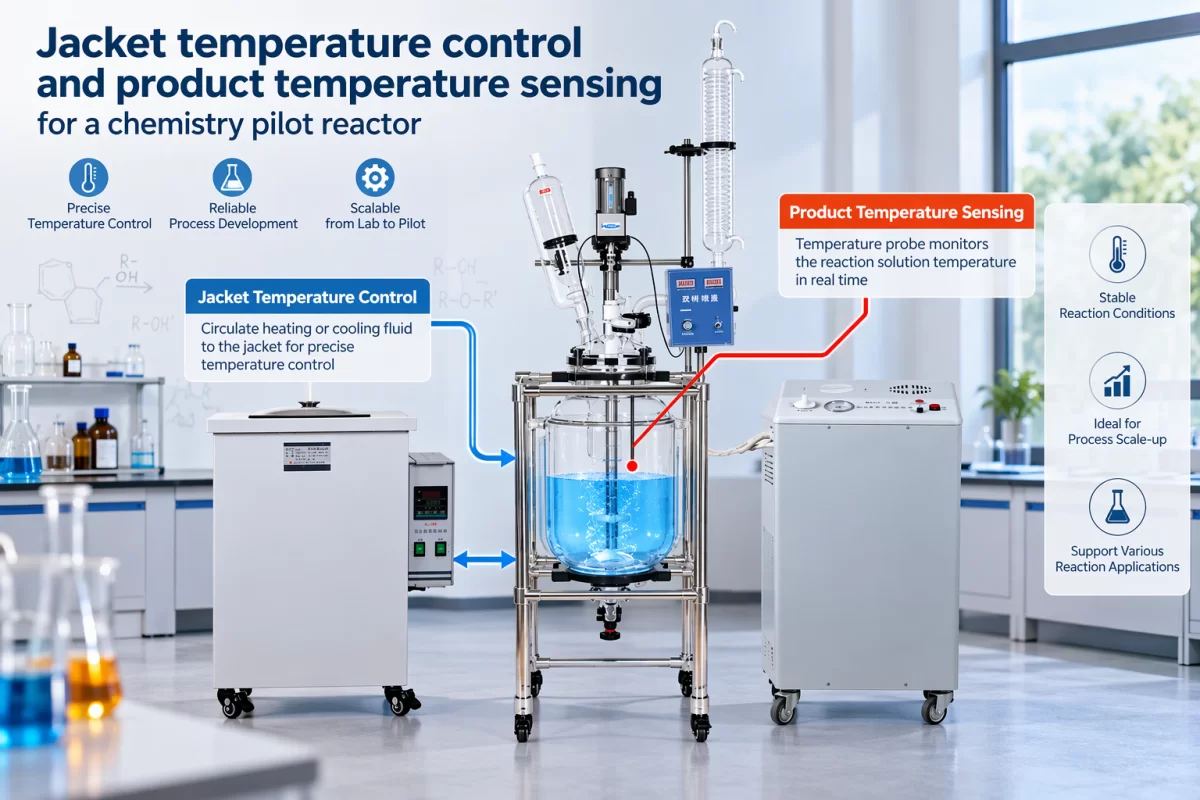
For a 50L chemistry pilot reactor, state the required material temperature range, allowable deviation, heating and cooling stages, and reaction heat-release profile. Then define the utility arrangement needed to achieve those conditions. A jacketed configuration provides a path for circulating heat-transfer fluid, but the achievable product temperature and response time depend on the complete system.
The comparison of single-layer and double-layer glass reactor designs is useful background when deciding how heat should enter or leave the process. It does not replace model-specific thermal specifications.
Is the circulator setpoint the same as the reaction temperature?
I would specify these as separate measurements. The circulator controls its heat-transfer fluid, while the material temperature depends on heat-transfer area, flow, fluid properties, agitation, batch mass, and reaction heat. Acceptance should be based on a suitably located product-temperature sensor and an agreed process profile.
- Heating and cooling duty: Include the batch thermal load, reaction heat, and the requested time for each temperature transition.
- Heat-transfer fluid: Match the fluid to the operating range, jacket materials, hoses, and circulation equipment.
- Circulation conditions: Specify required flow and allowable jacket pressure separately from vessel pressure.
- Measurement and protection: Define product sensing, control logic, alarms, and the response to loss of circulation or agitation.
When comparing capacities, use the same formulation, starting temperature, target temperature, utility conditions, and acceptance criteria. A smaller-vessel heating result cannot simply be assigned to a 50 L batch, and a circulator’s advertised temperature range does not establish the reactor’s permissible operating range.
4. Match condensation, connections, and discharge to the batch
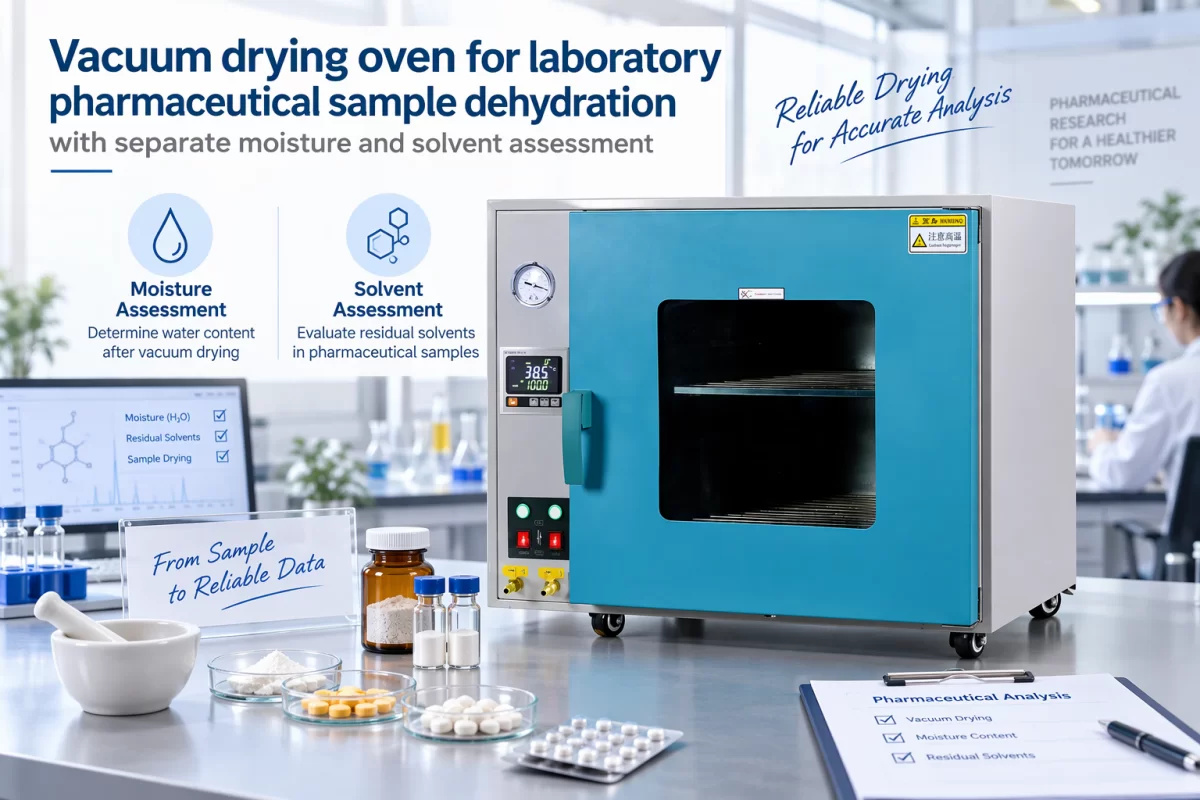
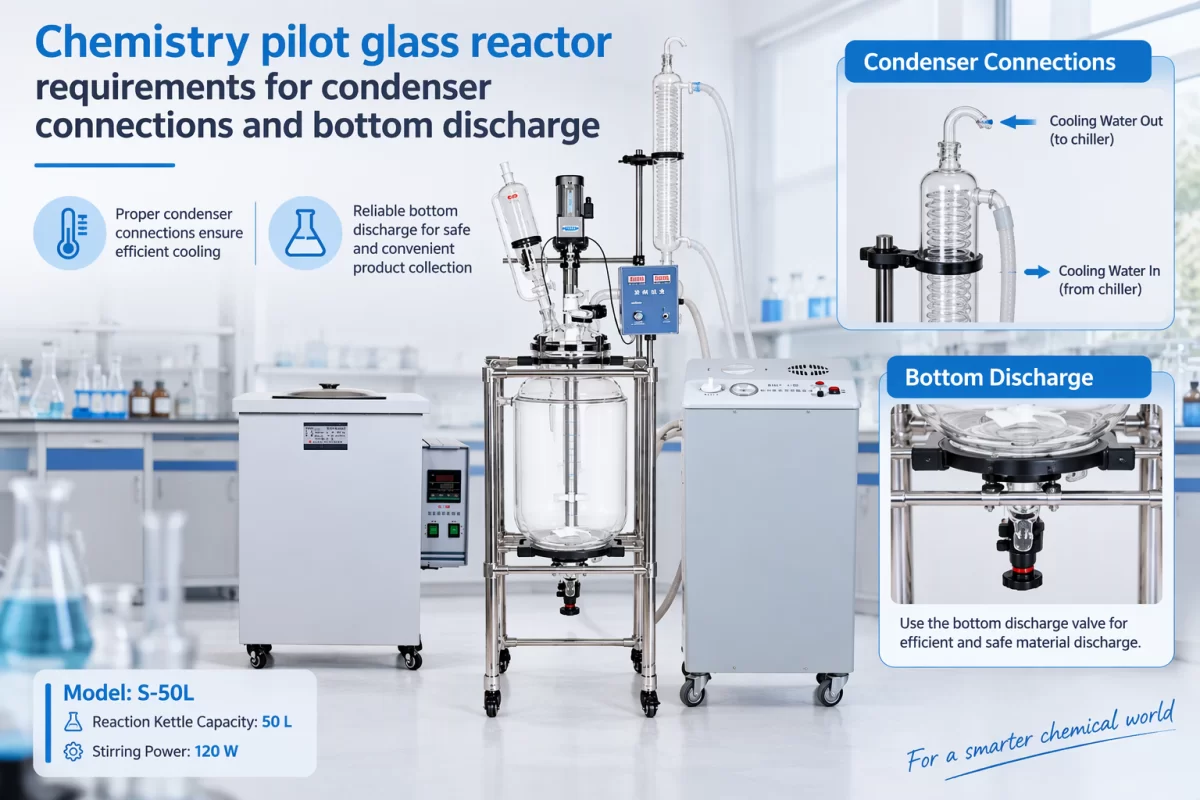
Reflux and solvent-removal work require a condenser assessment based on expected vapor composition and generation rate, coolant conditions, and the intended operating pressure. Vessel capacity alone is not a condenser sizing method. Include the receiver, vapor routing, and any vacuum equipment in the configuration review where those operations are required.
A connection schedule should reserve access for feeds, temperature probes, sampling, vapor handling, and any specified gas service. Consider whether these functions must operate simultaneously. An available opening is only useful if its size, position, sealing arrangement, and connected accessory suit the process.
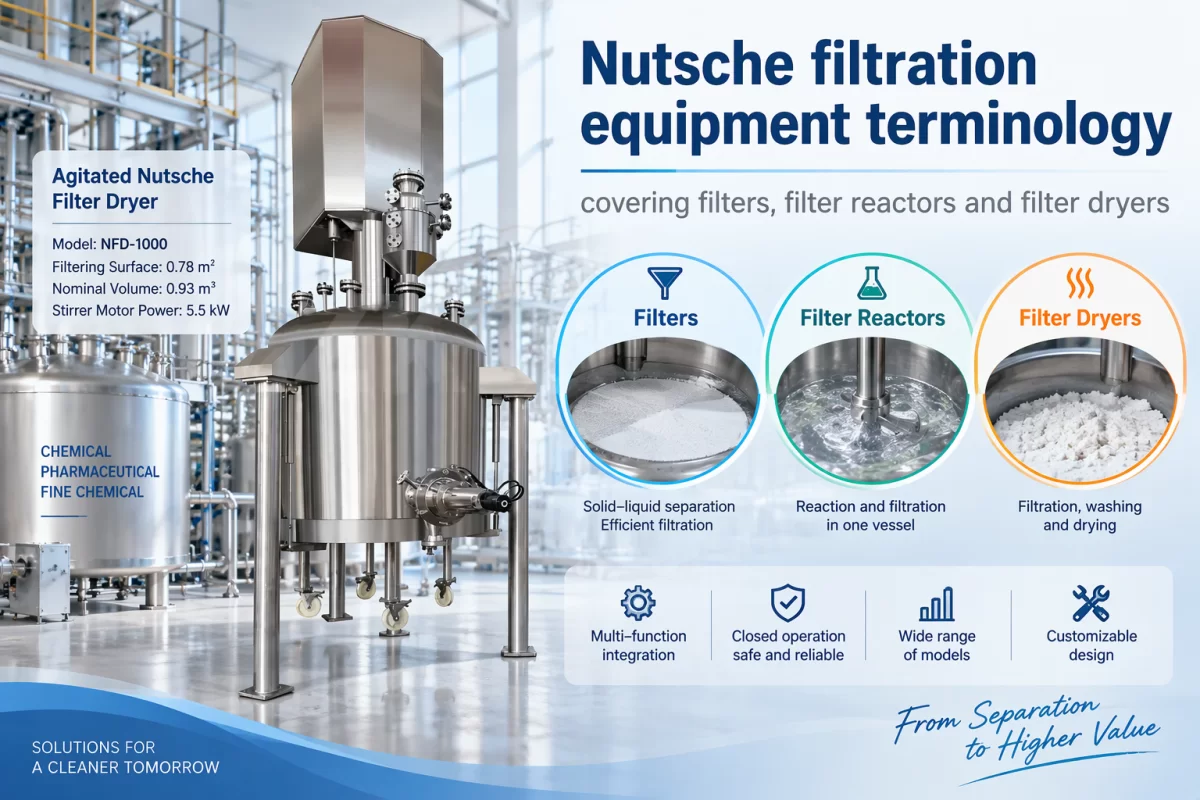
Discharge deserves particular attention for crystallization or slurry work. Describe solids size, settling behavior, viscosity at discharge, and the receiving vessel arrangement. Evaluate the bottom valve and outlet for flow restriction, retained material, cleaning access, and safe handling of the batch.
5. Compare quotations on a consistent configuration
Separate the reactor assembly from the heating/cooling circulator, condenser accessories, vacuum equipment, instrumentation, and installation items in the quotation. Compare offers against the same working batch, chemistry, thermal profile, mixing task, and utility conditions.
Our company’s catalog reference price is US$1,699. This is a catalog-level reference across the supplied product listings, not a specific S-50L system quotation. The actual quotation depends on configuration and the enquiry result.
What makes two 50 L reactor quotations meaningfully comparable?
I compare the supplied scope and documented operating capability before the price. Equivalent quotations need the same wetted-material requirements, working batch basis, drive selection, thermal duty, condenser arrangement, seals, ports, and discharge provisions.
Final selection: a 50L reactor for chemistry pilot work
Choose the S-50L Jacketed Glass Reactor only when its proposed configuration matches the actual batch sequence. Nominal capacity is the starting point; material compatibility, mixing, thermal performance, pressure limits, vapor handling, and discharge determine whether the system fits the pilot task.
For a configuration assessment and quotation, submit the material composition, target throughput or working batch volume, initial charge and additions, temperature and pressure conditions, viscosity and solids information, available utilities, and required accessories. These inputs provide a practical basis for selecting the reactor and its supporting equipment.