Pilot processing · Package selection
Pilot Glass Reactor Packages with Chillers and Vacuum Pumps
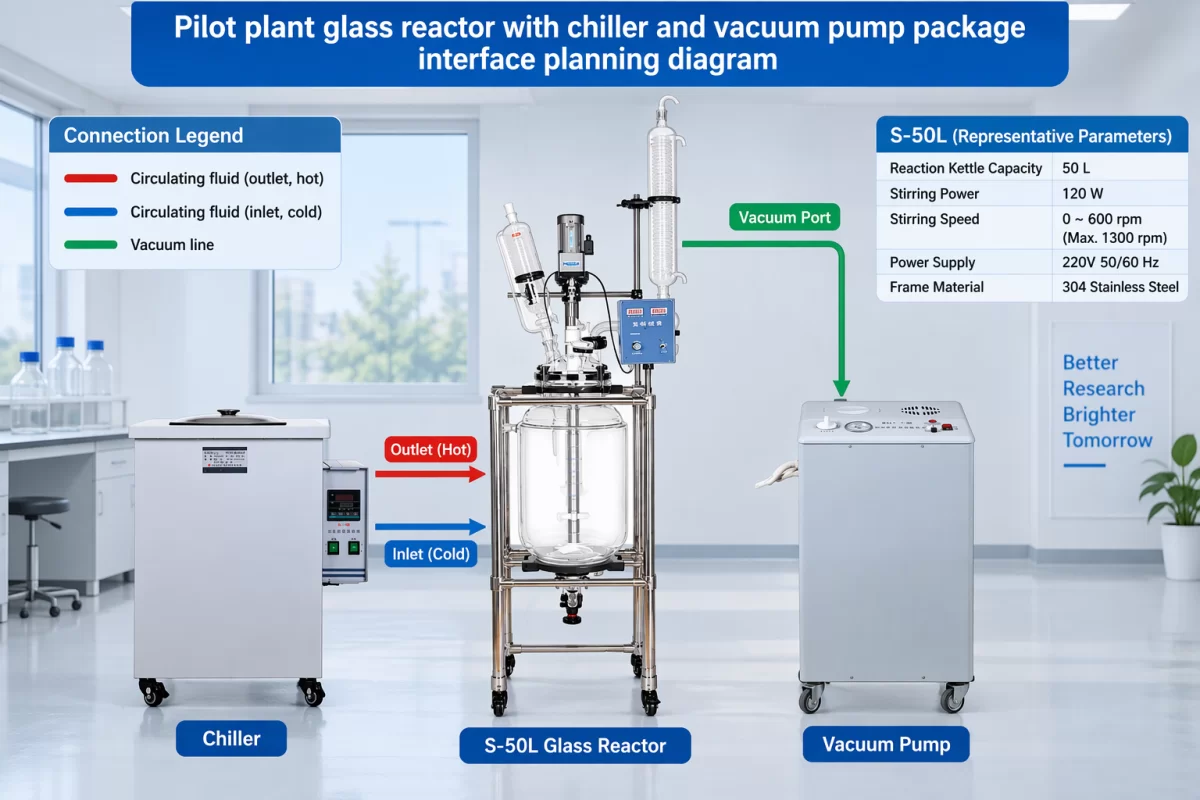
A Pilot plant glass reactor with chiller and vacuum pump should be specified as a connected process system—not simply three pieces of equipment purchased together.
Start with the process duties and connection map
A jacketed glass reactor package must coordinate mixing, heat transfer, vapor handling, vacuum regulation, and product discharge. A suitable vessel alone does not establish whether the complete system can support a particular pilot process. The purchasing decision should begin with a process description and an interface schedule connecting each duty to the equipment responsible for it.
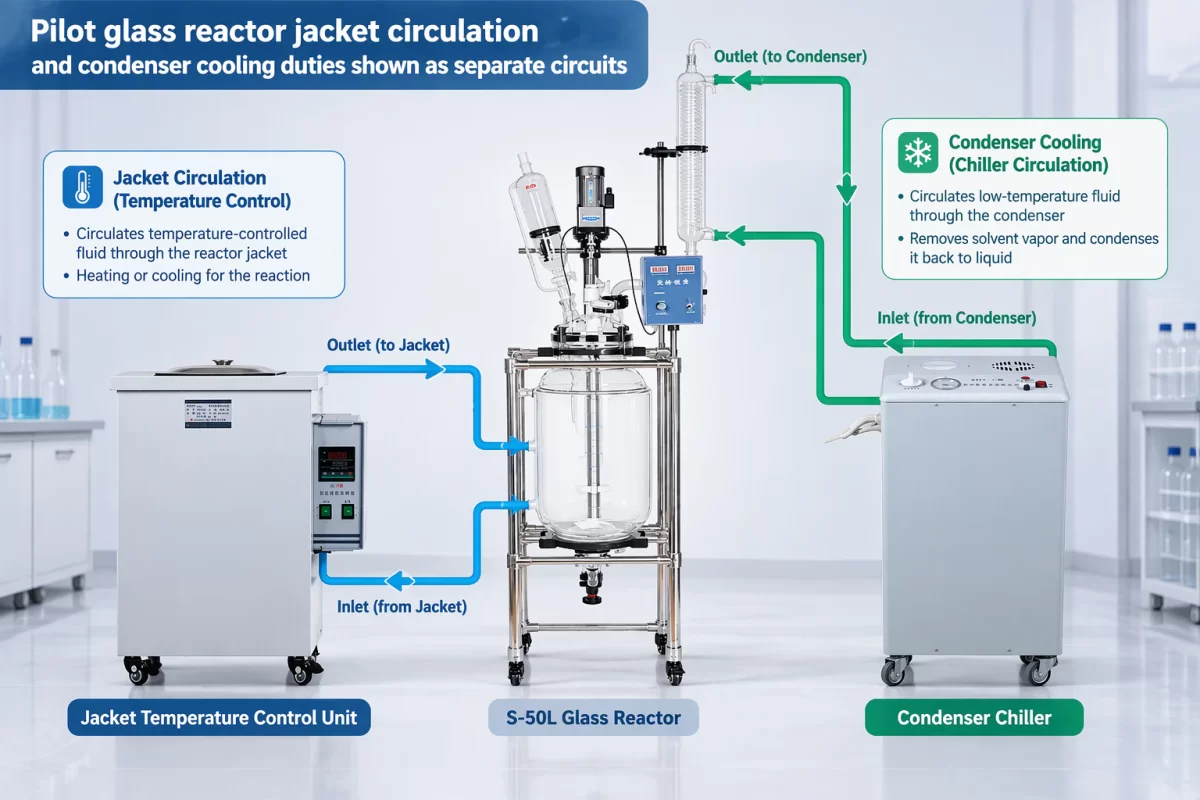
Separate the reactor contents from the jacket fluid and the condenser coolant. These are distinct circuits with different compatibility and operating requirements. Likewise, the vacuum connection carries gases and vapors rather than cooling fluid. Identify every connection by function, connection type, required size, wetted material, and the party supplying its adapter, hose, valve, or instrument.
Choose nominal capacity around the changing working batch
The S-series model capacities below provide a starting point for vessel selection. They are nominal vessel capacities, not recommended working volumes. For intermediate capacity options, explore the 10L to 50L jacketed glass reactors, then define the actual batch profile before selecting a model.
| Model | Nominal capacity (L) | Model | Nominal capacity (L) |
|---|---|---|---|
| S-1L | 1 | S-10L | 10 |
| S-2L | 2 | S-20L | 20 |
| S-3L | 3 | S-30L | 30 |
| S-5L | 5 | S-50L | 50 |
| — | — | S-100L | 100 |
- Initial charge: establish the starting liquid and solids inventory, including whether the impeller and temperature probe are adequately immersed.
- Feed changes: calculate how additions, withdrawals, evaporation, and volume changes affect the maximum inventory.
- Process allowance: reserve space according to foaming, boiling, gas evolution, mixing behavior, and vapor disengagement—not a universal filling percentage.
- Future expansion: evaluate larger batches separately. Extra capacity can change low-volume mixing and thermal response, so oversizing is not automatically beneficial.
Does a 20 L nominal reactor support a 20 L working batch?
I would not treat those quantities as interchangeable. The usable working batch depends on the liquid level, agitation geometry, additions, and process headspace. Nominal capacity identifies the vessel size; it does not establish a safe or effective loading limit for every material.
Planning example: assume an initial liquid charge of 8 L and an additional 4 L feed, with no withdrawal, evaporation, or mixing-induced volume change. The calculated peak liquid inventory is 8 + 4 = 12 L. A 10 L nominal vessel is therefore not a candidate for that assumed inventory. A 20 L vessel leaves an arithmetic difference of 8 L, but that difference is not a validated process allowance. Suitability still depends on foaming, mixing, and the vessel configuration.
Split temperature control into jacket and condenser tasks
The jacket circuit controls heat transfer to and from the reaction vessel. Its requirements follow the material inventory, heat capacity, reaction heat, target ramp, and hold conditions. Select heating and cooling circulators against the required duty at the intended operating temperatures, not only a controller’s displayed temperature range.
The condenser has a separate task: removing heat from process vapors. Its coolant requirement depends on vapor composition, vapor rate, condensation temperature, and the intended reflux or collection arrangement. One circulation unit should not be assumed to serve both circuits unless simultaneous loads, temperature requirements, and the plumbing arrangement have been assessed.
Does the circulator setpoint equal the reaction mixture temperature?
I distinguish the fluid setpoint from the measured process temperature. Heat-transfer resistance, mixing, reaction heat, and sensor location can create a difference. Specify a suitably positioned process probe and evaluate the control strategy against the required batch temperature and response.
For each candidate vessel, include jacket connections, permitted jacket operating conditions, compatible heat-transfer fluid, required circulation flow, and hose routing in the quotation scope. Reactor temperature limits and jacket limits must be tied to the selected model and assembly. Ordinary jacketed glass construction does not establish high-pressure capability.
Build vacuum control around the vapor path
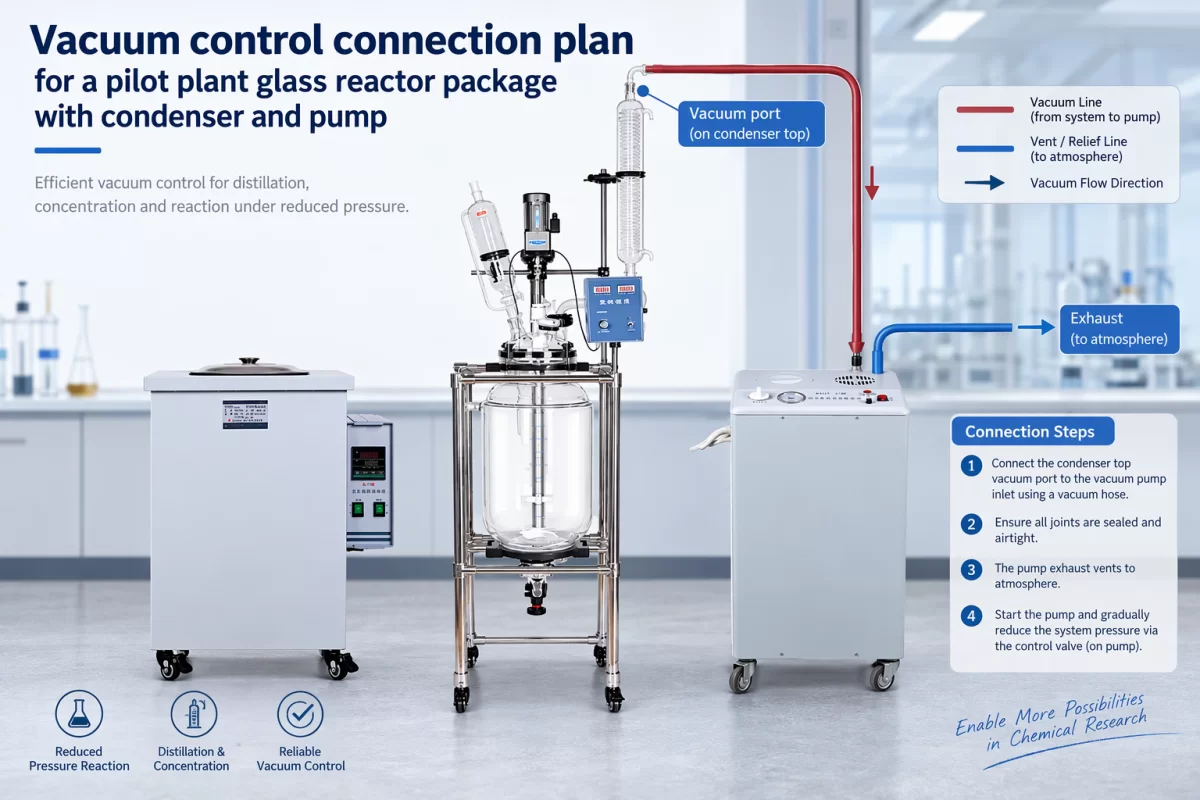
A vacuum pump provides evacuation; it does not by itself define stable process pressure. Specify the desired absolute pressure, pressure measurement location, vapor load, non-condensable gas load, and acceptable control behavior. Distinguish pump inlet performance from pressure measured at the reactor, since restrictions and vapor flow affect the operating system.
A typical planning sequence is reactor vapor outlet, condenser, collection or protective trapping arrangement, and vacuum pump. The exact sequence must suit the process. Include a vacuum-rated pressure sensor and a compatible regulating method, plus provisions for isolation and controlled return to atmospheric pressure.
For a circulating water vacuum pump, evaluate compatibility of process vapors with the circulating water, the effect of water temperature on attainable pressure, and management of contaminated water and exhaust. Do not assume this pump type is suitable for every solvent or target vacuum. Condenser and trap selection should limit carryover according to the actual vapor duty.
Is a larger vacuum pump always the better package choice?
I would select it against the required operating pressure and gas load. Increasing pump size alone cannot correct inadequate condensation, leakage, or restrictive pipework, and it does not replace pressure regulation. Evaluate the connected system under the same process conditions when comparing alternatives.
Turn the package into an itemized supply schedule
Request a configuration-specific schedule rather than relying on the word “package.” Each row should state the selected item, its process position, its connection requirements, and whether it is supplier-provided or customer-provided.
| Unit or assembly | Duty and process position | Interfaces and supply scope to define |
|---|---|---|
| Vessel and jacket | Contain the batch; transfer heat through the jacket | Model, ports, wetted materials, jacket connections, support frame |
| Agitator and seal | Mix inside the vessel; seal the rotating shaft | Impeller geometry, drive suitability for viscosity, shaft assembly, seal compatibility |
| Thermal circulator | Supply controlled fluid to the jacket | Duty at operating temperature, hoses, fluid, adapters, electrical supply |
| Condenser and receiver | Condense and collect or return vapor | Vapor connections, coolant circuit, receiver arrangement, supports |
| Vacuum and control assembly | Evacuate and regulate the vapor system | Pump, sensor, valves, trap, vacuum tubing, exhaust handling |
| Feed and discharge assemblies | Add material and remove product | Feed ports, bottom outlet, valve materials, solids passage, receiving vessel |
Check seal and wetted-part compatibility with the actual material. Select agitation for viscosity, solids, and mixing objectives rather than capacity alone. For slurries or crystallizing batches, assess the discharge path and blockage risk. Any hazardous-area drive or electrical arrangement needs configuration-specific documentation; it should not be inferred from a product family name.
Plan access for glass assembly, hose support, draining, cleaning, and maintenance. The glass reactor installation guide is a useful starting point for organizing installation work alongside the selected package’s instructions.
Reference price and comparable quotations
Our company’s reference price is US$1,699. This is a reactor reference price, not a quotation for a complete pilot package with a chiller, vacuum pump, controls, and installation accessories. The actual quotation depends on the selected configuration and inquiry results.
Compare quotations using the same working-batch profile, process temperature requirements, absolute-pressure target, vapor duty, and supply boundary. Identify thermal units, condenser cooling, vacuum controls, connection kits, commissioning, and utilities separately so that a lower initial equipment price does not conceal a different package scope.
Select the connected system, not just the vessel size
A Pilot plant glass reactor with chiller and vacuum pump should be chosen by matching the changing batch inventory to the vessel, separating jacket and condenser duties, and defining vacuum control across the complete vapor path. Model-specific vessel, seal, agitation, connection, and discharge details determine whether the proposed package fits the process.
Request a configuration and quotation: submit the material and solvent system, target throughput or working batch, initial charge and feed profile, viscosity or solids content, target process temperatures, absolute-pressure requirements, vapor-handling needs, available utilities, and desired supply scope. These details provide the basis for assessing a suitable pilot reactor package and its price.