Pharmaceutical laboratory equipment • Procurement guide
Vacuum Oven Pricing for Pharmaceutical Labs: Chamber Size and Pump Options
Evaluating the vacuum drying oven price for pharmaceutical lab equipment starts with two decisions: how much usable loading space the task needs, and which pump configuration can support its operating conditions. A larger chamber is not automatically a better purchase, and a pump’s ultimate pressure alone does not establish drying performance.
This guide focuses on DZF chamber selection and pump requirements for research, experimental work and individually assessed small-batch tasks. It compares equipment configuration rather than the service costs of complete installation or qualification packages.
A reference price is a budgeting point—not a chamber specification
A useful quotation must identify the DZF model, loading arrangement and pump scope. An oven-only offer and an oven supplied with a pump are different purchasing configurations, even when their product descriptions sound similar.
This is a company reference price, not a model-specific offer or a guaranteed pharmaceutical laboratory package price. The actual quotation depends on the selected configuration and inquiry result.
For a meaningful comparison, hold the sample task constant: the same material, wet batch mass, container arrangement, loading thickness, target temperature, operating pressure and endpoint. Then compare the chamber and pump options needed to meet that task. The broader guide to vacuum drying oven price factors provides additional purchasing context.
Do not calculate cost per batch from chamber liters alone. Neither liters nor shelf count establishes the permissible sample mass, drying time or number of acceptable batches per day.
Choose chamber dimensions before estimating sample capacity
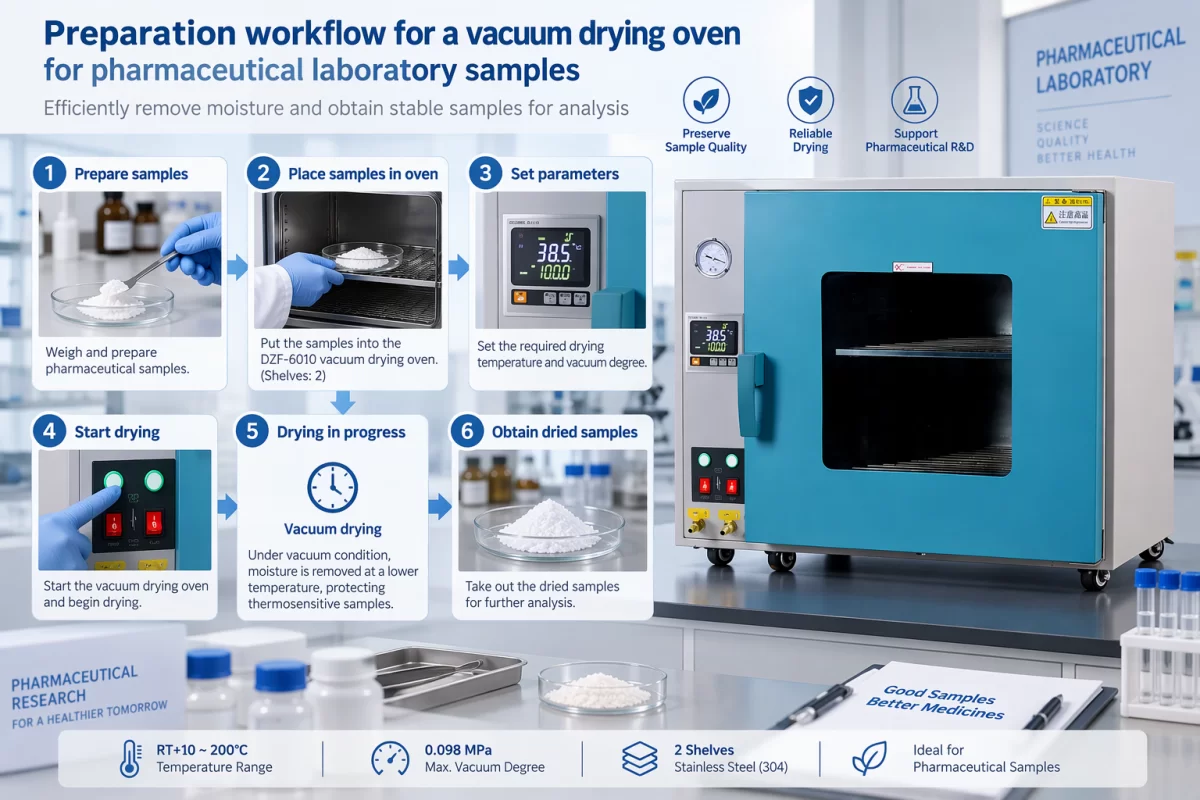
The DZF range offers different chamber footprints and shelf counts. The following selection data help screen container fit and loading arrangements; they are not rated sample-load capacities.
| Model | Chamber volume (L) | Internal W × D × H (mm) | Shelves (pcs) |
|---|---|---|---|
| DZF-6010 | 8 | 200 × 200 × 200 | 1 |
| DZF-6020 | 25 | 300 × 300 × 270 | 1 |
| DZF-6050 | 55 | 400 × 400 × 345 | 2 |
| DZF-6090 | 90 | 450 × 450 × 450 | 2 |
Internal dimensions describe chamber space. They do not specify usable tray dimensions, shelf spacing or allowable load per shelf.
Does a larger chamber guarantee a larger practical batch?
My answer is no. I would first compare usable tray area, container clearance and the acceptable material layer thickness. A tall chamber can accommodate taller vessels without providing a proportionate increase in exposed sample area. Actual loading also depends on shelf load limits and the drying behavior demonstrated in trials.
Consider a geometry-only example under identical container conditions. Assume a rigid vessel has a 250 × 250 mm footprint, and allow 20 mm clearance on each side. Its screening envelope is therefore 290 × 290 mm. That envelope exceeds the DZF-6010’s 200 × 200 mm chamber footprint but fits within the DZF-6020’s 300 × 300 mm footprint on paper. This calculation does not establish shelf fit, door access, vertical clearance or drying performance.
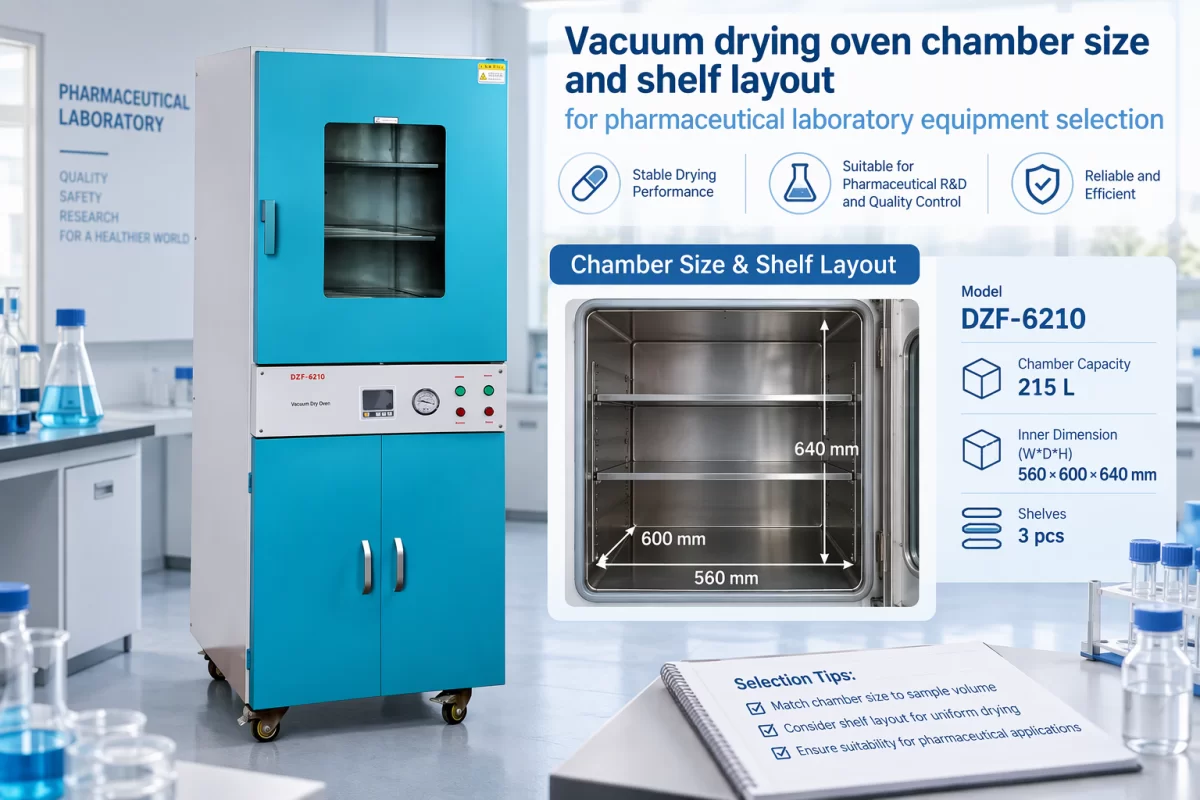
For a larger loading arrangement, the DZF-6210 has listed internal dimensions of 560 × 600 × 640 mm and three shelves. Explore vacuum drying ovens with pump options when that geometry is relevant. Its internal width and depth should still not be treated as usable tray dimensions.
Translate tray area into a task-specific load
Chamber volume, usable tray area and actual sample load are three separate quantities. Chamber volume describes space; usable tray area describes where containers or material can be placed; sample load depends on material properties and the chosen drying method.
For a hypothetical loading calculation, assume the selected containers provide a total usable area of 0.10 m², the wet material is spread uniformly to 0.005 m thickness, and its measured wet bulk density is 800 kg/m³. The estimated initial wet load is:
0.10 m² × 0.005 m × 800 kg/m³ = 0.40 kg.
This is a planning example, not a DZF capacity guarantee. If two configurations are compared using this method, keep density, thickness and usable area definitions identical. Increasing layer thickness may change the time needed to reach the endpoint, so doubling the thickness should not be assumed to double validated throughput.
Container construction also matters. A deep vial, a shallow dish and a covered vessel can present different heat-transfer and vapor-release conditions. Establish an endpoint appropriate to the task—such as a defined mass-change criterion or a suitable moisture assay—rather than using elapsed time alone. Moisture loss does not demonstrate organic solvent removal.
Match the pump to vapor load and operating pressure
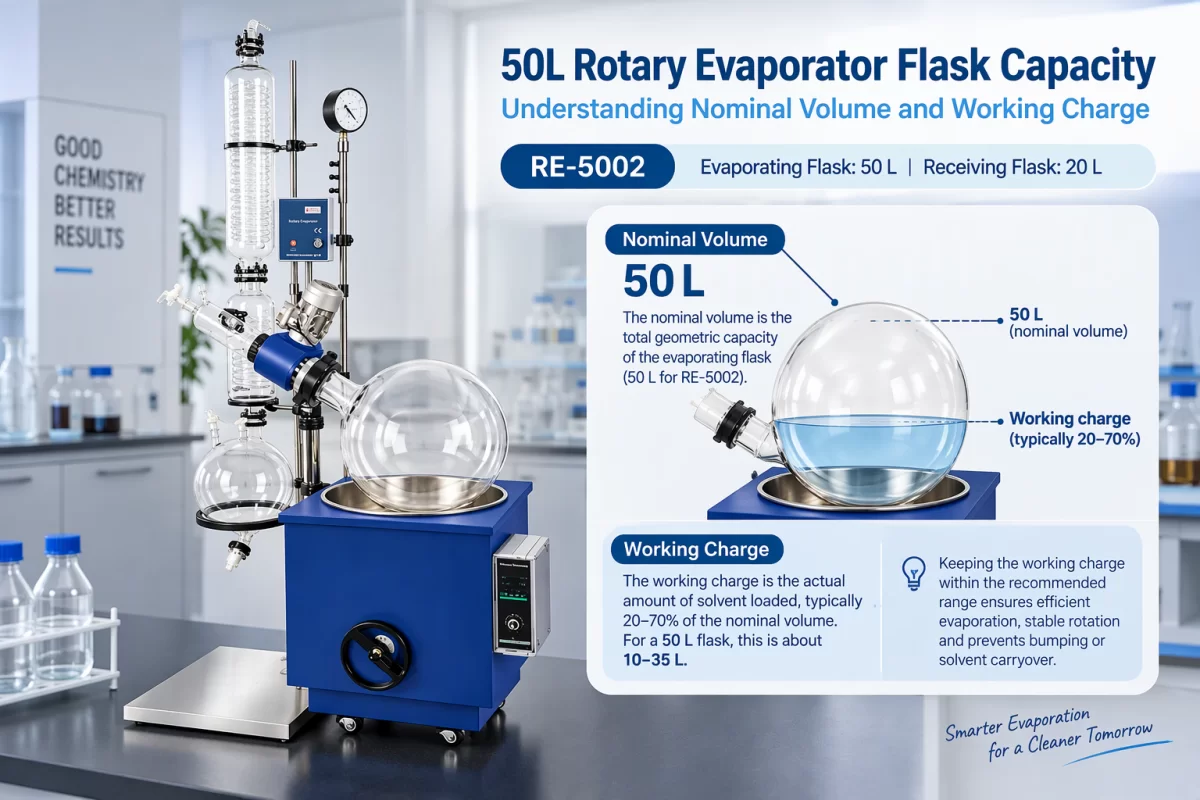
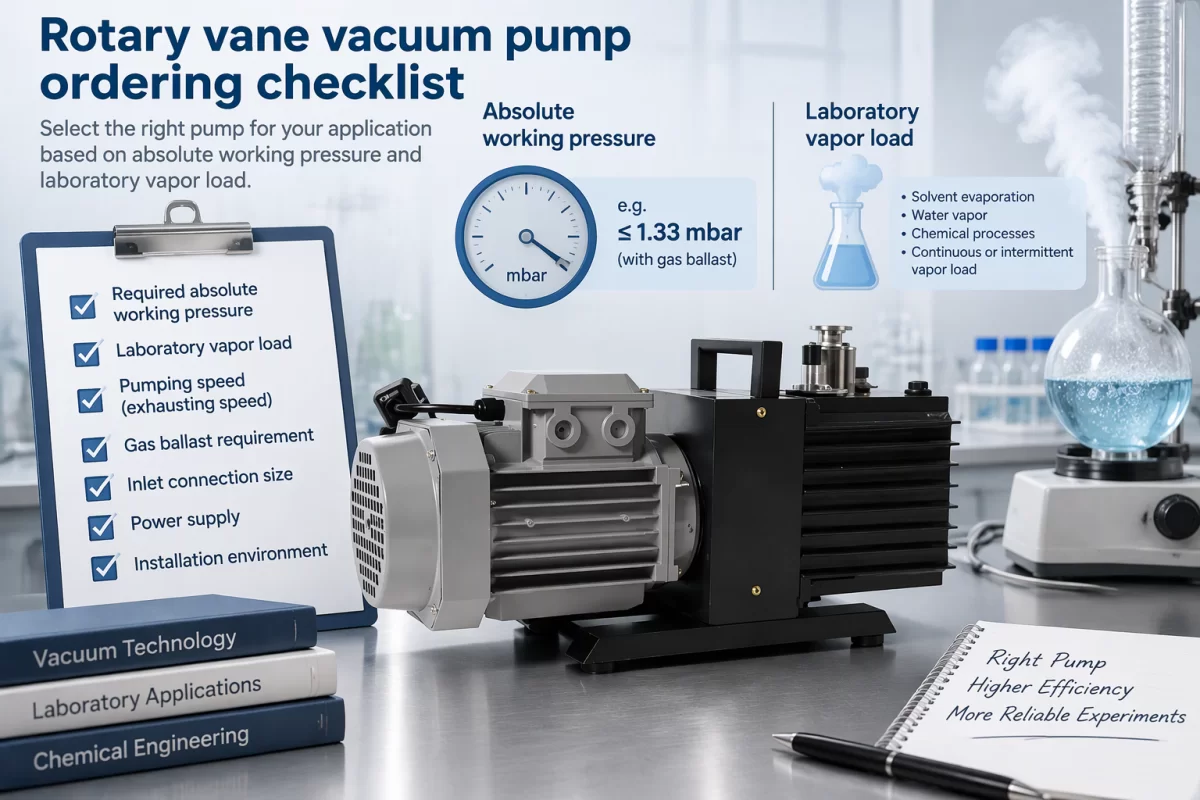
The price list includes a double-stage oil rotary vane pump listing and oven listings described as supplied with pumps. These are configuration possibilities, not evidence that every DZF model uses the same pump or that a particular pump is compatible with every pharmaceutical material.
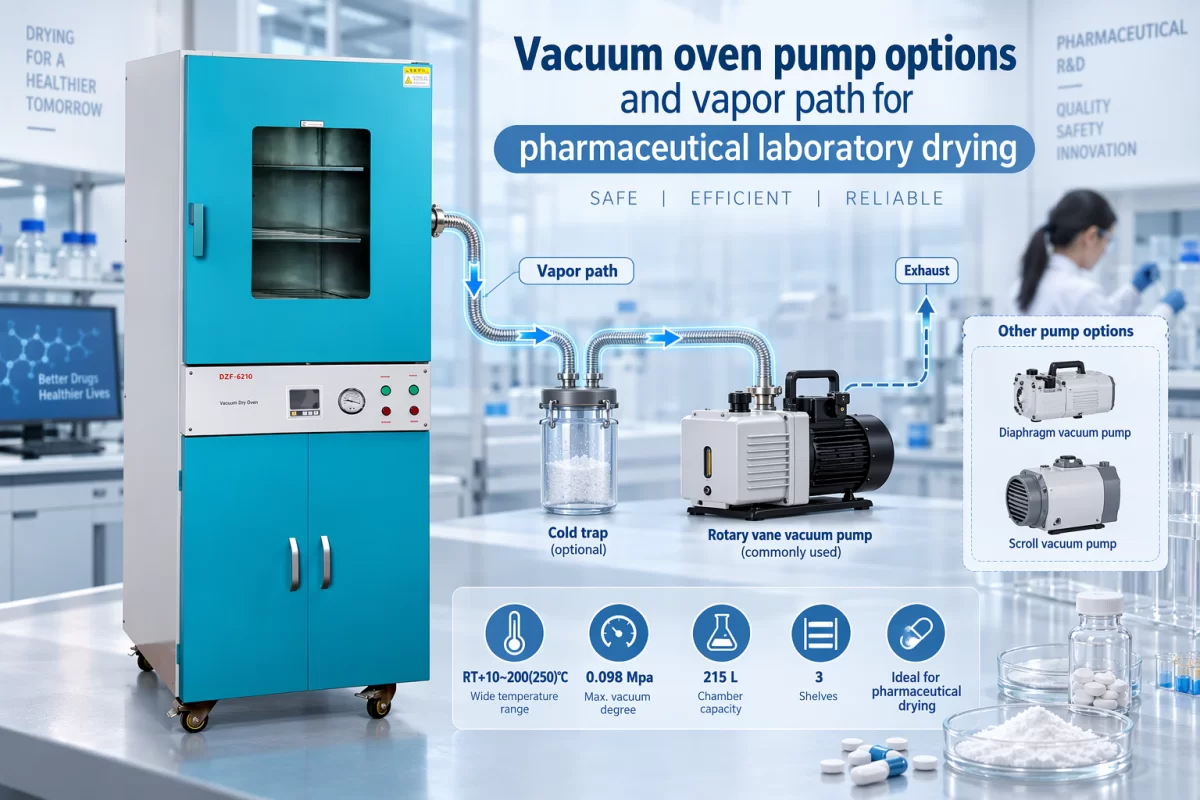
For pump selection, describe the expected water or solvent vapor, desired chamber pressure during drying, batch size and intended operating temperature. Compare pumping performance at that operating pressure, not only a pump’s ultimate-pressure specification. Connection bore, hose length, seals and restrictions can influence effective pumping at the chamber.
An oil rotary vane option warrants assessment of vapor compatibility, oil management, backflow protection and exhaust handling. The article on rotary vane vacuum pump advantages and disadvantages is relevant background, but does not establish a model-specific pump recommendation.
Is an empty-chamber ultimate pressure the pressure achieved during drying?
I treat them as different measurements. An empty-chamber result reflects a particular test setup, while a wet load continuously releases vapor. For selection, I would specify absolute pressure at the chamber and the relevant loaded conditions, including temperature, vapor load, pump and connecting line. An ordinary vacuum drying oven should not be described as high-vacuum equipment without supporting evidence.
- Vacuum interface: specify the required port connection, line bore, hose material and sealing arrangement in the quotation.
- Pump scope: identify the pump model and its relevant performance data, rather than accepting “with pump” as a complete specification.
- Vapor management: assess whether the task needs a compatible trap, condenser or exhaust treatment; these should not be assumed included.
- Hazard assessment: evaluate flammable, corrosive or otherwise hazardous vapors before choosing the oven, pump and associated components.
Keep controller settings separate from material temperature
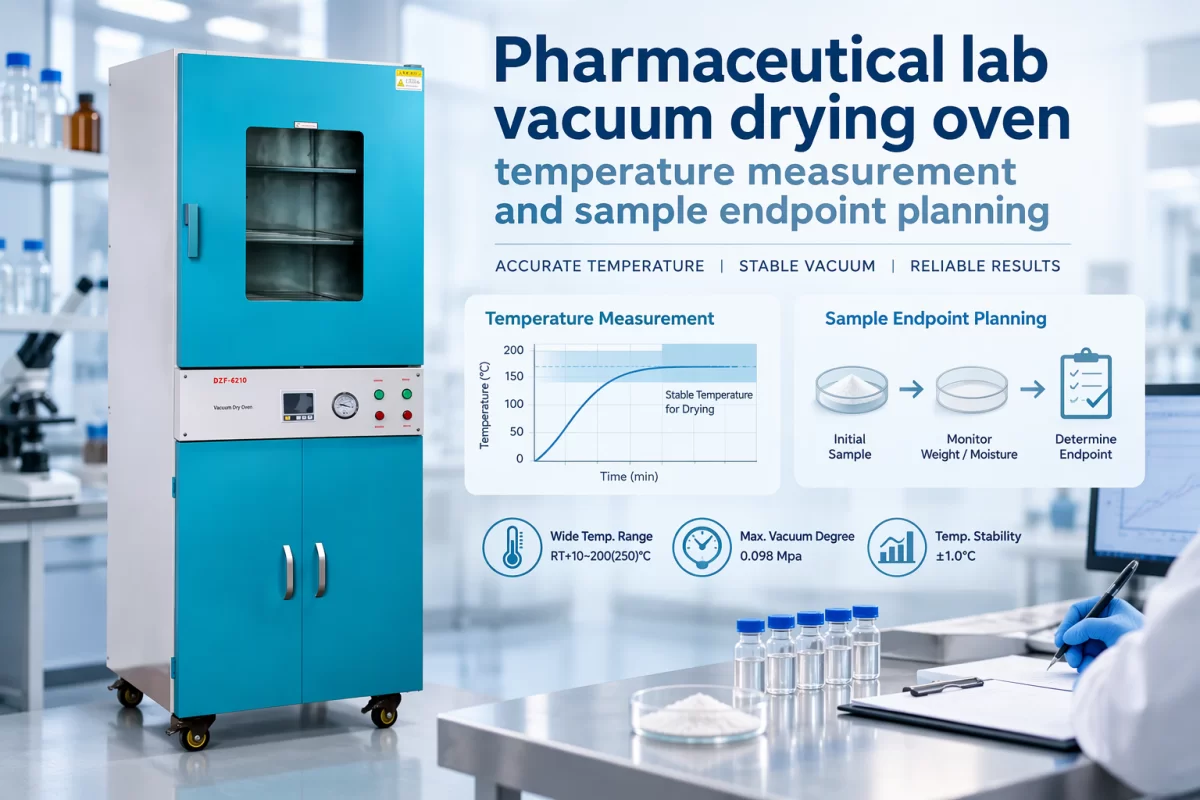
A controller setpoint is the requested temperature. Chamber temperature is measured at a particular sensor location. Material temperature depends on heat transfer, container contact, loading thickness and evaporation. These values can differ during warm-up and active drying.
The DZF specifications list temperature stability of ±1.0°C. This stability figure should not be interpreted as proof of uniform temperature throughout a loaded chamber, sample-temperature accuracy or a demonstrated drying endpoint. Select the operating temperature around the material’s requirements and assess the measurement arrangement for the intended experiment.
Can the controller display alone establish that a sample has reached its drying temperature?
I would not use the display as the sole evidence. For temperature-sensitive work, I would assess representative material-temperature measurement under the intended loading and pressure conditions. Any probe arrangement should be suitable for the vacuum setup and should not introduce unacceptable leakage or contamination.
The listed liner material is 304 stainless steel. This identifies the chamber liner, not every sample-contact or vapor-contact component. Assess trays, containers, gaskets, tubing and pump materials separately for chemical compatibility and cleaning needs.
An optional explosion-proof configuration is listed, but that wording alone does not establish suitability for a specific solvent atmosphere or a certified installation. Laboratory drying capability also does not establish sterile processing, commercial drug production suitability or regulatory qualification.
Request a quotation built around chamber fit and pump duty
The most useful comparison of vacuum drying oven pricing for pharmaceutical laboratories starts with the smallest chamber that accommodates the required containers and usable loading area, then matches the pump and vapor path to the intended operating conditions. A larger chamber is justified by the loading arrangement—not by liters alone—and a lower ultimate pressure is not a substitute for loaded drying performance.
To evaluate a DZF Drying Oven configuration and obtain a quotation, submit:
- The material and expected water or solvent content.
- The target processing quantity or working batch mass.
- Container dimensions, planned layer thickness and required shelf arrangement.
- Target operating temperature, absolute drying pressure and endpoint criterion.
- Pump, connection, vapor-handling and material-compatibility requirements.
With those details, the chamber and pump options can be assessed for the proposed research, experimental or evaluated small-batch task, and the quotation can reflect a clearly defined configuration.