Drying Oven · Pharmaceutical Laboratory Selection
Vacuum Drying Ovens for Pharmaceutical Labs: From Research to Small Batches
Selecting a vacuum drying oven for pharmaceutical lab production starts with a practical distinction: drying a research sample is not the same task as repeatedly processing a small working batch. Chamber volume matters, but usable tray area, material temperature, operating pressure and batch records determine whether a proposed loading arrangement is suitable.
This guide focuses on pharmaceutical research, drying trials and evaluated small-batch tasks. It does not treat a laboratory drying oven as evidence of suitability for commercial drug manufacturing, sterile processing or regulatory qualification.
Research samples and small batches need different evidence
In research, the immediate objective may be to compare drying behavior across a few samples, preserve a temperature-sensitive material or establish a preliminary moisture endpoint. A compact chamber can be useful when the load is small and the experimental arrangement is easy to reproduce.
An evaluated small-batch task adds another question: can the same acceptable result be obtained across all containers, shelf positions and repeated runs? A larger load changes vapor generation, heating response and the distance moisture must travel through the material. Increasing chamber size alone does not establish a transferable drying process.
Does a larger chamber automatically support a larger pharmaceutical working batch?
My recommendation is to compare the actual loading layout first. Extra chamber volume may accommodate taller containers without increasing exposed drying area. A thicker material bed can also extend drying time, so batch mass must be evaluated together with container geometry and layer thickness.
Compare DZF chamber capacity, shelf count and usable loading area
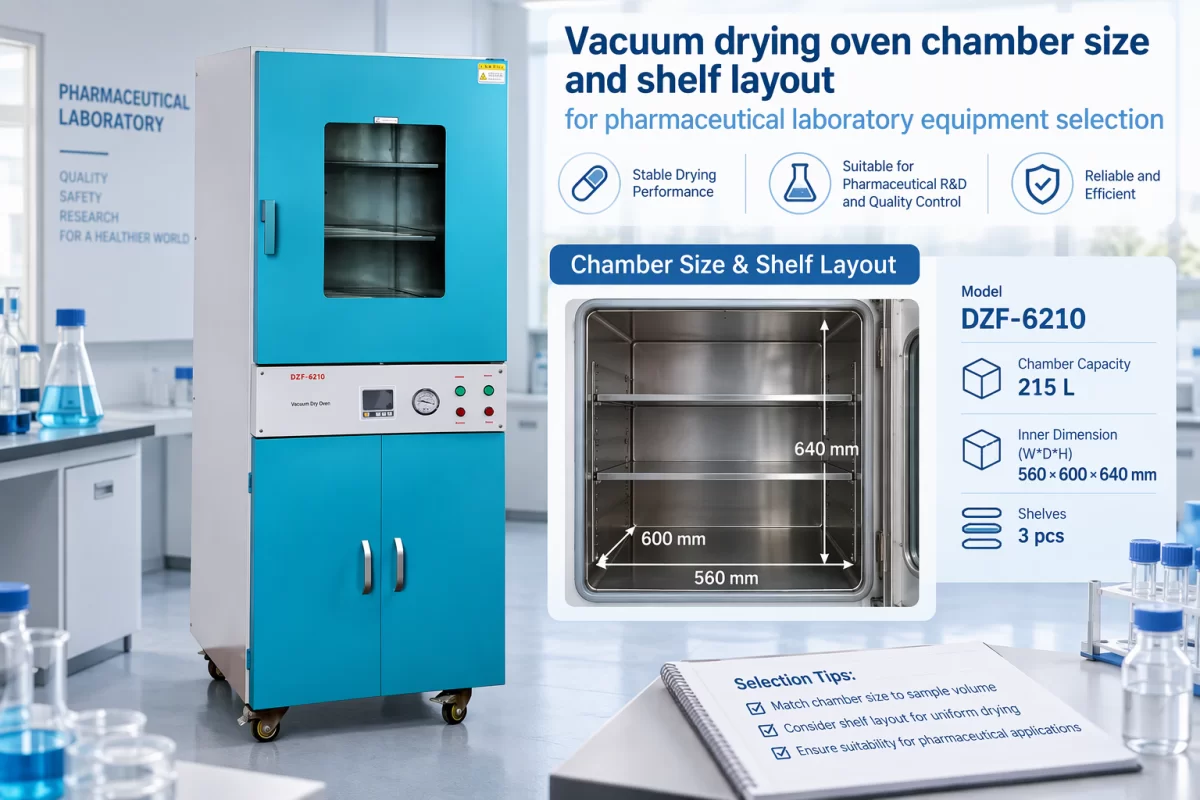
For equipment selection, the following DZF models provide a useful progression from compact research chambers to larger laboratory arrangements. The DZF-6090 product page for laboratory vacuum drying ovens is a relevant starting point when evaluating a 90 L chamber against the intended containers and working load.
| Model | Chamber capacity (L) | Inner W × D × H (mm) | Shelves (pieces) | Input power (W) |
|---|---|---|---|---|
| DZF-6010 | 8 | 200 × 200 × 200 | 1 | 400 |
| DZF-6020 | 25 | 300 × 300 × 270 | 1 | 700 |
| DZF-6050 | 55 | 400 × 400 × 345 | 2 | 1400 |
| DZF-6090 | 90 | 450 × 450 × 450 | 2 | 2000 |
Chamber dimensions describe the internal enclosure, not the usable dimensions of each tray. Input power is an electrical rating, not a drying-throughput or temperature-uniformity guarantee.
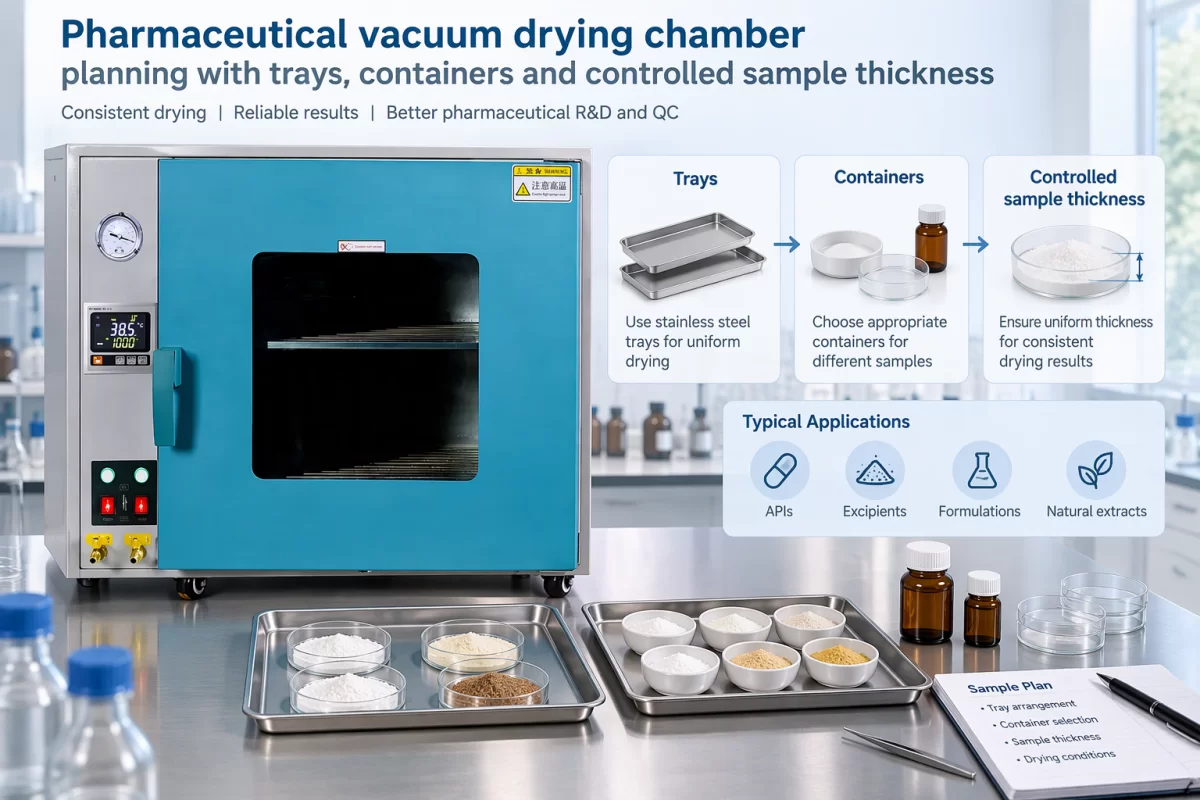
The DZF-6010 and DZF-6020 offer single-shelf arrangements for compact loads. The DZF-6050 and DZF-6090 provide two shelves, allowing more container positions to be considered. However, shelf count is not a tray-area specification: container footprints, edge clearance, shelf spacing and access for loading still need to be included in the layout.
Loading calculation: area is more useful than liters alone
Assume a proposed arrangement has two trays, each with an assessed usable sample area of 0.08 m². Assume a uniform wet-material layer of 5 mm and a wet bulk density of 800 kg/m³. These are hypothetical process assumptions, not DZF tray dimensions or equipment load ratings.
Wet load = 2 × 0.08 m² × 0.005 m × 800 kg/m³ = 0.64 kg
Under the same area and density assumptions, increasing the layer to 10 mm gives 1.28 kg. That doubles the calculated wet load, but it does not guarantee the same drying time or endpoint uniformity. Any comparison between ovens should retain the same material, layer thickness, container type and endpoint method.
Temperature stability is not loaded temperature uniformity
The DZF-6010, DZF-6020, DZF-6050 and DZF-6090 list temperature stability of ±1.0 °C. This specification should not be substituted for a spatial uniformity result across a loaded chamber or for material-temperature accuracy. A meaningful comparison needs a defined setpoint, pressure, sensor arrangement, loading pattern and stabilization period.
Keep three measurements separate: set temperature is the controller target; chamber temperature is the reading at a measurement location; and material temperature is the temperature within or at the relevant part of the sample. During evaporation, the material can respond differently from the chamber sensor.
For research, a repeatable measurement position can help compare trials. For small batches, assess representative positions on each occupied shelf, including locations expected to heat more slowly. Record the measuring instruments and calibration status, and compare results only under equivalent loading and operating conditions.
Can the controller reading establish that every sample has reached the drying temperature?
I would use the controller reading as one part of the record, not as the complete answer. Representative material-temperature measurements and a defined endpoint test are needed to assess the actual load, particularly when container size or layer thickness changes.
Evaluate working pressure, the vacuum connection and pump package
Reduced pressure can support evaporation at lower temperatures, but pressure terminology must remain precise. An empty-chamber ultimate pressure is not the same as the pressure maintained while a wet load generates vapor. Neither chamber size nor the label “vacuum drying oven” establishes high-vacuum performance.
The overview of vacuum drying principles provides useful background. For purchasing decisions, define the required operating pressure as an absolute pressure with clear units, then assess it at the intended temperature and vapor load. Empty-chamber and loaded tests should identify the pump, connections, test duration and measurement location.
- Vacuum interface: specify the connection size and type, hose compatibility, isolation arrangement and leak-tight connection requirements.
- Pump package: select for vapor composition, expected vapor generation, operating pressure and required evacuation time; do not assume a pump is included.
- Vapor handling: evaluate whether a trap, condenser, suitable exhaust arrangement or other protective measures are needed for the material.
- Contact materials: the four compared models list a 304 stainless steel liner. Separately assess trays, sample containers, seals and other exposed parts for compatibility and cleaning.
Does successful water removal demonstrate suitability for organic-solvent drying?
I would treat those as separate applications. Organic solvents introduce different compatibility, flammability, exhaust and endpoint requirements. Water-drying results do not demonstrate solvent-removal performance, production validation or suitability for a hazardous atmosphere.
Build batch records around the material, not just the timer
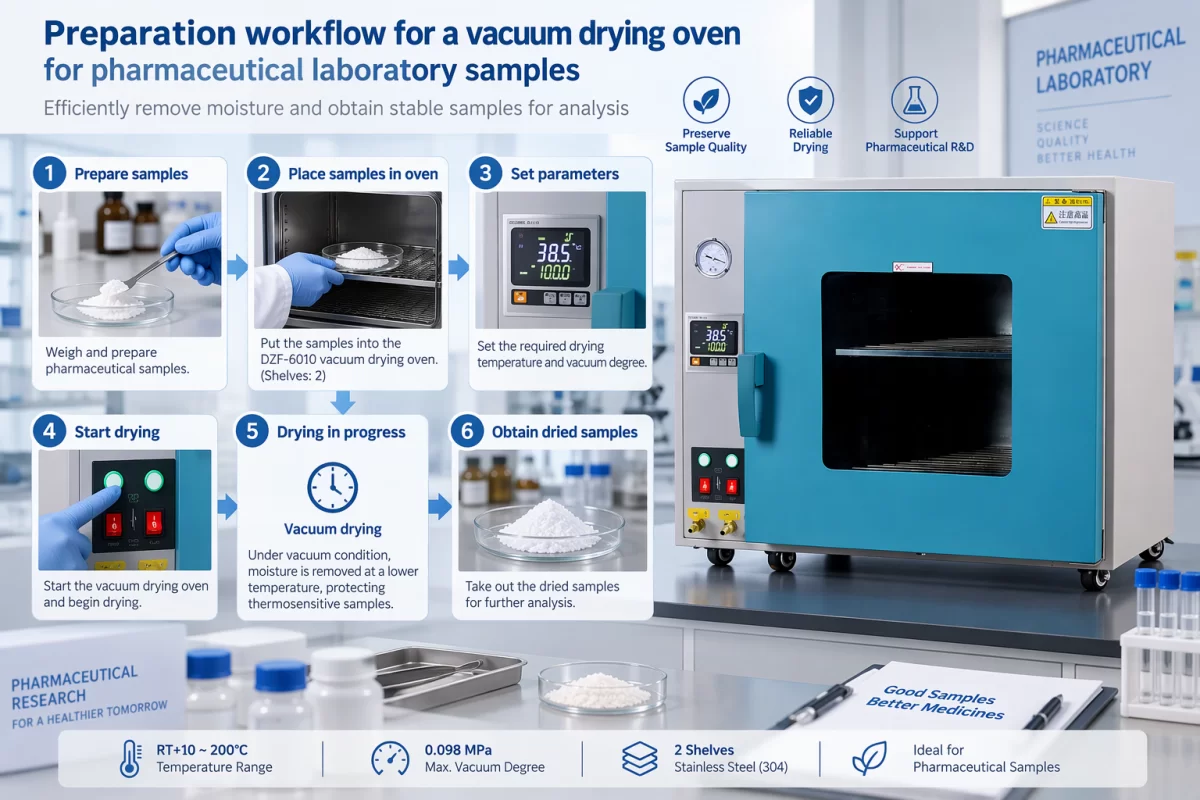
A research notebook may capture enough information to identify a promising drying condition. An evaluated small-batch procedure needs a more structured record so that loading differences and process deviations remain visible. The listed timer range for the four compared models is 1–9999 minutes, but a timer setting is not proof of dryness or an automatic batch-record system.
- Identify the load: record material identity, lot, initial mass, container type, layer thickness and shelf positions.
- Describe the process: record temperature settings, pressure units and reference basis, pump configuration, start time and operating observations.
- Capture measurements: retain chamber and representative material temperatures, pressure readings and any interruptions.
- Define completion: use a task-appropriate endpoint, such as an established moisture method or a defined constant-mass procedure. Residual solvent assessment requires an appropriate solvent-specific method.
- Record disposition: document final mass, sampling locations, results, deviations and the decision for the experimental batch.
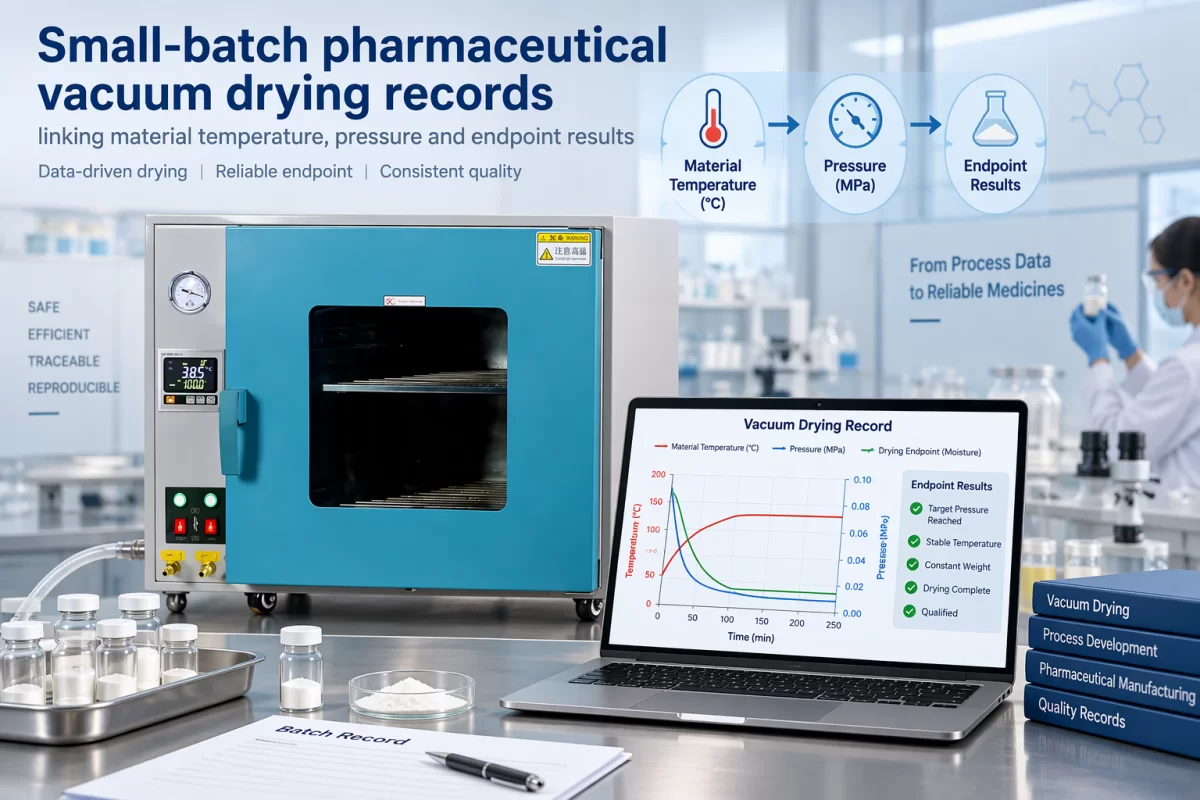
These records support laboratory evaluation and repeatability. They do not, by themselves, establish compliance qualifications, sterile capability or a validated commercial pharmaceutical manufacturing process.
Choose the oven around a reproducible working batch
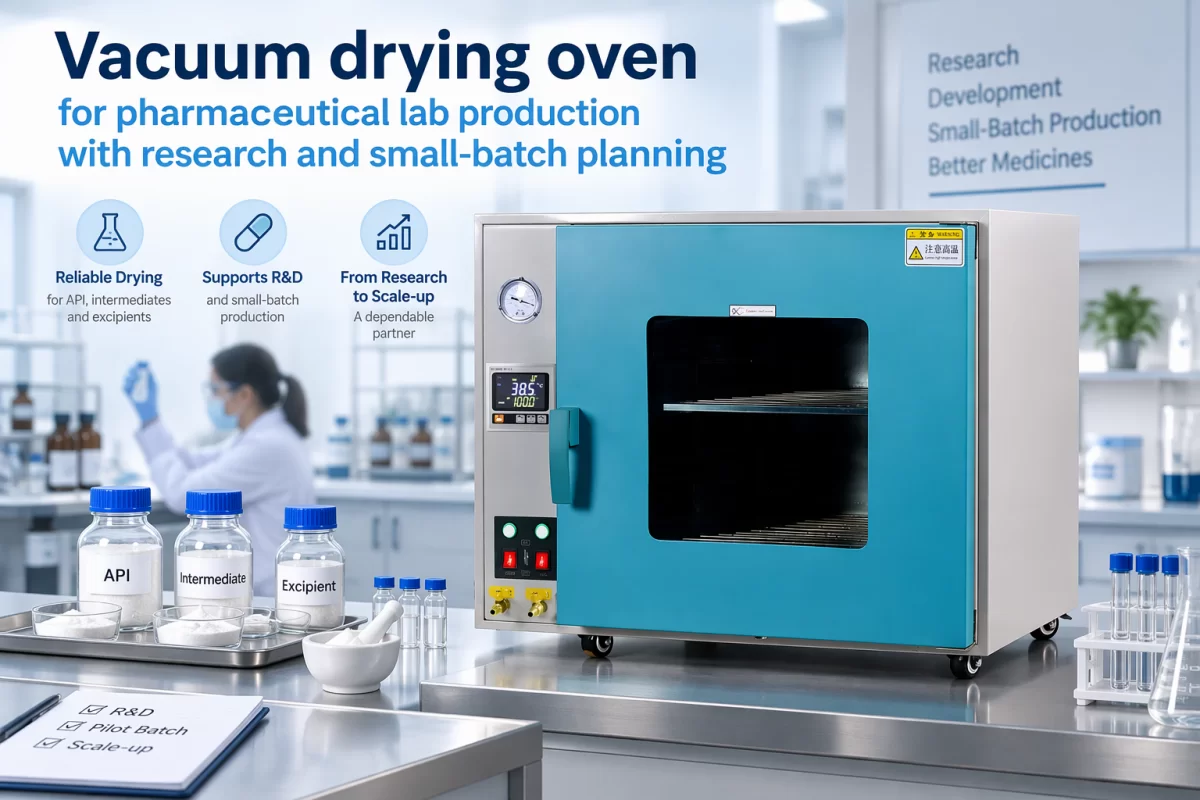
For a vacuum drying oven for pharmaceutical lab production, the purchasing decision should begin with the intended research or evaluated small-batch task. Consider the DZF-6010 or DZF-6020 when a compact single-shelf layout fits the samples. Compare the DZF-6050 and DZF-6090 when two-shelf loading is useful, then evaluate usable area, loaded temperature behavior and working pressure under the same process conditions.
Our company’s reference price is US$610. This is a general reference price, not a model-specific package quotation. The actual quotation depends on the selected configuration and inquiry results.
Request a task-specific equipment assessment and quotation
Submit the material and its moisture or solvent content, target throughput or working batch mass, container dimensions, intended layer thickness, temperature limits, required absolute operating pressure and endpoint method. Include electrical supply, vacuum-interface, pump, vapor-handling and material-compatibility requirements so the proposed drying oven package can be evaluated against the actual laboratory task.