Freeze Dryer · Laboratory purchasing guide
Laboratory Freeze Drying Equipment Prices: A Configuration Breakdown
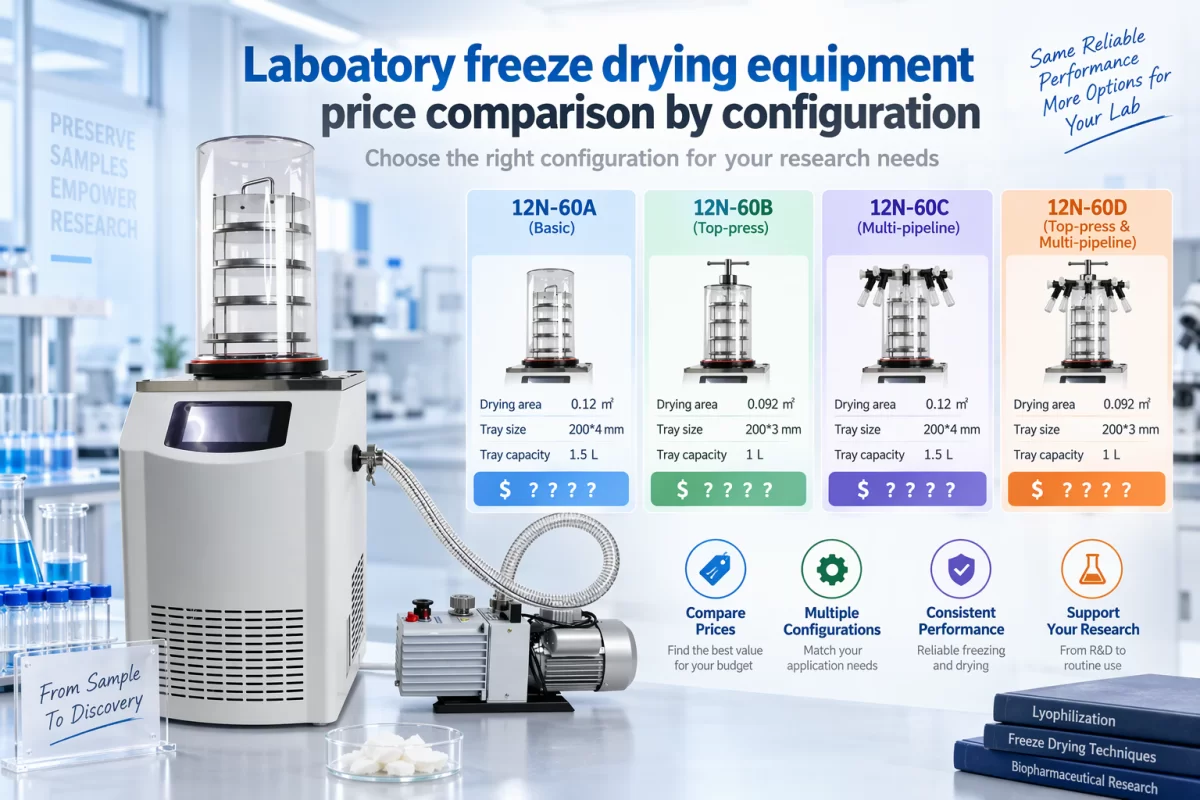
What is the price of lab freeze drying equipment? A useful answer starts with the quotation scope, not simply the lowest advertised figure. Cold-trap specifications, sample-loading hardware, the vacuum pump, measurement functions, and accessories determine whether two offers cover the same working setup.
A company reference price—not a complete configuration quote
This is a reference drawn from our company’s listed equipment prices. It is not a model-specific quotation for the FD-H series or a confirmed price for a complete laboratory installation. The actual quotation depends on configuration and the inquiry result.
For purchasing purposes, ask for a defined equipment package: dryer body, sample-loading assembly, cold trap, vacuum pump, connecting hardware, controls, and any separately priced options. Shipping, installation, and other commercial charges should be identified separately so that the equipment subtotal remains comparable.
A broader discussion of freeze dryer cost factors can help organize the budget. For this configuration breakdown, however, the central decision is whether each quotation includes the components required for the proposed material and workflow.
Does a listed freeze dryer price include the vacuum pump?
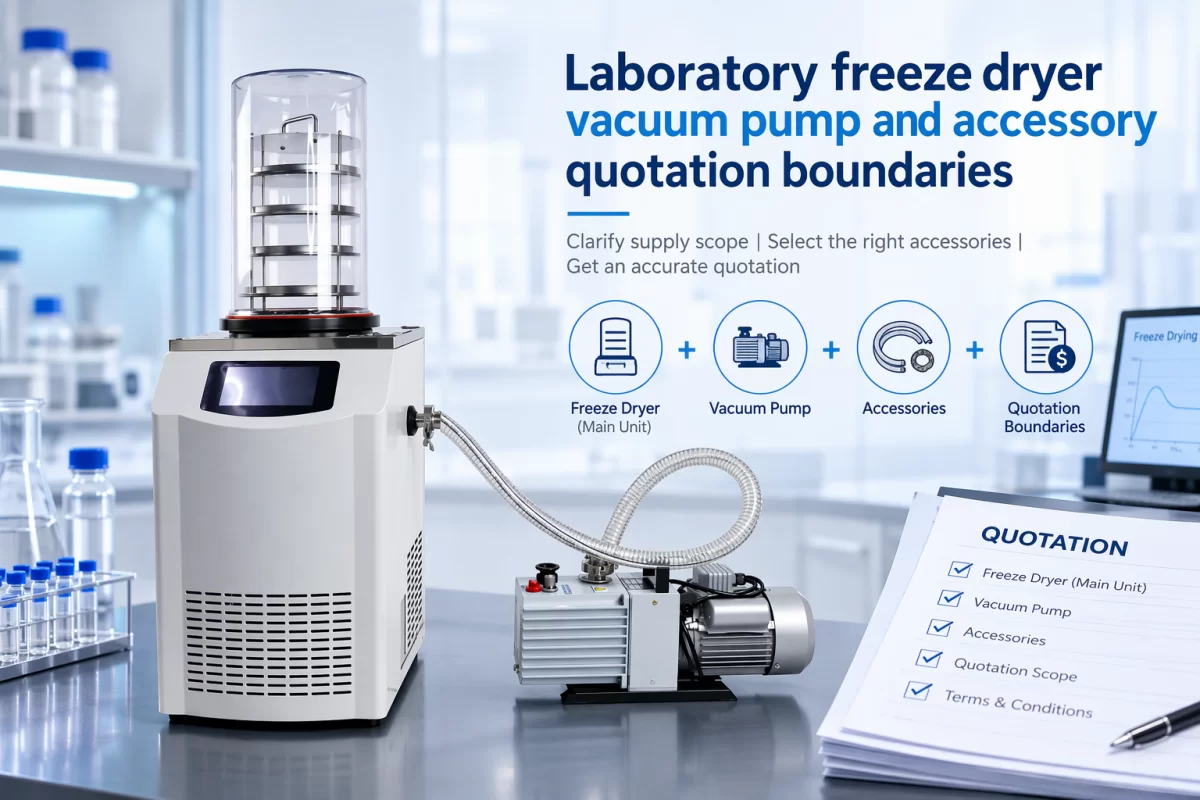
My recommendation is to treat pump inclusion as a separate quotation item unless the offer explicitly includes it. The pump, connection fittings, exhaust provisions, and initial consumables should be listed together. A headline equipment price alone does not establish that a ready-to-operate vacuum package is included.
Cold traps: separate temperature, volume, and water capture
The cold trap deserves its own line in a laboratory freeze dryer quotation. Its temperature specification, internal volume, and water-capture capability describe different characteristics; none should substitute for another.
- Cold-trap volume describes physical space, normally expressed in liters. It does not establish the mass of water that can be captured during a batch.
- Water-capture capacity describes an ice or moisture-handling quantity under stated conditions. A batch capacity and a rate per unit time are different purchasing criteria.
- Sample loading describes the material placed on trays or in containers. It is not identical to the water removed from that material.
- Working batch size depends on the material, container arrangement, moisture content, and selected operating conditions.
A minimum temperature measured without a load is not a promise that the same temperature will be maintained throughout drying. Compare temperature specifications under equivalent conditions and ask how the proposed cold trap relates to the expected vapor load. Likewise, the preparation workflow should state whether samples are prefrozen externally or frozen within the selected system; integrated prefreezing should not be assumed from the equipment name.
When reviewing laboratory freeze dryers, assess each model on its own configuration. The FD-H tray dimensions below should not be applied to another model merely because both products are called freeze dryers.
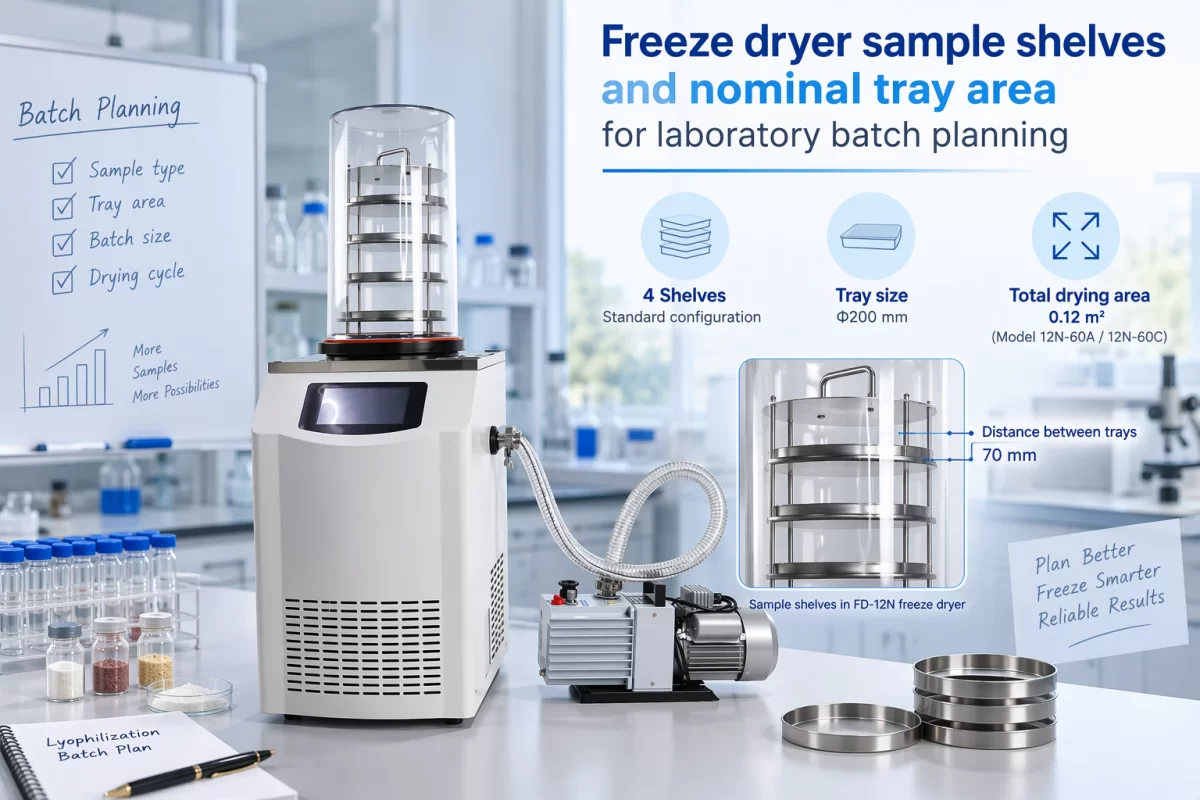
Sample shelves: compare usable loading geometry
The FD-H specifications provide a practical basis for comparing tray-loading geometry. Shelf count and tray dimensions help assess container fit and available placement area. They do not, by themselves, establish a suitable wet-material batch mass or drying time.
| Model | Shelves (count) | Tray W × L × H (mm) | Nominal total tray area (m²) |
|---|---|---|---|
| FD-05H | 4 | 220 × 550 × 20 | 0.484 |
| FD-08H | 5 | 265 × 612 × 20 | 0.811 |
| FD-10H | 6 | 265 × 612 × 20 | 0.973 |
| FD-15H | 7 | 270 × 800 × 20 | 1.512 |
Calculated area assumes one listed tray per shelf and uses nominal width × length × shelf count. Values are rounded to three decimal places and do not deduct edges, spacing, or container footprints.
For example, the FD-05H calculation is 4 × 0.220 m × 0.550 m = 0.484 m². Under the same geometric calculation, the FD-10H provides 6 × 0.265 m × 0.612 m = 0.97308 m². This is a comparison of nominal placement area only—not a guaranteed doubling of batch throughput.
Does a larger shelf area guarantee a larger successful batch?
I would use shelf area as a loading-layout check, not as a production guarantee. Material thickness, container spacing, heat transfer, vapor removal, and cold-trap performance also matter. The proposed batch should therefore be assessed using the actual material and loading arrangement.
Specify whether the work uses open trays, vials, or manifold-connected containers. If vial stoppering or manifold hardware is required, request a configuration designed for that loading form rather than assuming a tray-based assembly includes those functions.
Vacuum pumps, measurement, and controls: define the operating package
A vacuum pump quotation should identify the pump model, pumping speed with units, ultimate-pressure test conditions, and supplied connections. Ultimate vacuum is a limiting specification under defined conditions; it is not the pressure necessarily achieved while moisture is leaving a loaded sample.
For a meaningful comparison, use the same material, loading arrangement, intended pressure range, and connection requirements. Pump selection should also consider compatibility with the expected vapors, maintenance needs, and laboratory exhaust arrangements. Do not infer a pump specification from the dryer’s model number.
The FD-H series specification lists a 7-inch touch-screen display. A display specification alone does not establish sample-temperature measurement, the number of probe channels, recipe storage, data export, or recording frequency. Those functions should be described individually when they are needed for experimental traceability.
| Quotation block | Define in the offer | Keep separate |
|---|---|---|
| Cold trap | Temperature conditions, volume, water-capture capacity, and defrost arrangement | Unloaded minimum temperature versus loaded operation |
| Sample assembly | Loading form, shelf count, tray dimensions, and included containers | Nominal area versus material-specific working batch |
| Vacuum package | Pump model, performance conditions, fittings, and consumables | Ultimate pressure versus process pressure |
| Measurement and records | Sensor locations, channels, logging, storage, and export functions | Touch-screen operation versus documented data capability |
| Options and services | Each accessory, quantity, installation scope, and separate charge | Required equipment versus optional convenience features |
When is a higher-priced configuration justified?
My view is that the additional cost is justified when it meets a defined need: the correct sample-loading format, suitable vapor handling, required temperature measurements, or usable experimental records. A feature count is less useful than a clear connection between each extra item and the laboratory’s workflow.
Accessories: keep necessary items outside vague bundle descriptions
Request an itemized accessory list rather than a general “complete set” description. Depending on the selected system, the inquiry may need to address extra trays, compatible sample containers, manifold fittings, temperature probes, vacuum connections, pump consumables, or external prefreezing equipment. These are requirements to evaluate, not a statement that every item is available or included with every model.
Use freeze dryer accessories and solutions as a starting point for identifying relevant options. Then separate essential components from future expansion items so the initial equipment comparison uses the same scope.
For matched quotations, compare the dryer package subtotal first, followed by required options and delivery or service charges. Do not add a separate pump charge to one offer while leaving an included pump hidden in another; that would compare different configurations.
What is the price of lab freeze drying equipment? Match the configuration first
Our company’s US$1,600 reference price provides an initial budget marker, but the purchasing decision should rest on a matched configuration. Start with sample-loading form and prefreezing workflow, then assess cold-trap suitability, the vacuum package, measurement and recording needs, and required accessories.
No configuration comparison establishes a universal drying cycle, activity-retention rate, or final product quality. Research equipment should also not be treated as equivalent to a validated sterile commercial production system.
Request a configuration-based quotation
Submit the material, moisture or solvent information, target processing quantity or working batch, sample containers, prefreezing method, intended operating conditions, and required controls or accessories. These details support a more useful equipment assessment and an itemized quotation based on the proposed application.