Laboratory equipment · Procurement guide
Specifying a Rotary Evaporator and Chiller Package with One Supplier
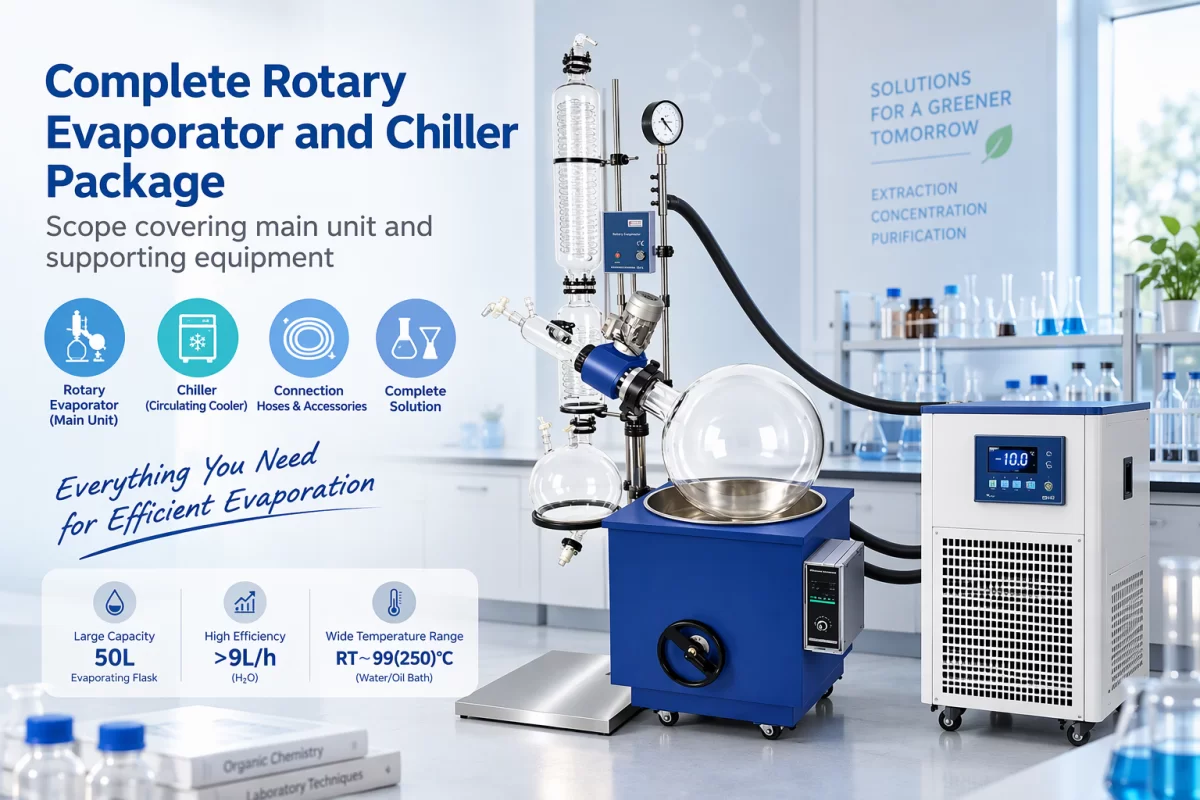
Who supplies complete rotary evaporator and chiller packages? ZZKEDA’s product offerings include a rotary evaporator bundle described as including an evaporator, chiller, and vacuum pump. For procurement, however, a bundle description is only the starting point: the quotation must identify the selected equipment, connection hardware, control functions, and responsibility for making the units work together.
Define “complete package” before comparing suppliers
Buying from one supplier can simplify coordination, but it does not automatically mean that every accessory or service is included. A rotary evaporator quotation may cover the main machine and specified glassware without an external cooling source. Likewise, a package containing a chiller and vacuum pump may still exclude a cold trap, vacuum controller, coolant, installation labor, or site commissioning.
The practical purchasing test is whether the supplier accepts a clearly documented integration scope. Request a bill of materials with model numbers, quantities, included accessories, exclusions, and a named party responsible for each interface. Keep equipment supply separate from installation and performance acceptance.
Purchasing rule: Do not treat the chiller as included in the main evaporator price unless it appears as an included, identifiable item in the quotation.
Does a “rotary evaporator package” necessarily include a cold trap and automatic vacuum control?
I would not assume either is included. A pump produces reduced pressure; a controller regulates it, and a cold trap provides an additional vapor-capture stage. These are different functions and should appear separately in the supply schedule when required.
Select the evaporator around the working batch—not just flask size
Evaporating-flask capacity is a useful initial selection criterion, but nominal flask volume is neither the recommended liquid charge nor an hourly solvent-recovery rate. Allowance for vapor space, foaming, viscosity, rotation, and bumping affects the working charge. Receiving-flask volume also matters because collection and draining procedures can interrupt operation.
| Model | Evaporating flask (L) | Receiving flask (L) |
|---|---|---|
| RE-201D | 2 | 1 |
| RE-301 | 3 | 2 |
| RE-501 | 5 | 3 |
| R1005 | 5 | 3 |
| R1010 | 10 | 5 |
| R1020 | 20 | 10 |
| R1050 | 50 | 20 |
The capacities above describe the named flasks only; they do not establish permissible fill volumes or process throughput.
For larger batches, review the 20L and 50L rotary evaporator configurations alongside the actual process requirements. The R1020 has a specified bath size of Φ450 × 260 mm and a lift stroke of 0–190 mm; the R1050 has a bath size of Φ550 × 320 mm and a lift stroke of 0–180 mm. These dimensions inform installation and flask handling, not cooling capacity or recovery speed.
The selected model’s condenser arrangement, rotation mechanism, lifting method, heating bath, seals, and vacuum-control arrangement should be listed in the technical offer. Assess rotation against film formation and material behavior, lifting against safe flask removal and bath clearance, and heating against the solvent and product temperature limits. Specify whether vacuum adjustment is manual or controlled automatically rather than inferring it from the presence of a pump.
When processing an extraction liquid, the rotary evaporator belongs at the solvent-recovery or concentration stage. This use does not establish direct extraction capability, selective purification of target compounds, or pharmaceutical production-grade suitability.
Match the external chiller to actual vapor duty
Select the cooling source after defining the solvent composition, intended operating pressure, bath temperature, target batch, and batch or feeding method. A larger flask does not by itself identify the required chiller. Continuous or intermittent feeding can change peak vapor load, while warm incoming liquid and changing solvent composition can alter the cooling demand during a run.
In evaluating laboratory cooling chillers, request cooling capacity at the proposed coolant setpoint and ambient conditions, together with circulating flow, available pump pressure, coolant compatibility, and connection details. Minimum attainable temperature alone is not a sufficient sizing basis.
Can a chiller be selected from evaporating-flask capacity alone?
I would size it from the expected condensation duty and operating conditions, then check the condenser and circulation loop. The same flask can produce substantially different vapor loads with different solvents, heating inputs, pressures, and feeding schedules.
A transparent cooling-duty example
Assume, solely for a preliminary calculation, a solvent vapor flow of 2 kg/h and an assumed latent heat of 800 kJ/kg. The latent condensation duty is:
Q = 2 kg/h × 800 kJ/kg ÷ 3,600 s/h ≈ 0.44 kW.
This example covers latent heat only. It excludes vapor cooling, condensate cooling, heat entering through hoses, and any sizing allowance. It is not a performance value for any listed evaporator or chiller. An actual selection needs material-specific properties and a cooling-capacity assessment at the intended operating temperature.
Assign supply responsibility at every connection
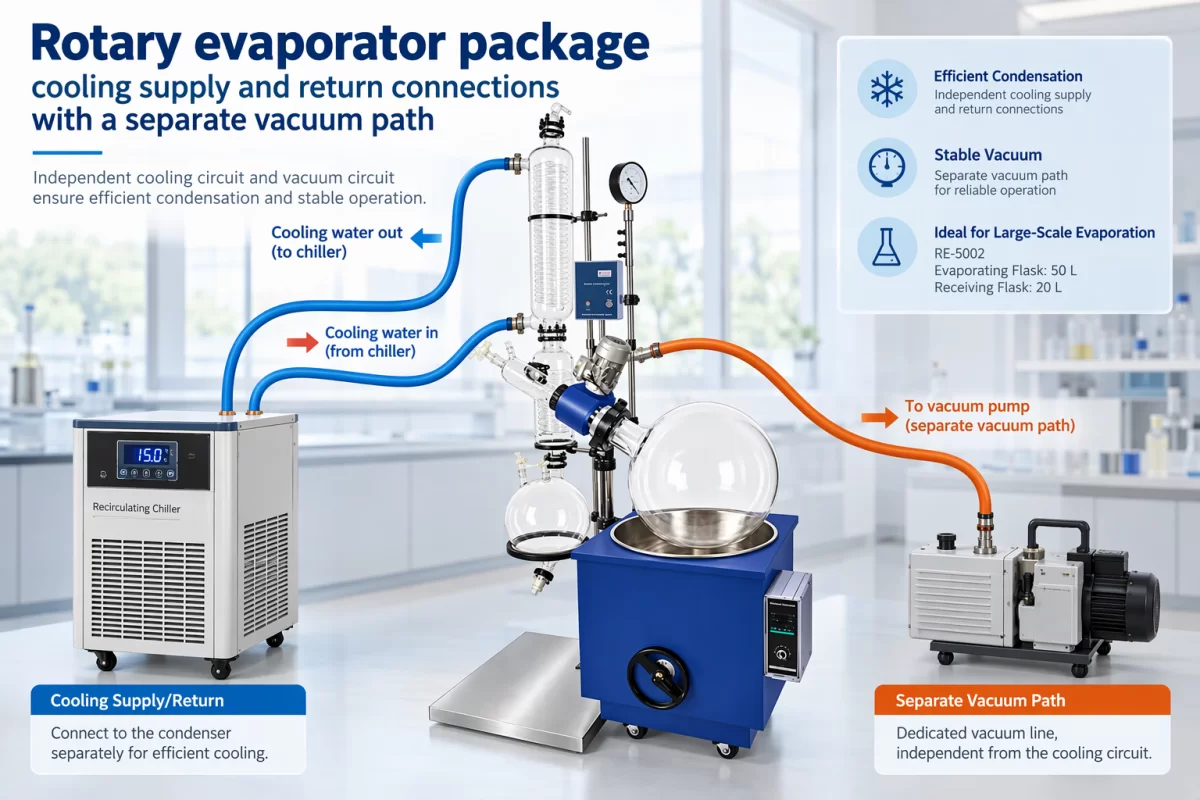
A complete rotary evaporator and chiller package needs a connection schedule, not simply a list of machines. The cooling circuit links chiller supply and return to the condenser. The vacuum path links the evaporator’s designated vacuum outlet to the pump, with a cold trap where specified. Electrical supplies and control signals are separate interfaces.
| Item | Purpose and process position | Interfaces to specify | Supply responsibility to record |
|---|---|---|---|
| Main evaporator | Heats and rotates the liquid; its condenser and receiver collect condensed solvent. | Glass joints, coolant ports, vacuum outlet, electrical supply, lift clearance. | Selected model, glassware, bath, drive, lift, seals, and included fittings. |
| Vacuum pump | Establishes reduced pressure downstream of the vapor-capture stages. | Vacuum hose, inlet fitting, exhaust routing, power supply. | Pump model, solvent compatibility, exhaust provisions, and any controller supplied. |
| Chiller | Circulates cooled liquid through the condenser cooling circuit. | Supply/return fittings, hose size, coolant, flow and pressure requirements. | Chiller model, coolant provision, connection kit, and operating-duty selection. |
| Cold trap | Provides an additional vapor-capture stage between the evaporator and pump when specified. | Vacuum connections, cooling method, drainage and servicing access. | Separate inclusion or exclusion, cooling provision, and collection components. |
| Tubing and adapters | Complete the cooling and vacuum circuits. | Material, diameter, length, pressure/vacuum rating, clamps and adapters. | Who supplies, fits, and checks every hose assembly. |
| Services | Connect, start, test, and hand over the assembled system. | Site utilities, test conditions, operator training, acceptance record. | Supplier work, customer preparation, travel, remote support, and charges. |
Hose compatibility should cover both the circulating coolant and any solvent exposure. Identify the condenser’s cooling ports separately from its vacuum connection. Ask for a connection diagram showing flow direction, adapter locations, vacuum measurement position, and exhaust destination. For flammable solvents, the site safety assessment must also address ventilation, ignition risks, and electrical suitability; a package name does not establish those protections.
Make integrated commissioning a contractual deliverable
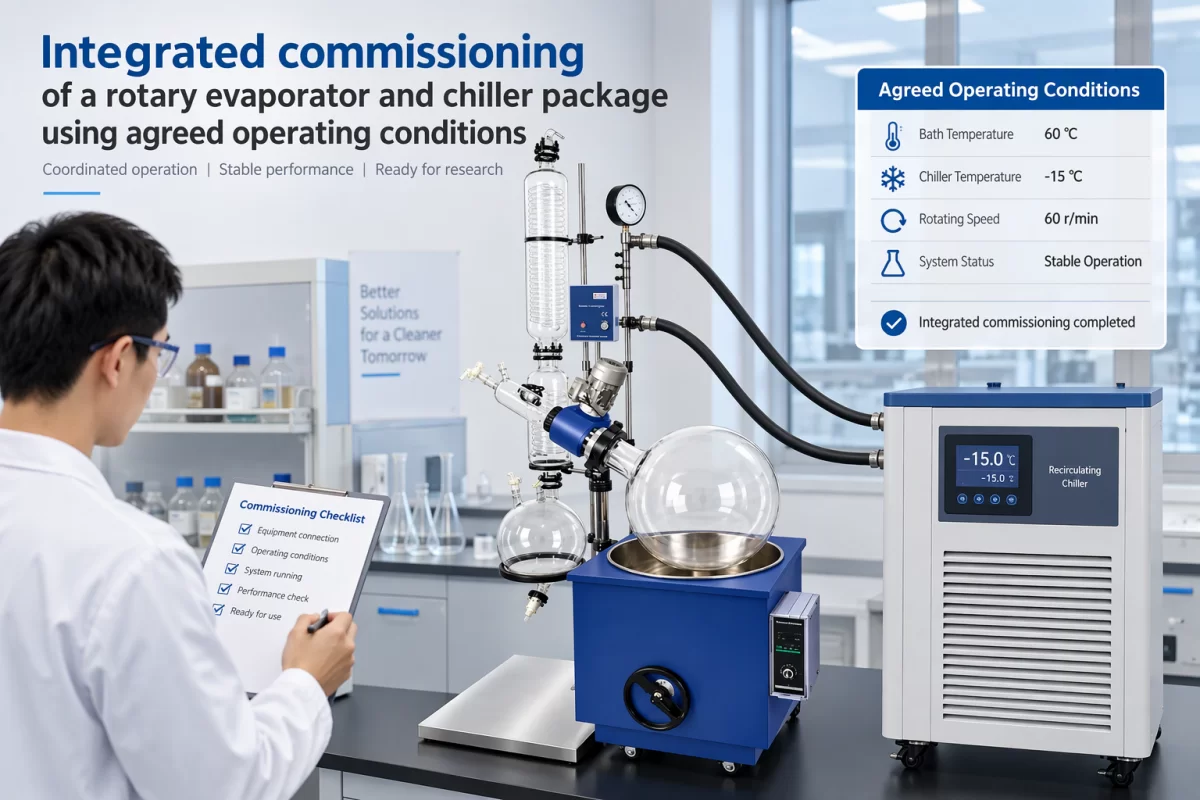
Separate machine start-up checks do not demonstrate that the assembled package operates satisfactorily. Define who performs the integrated test, who supplies test material, what site utilities are required, and which results determine acceptance.
- Inspect the assembly: check glassware support, seals, hose routing, lift clearance, and the specified electrical connections before operation.
- Check the cooling loop: verify circulation, leaks, flow direction, and temperature behavior under the agreed load.
- Check vacuum operation: assess leak tightness, pressure measurement, adjustment or control behavior, and pump exhaust arrangements.
- Run the agreed process trial: record solvent, working charge, feed method, bath and coolant temperatures, pressure, rotation, elapsed time, and collected solvent.
- Complete handover: document operating limits, shutdown procedures, receiver emptying, maintenance, and the contact responsible for integration issues.
Compare candidate packages under the same trial conditions. State whether the measured rate covers only steady operation or the entire cycle, including charging, warm-up, receiver handling, and discharge. This prevents a short steady-state test from being mistaken for practical batch productivity.
Read package pricing against the written scope
Equipment-only and integrated-package offers are not directly comparable unless their inclusions match. For context on rotary evaporator package costs, distinguish the main evaporator, cooling source, vacuum equipment, control accessories, tubing, and services before evaluating the total.
Our company’s reference price: US$1,480. This is a reference point from our listed prices, not a quotation for the complete package described here. The actual quotation depends on the selected configuration and inquiry results.
What makes two package quotations meaningfully comparable?
I would compare an identical equipment and service boundary, using the same solvent duty, working batch, cooling conditions, vacuum-control requirements, and acceptance test. A lower headline price is not equivalent value if essential connections or commissioning are excluded.
Choose one supplier—and one accountable integration scope
The useful answer to who supplies complete rotary evaporator and chiller packages is more than a supplier name. Choose an offer that identifies the evaporator model, matches the external cooling and vacuum equipment to the intended process, includes the necessary interfaces, and assigns responsibility for integrated commissioning.
Start with the working batch and solvent duty, not nominal bottle capacity. Treat the chiller, pump, cold trap, controller, tubing, and services as separately defined items until the quotation explicitly includes them.
Prepare a package inquiry for ZZKEDA
Submit the material and solvent composition, target processing quantity or working batch, batch or feeding method, desired concentration endpoint, proposed temperatures and pressure, site utilities, and required equipment and services. These details support a model-specific package assessment and a quotation with clear supply and commissioning boundaries.