Solid-liquid separation · Equipment selection
Nutsche Filter-Dryers: Selecting Filtration, Washing and Drying Functions
Selecting nutsche filter-dryers starts with the required condition of the recovered solid—not simply the vessel size. A process that needs a drained cake has different configuration requirements from one that needs washed crystals or a product with a specified residual-solvent level. The useful comparison is therefore filtration versus washing versus drying under the same material and batch conditions.
Start with the separation task, not the equipment name
A purchase specification should identify the feed slurry, the solid to be retained, the liquid to be removed and the required product endpoint. Particle size distribution, solids concentration, viscosity and cake compressibility can change the separation behavior substantially. A large vessel does not compensate automatically for a poorly matched filter medium or a cake that becomes difficult to drain.
- A nutsche filter uses a supported filter medium to retain solids while liquid passes through. Washing may be possible with suitable liquid-addition and drainage provisions, but agitation and drying are not inherent in the basic filter structure.
- A filter reactor combines a filtration arrangement with a vessel intended for reaction duties. Reaction service requires its own evidence for mixing, materials, temperature control and operating pressure. It is not equivalent to a dryer merely because filtration is included.
- An agitated nutsche filter dryer is considered when cake handling, washing and a defined drying stage are needed in a coordinated system. The actual heating, vapor removal, sealing and discharge arrangement must match that task.
When evaluating agitated nutsche filter dryers, separate the required process functions from the documented hardware. This helps distinguish a suitable filtration configuration from a more demanding washing-and-drying package without treating the names as interchangeable.
Filtration: match area, medium and cake conditions
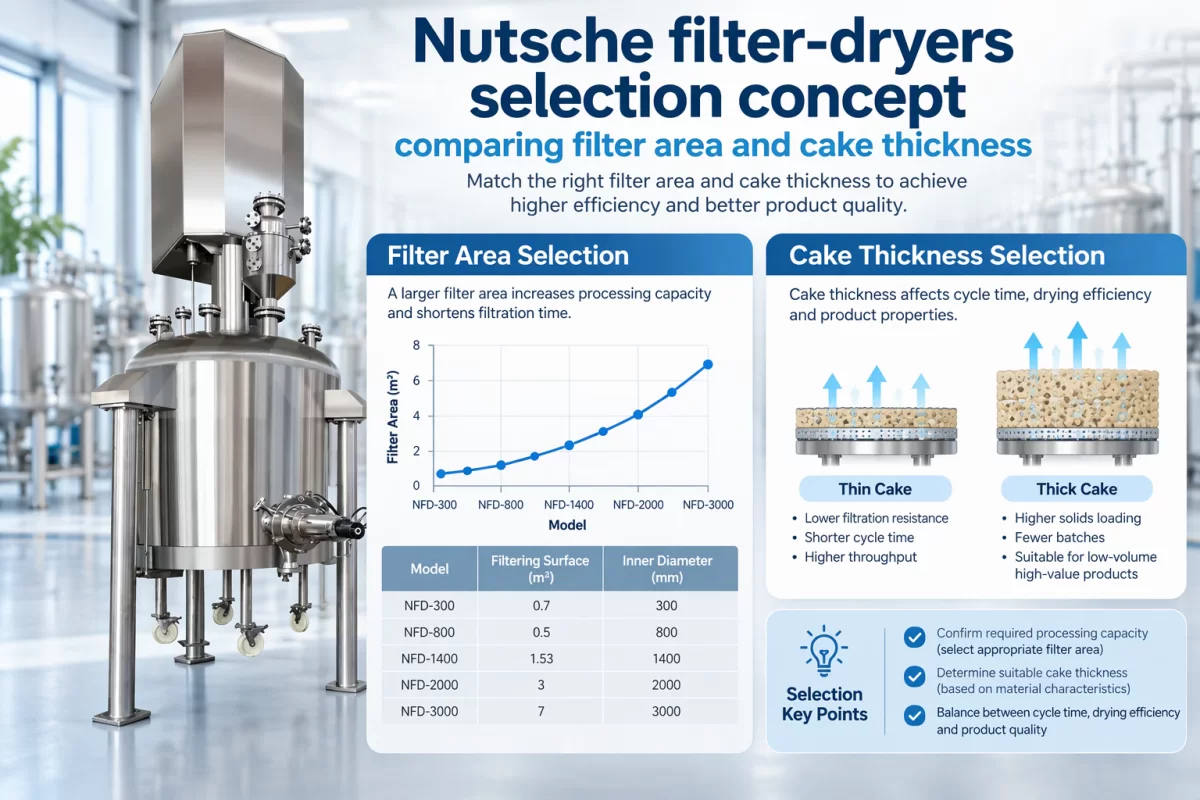
Filter area is the surface available for liquid passage. Nominal vessel volume describes a different quantity, and neither value alone establishes the allowable slurry batch. Batch selection also depends on solids loading, cake thickness, freeboard and the space needed during agitation or washing.
The filter medium should be selected against particle retention, liquid compatibility, operating temperature and cleaning requirements. Fine particles may require a tighter retention specification, but that choice can increase resistance or encourage blinding. For a compressible cake, increasing the pressure difference may compact the solids rather than produce a proportional increase in filtrate flow.
Does a 30 L vessel provide a 30 L solids batch?
I would not use nominal volume as a solids-capacity statement. A slurry batch contains both liquid and solids, while the retained cake occupies only part of the vessel. I would assess slurry volume, expected cake volume and operating space separately before setting the working batch.
Illustrative cake-volume calculation
Assume a flat, uniform cake covering 0.03 m² of filter area at a thickness of 80 mm = 0.080 m. The geometric cake volume is:
0.03 m² × 0.080 m = 0.0024 m³ = 2.4 L.
This example uses the area and cake-thickness entries in the NFD 200 technical sheet. It describes geometric cake volume only—not dry-solids mass, slurry charge, filtration time or guaranteed capacity. Cake porosity, liquid retention and material-specific testing are still needed to estimate a practical batch.
Documented parameters for the NFD 200 configuration
The following values describe the configuration in the NFD 200 technical sheet. Vessel-side and jacket-side operating limits are shown separately because the process material and heating utility occupy different spaces.
| Parameter | Value | Selection relevance |
|---|---|---|
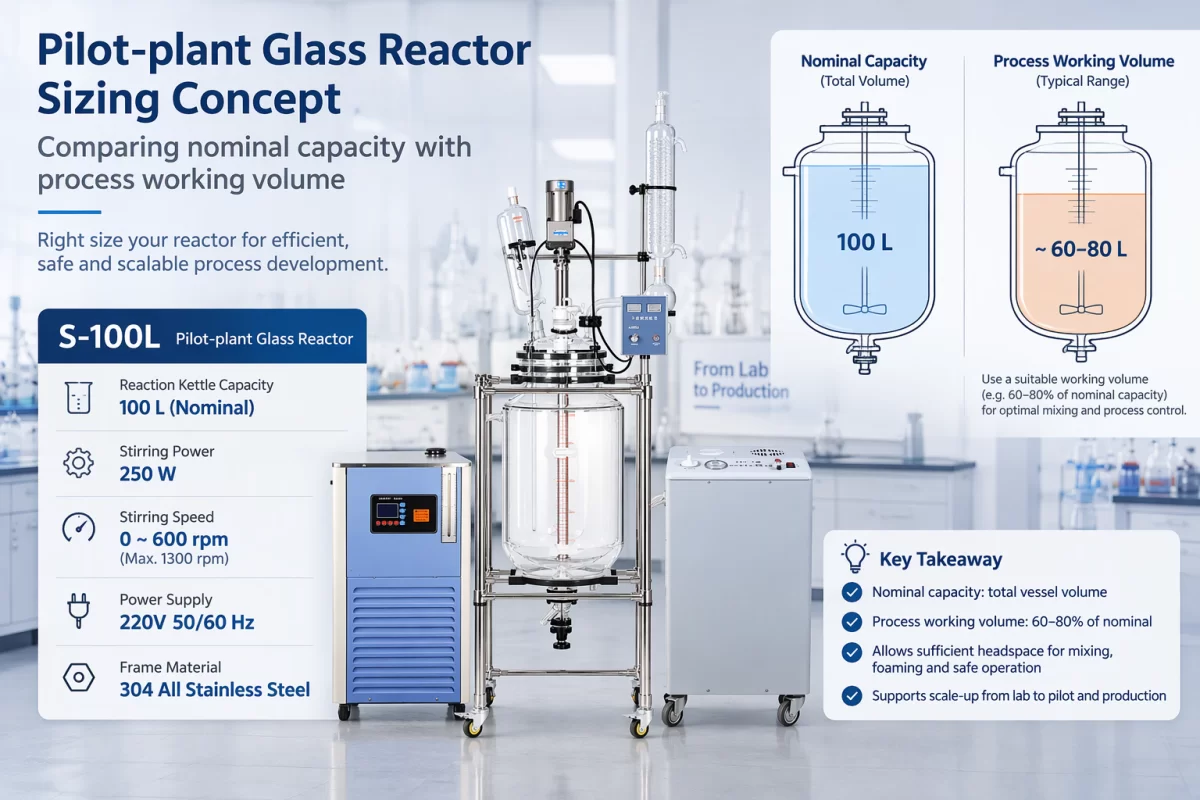
| Nominal / full volume | 30 L / 35 L | Vessel volumes, not solids batch ratings |
| Filter area | 0.03 m² | Available filtration surface |
| Filter cake thickness | 80 mm | Listed cake geometry |
| Agitator stroke | 100 mm | Vertical agitator travel |
| Stirring speed / power | 0–25 rpm / 0.55 kW | Documented agitation parameters |
| Maximum working pressure | Vessel: 0.2 MPa; jacket: 0.2 MPa | Separate operating-pressure limits |
| Design pressure | Vessel: 0.3 MPa; jacket: 0.35 MPa | Design values, not operating setpoints |
| Working temperature | Vessel: 85 °C; jacket: 85 °C | Listed working temperatures |
| Design temperature | Vessel: 90 °C; jacket: 95 °C | Separate from working temperatures |
| Main pressure-component materials | Vessel: 316L; jacket: 304 | Starting point for compatibility assessment |
| Jacket working medium | Hot water or thermal oil | Listed heating-utility media |
| Shaft seal | Packing seal | Relevant to leakage and maintenance requirements |
Use these parameters as a starting point for a material-specific assessment. They do not establish a filtration rate, drying duration, reaction capability, sterile-processing capability or vacuum operating limit.
Washing: choose between displacement and reslurry duties
Cake washing should be specified by the impurity-removal target, not merely by adding a wash-liquid connection. In displacement washing, fresh liquid passes through the retained cake to replace mother liquor. This approach depends on reasonably uniform flow; cracks or channels can leave some regions insufficiently washed.
Reslurry washing mixes the retained solids with wash liquid before another filtration stage. It can help redistribute liquid through the solids, but it requires suitable agitation, working space and compatibility between the product and wash solvent. Fragile crystals may also be sensitive to mechanical handling.
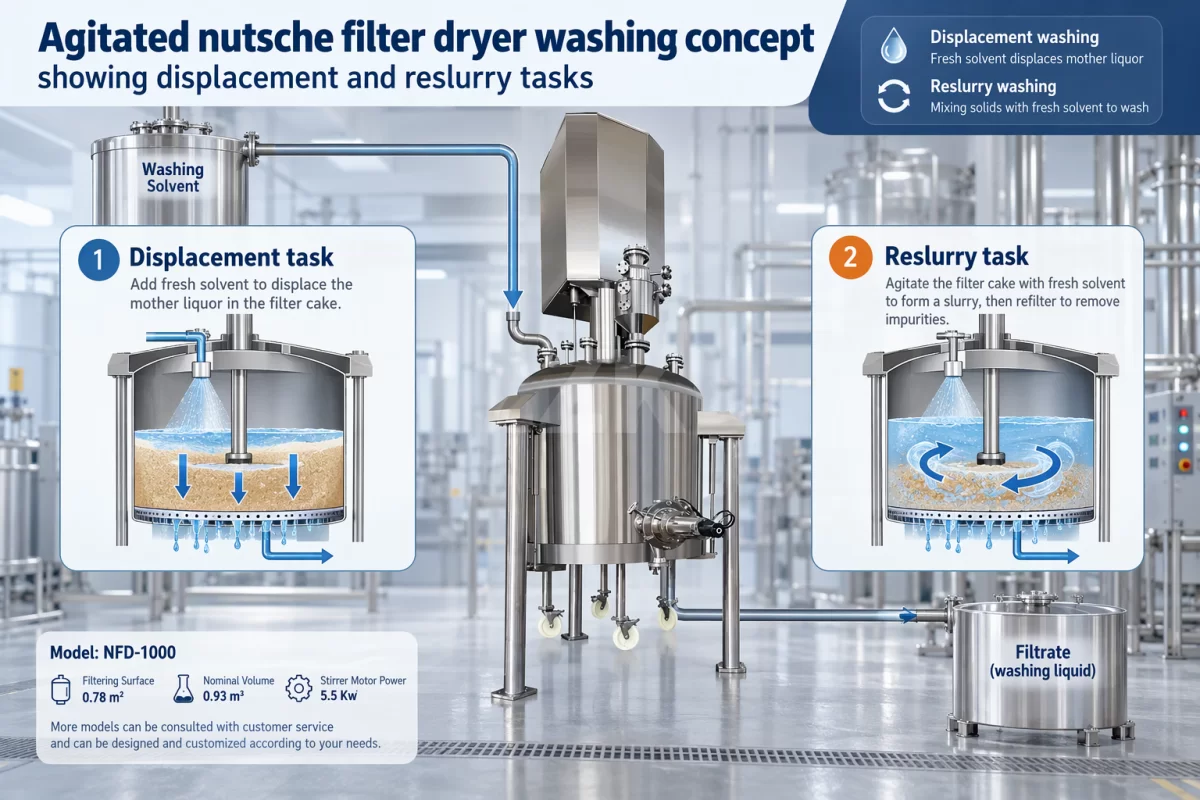
Is agitation always necessary for effective cake washing?
I would choose agitation according to the cake behavior and washing target. A permeable, stable cake may suit displacement washing, while a cake requiring resuspension needs an appropriate mixing arrangement. I would compare both methods using the same starting cake, wash solvent and impurity endpoint.
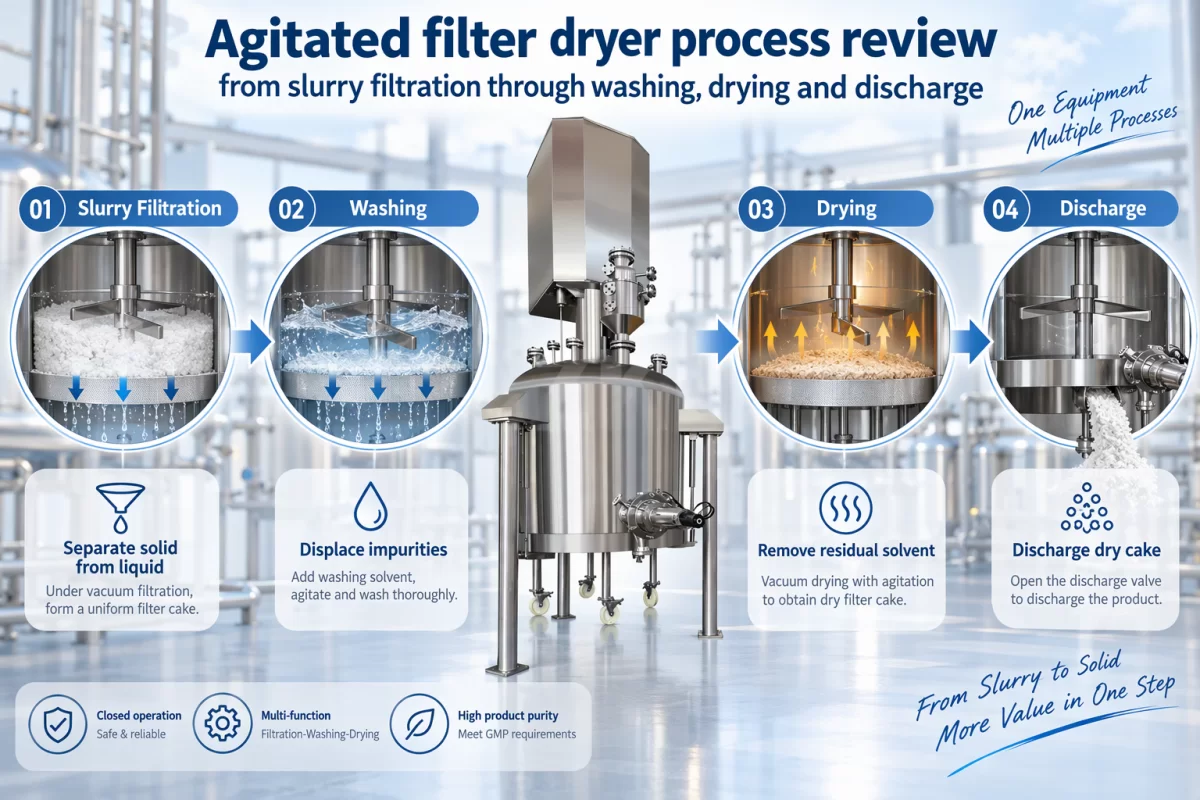
The NFD 200 sheet lists agitator speed and vertical stroke, but those values alone do not establish reslurry effectiveness or crystal protection. A useful enquiry should include particle fragility, cake consistency, wash-liquid quantity, the number of washing stages and the required purity. An overview of filtration, washing and drying in an ANFD can help frame the sequence before a detailed configuration is selected.
Deliquoring and drying are different endpoints
Deliquoring removes additional liquid through the filter medium after cake formation. It can reduce the load on a subsequent dryer, but a drained cake can still contain substantial retained liquid. Drying adds the requirement to evaporate that liquid and remove the resulting vapor.
The documented hot-water or thermal-oil jacket provides a basis for discussing heat input. It does not, by itself, establish a complete drying arrangement. A drying specification must also address solvent properties, allowable product temperature, vapor handling, any required vacuum operation and the residual-moisture or residual-solvent endpoint.
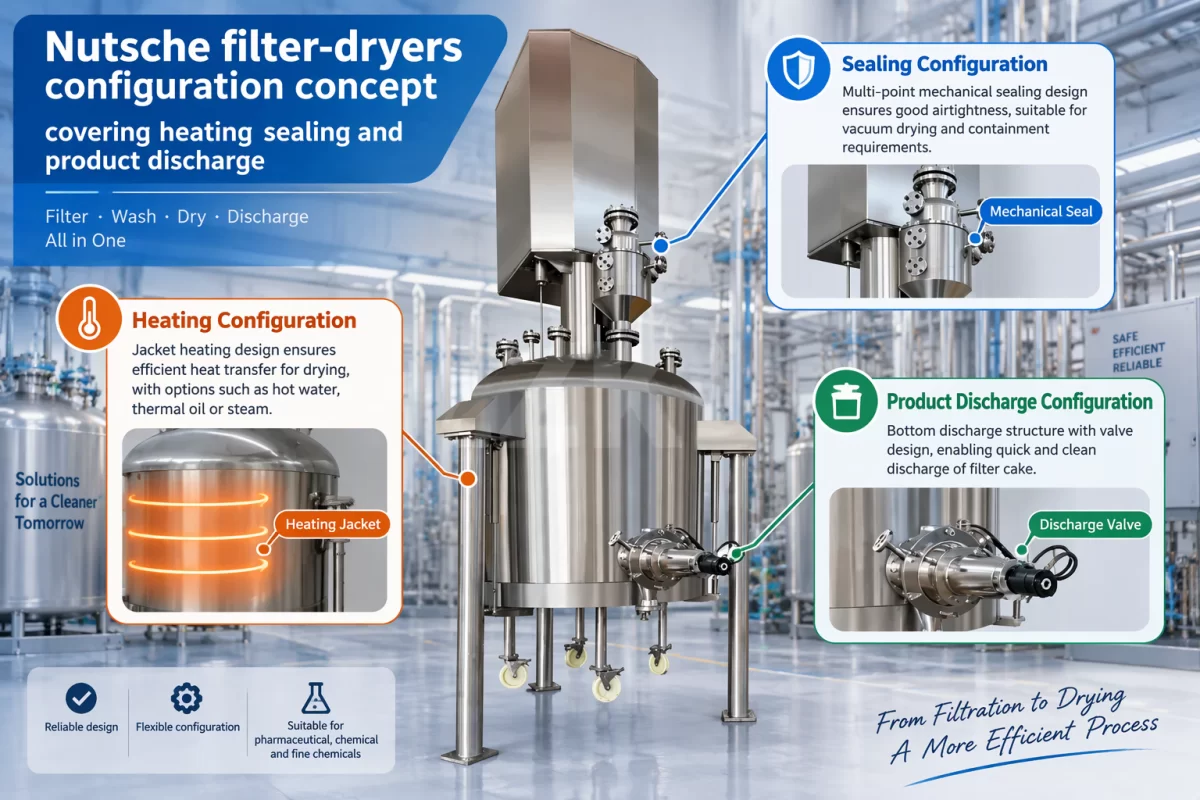
Does a heated jacket prove that a cake can reach a specified dryness?
I would treat the jacket as one part of the drying assessment. The achievable endpoint also depends on heat transfer through the cake, solvent removal, agitation and product temperature limits. I would require a defined drying configuration and material-specific evidence before accepting a dryness or cycle-time commitment.
For a fair comparison between integrated drying and a separate dryer, keep the dry-solids mass, initial liquid content and final specification identical. Include filtration, washing, deliquoring, drying, unloading and cleaning in the total batch cycle rather than comparing drying time alone.
Sealing, discharge and cleaning complete the selection
The NFD 200 configuration lists a packing shaft seal. Seal suitability should be assessed against the process fluid, temperature, required leakage control and maintenance plan. The listed seal type should not be interpreted as evidence of hermetic containment or aseptic service.
Product discharge deserves equal attention. A free-flowing cake and a sticky paste can require different outlet arrangements and unloading procedures. Specify the receiving container, acceptable product hold-up and whether manual contact is permissible. A lifting mechanism does not, on its own, demonstrate automatic solids discharge.
Cleaning requirements should cover access to the filter medium, the underside of the agitator, vessel surfaces, seals and discharge passages. Product-change frequency, cleaning-liquid compatibility and acceptable residue levels help determine whether manual cleaning is sufficient or whether a dedicated cleaning arrangement is needed. Clean-in-place performance should be assessed as a specific requirement, not assumed from the vessel appearance.
Purchasing nutsche filter-dryers by the required endpoint
Choose filtration capacity from filter area, medium suitability and cake behavior. Add washing provisions when mother-liquor removal or purity requires them, and select agitation according to the washing method and product sensitivity. Specify drying only when the heating and vapor-removal arrangement can be evaluated against a defined final endpoint.
For the documented NFD 200 configuration, vessel volume, filter area, agitation, pressure limits, jacket media and seal type provide useful starting information. The purchasing decision should still be based on the complete solid-liquid separation task rather than a model name or nominal volume.
Submit the material and solvent details, particle characteristics, target throughput or working batch, operating conditions, final cake specification, and washing, drying, sealing, discharge and cleaning requirements. These inputs support a configuration-specific assessment and quotation for an Agitated Nutsche Filter Dryer.