Improving Solvent Recovery with a Falling Film Evaporator
Improving falling film evaporator performance for industrial solvent recovery requires more than increasing heat input. Stable liquid distribution, sufficient condensation and controlled vacuum must work together so that evaporated solvent becomes measurable, usable recovered liquid.
Start with the recovery duty—not the feed-rate label
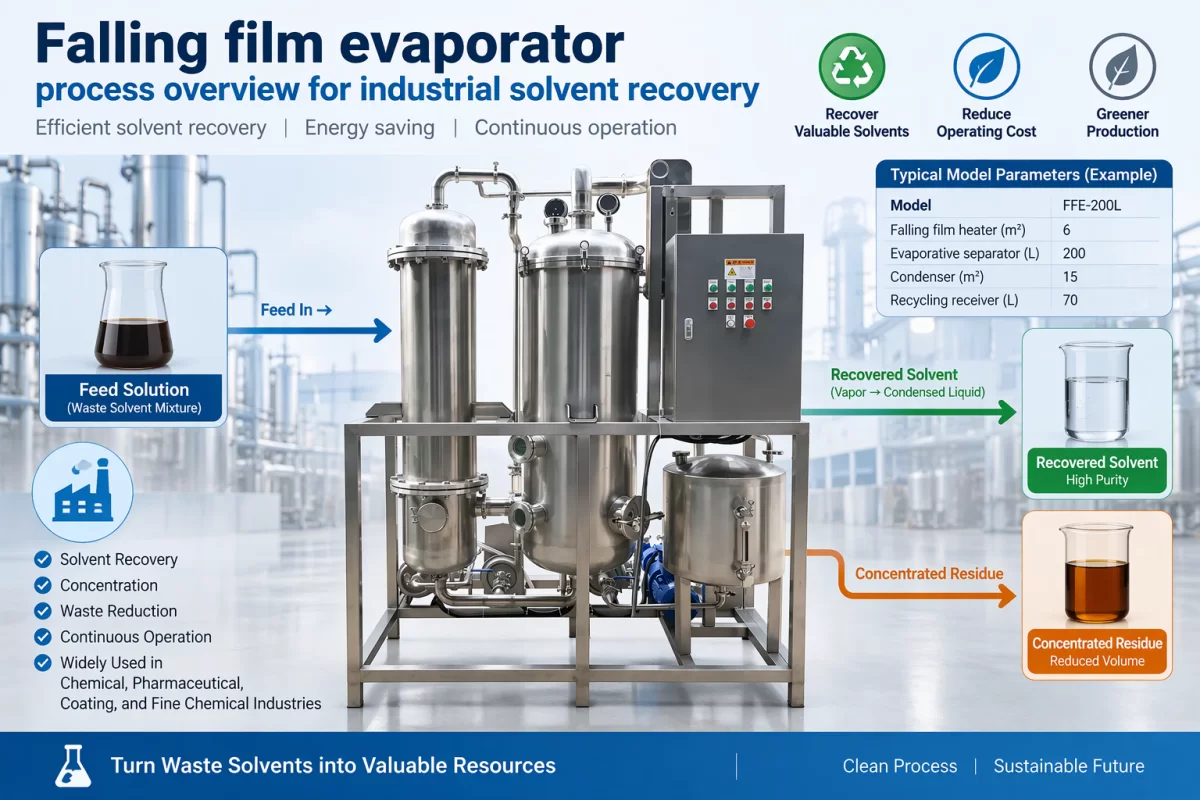
A falling film evaporator distributes liquid over a heated surface, where a descending film transfers heat and releases vapor. The vapor must then be separated from entrained liquid, condensed and collected. A strong evaporation rate alone does not demonstrate strong recovery performance: solvent can remain in the concentrate, escape condensation or become unsuitable for reuse through contamination.
Three quantities therefore need separate definitions. Feed flow is the total mixture entering the equipment. Solvent evaporation rate is the solvent transferred into the vapor phase. Actual recovered solvent is the solvent collected as liquid within a defined measurement boundary. Condensate mass is not automatically pure-solvent mass when water or other volatile components are present.
For the underlying film formation and heat-transfer mechanism, see falling film evaporator working principles. In purchasing discussions, this mechanism should be connected to the actual feed properties rather than treated as a universal capacity claim.
Match condensation to the real vapor load
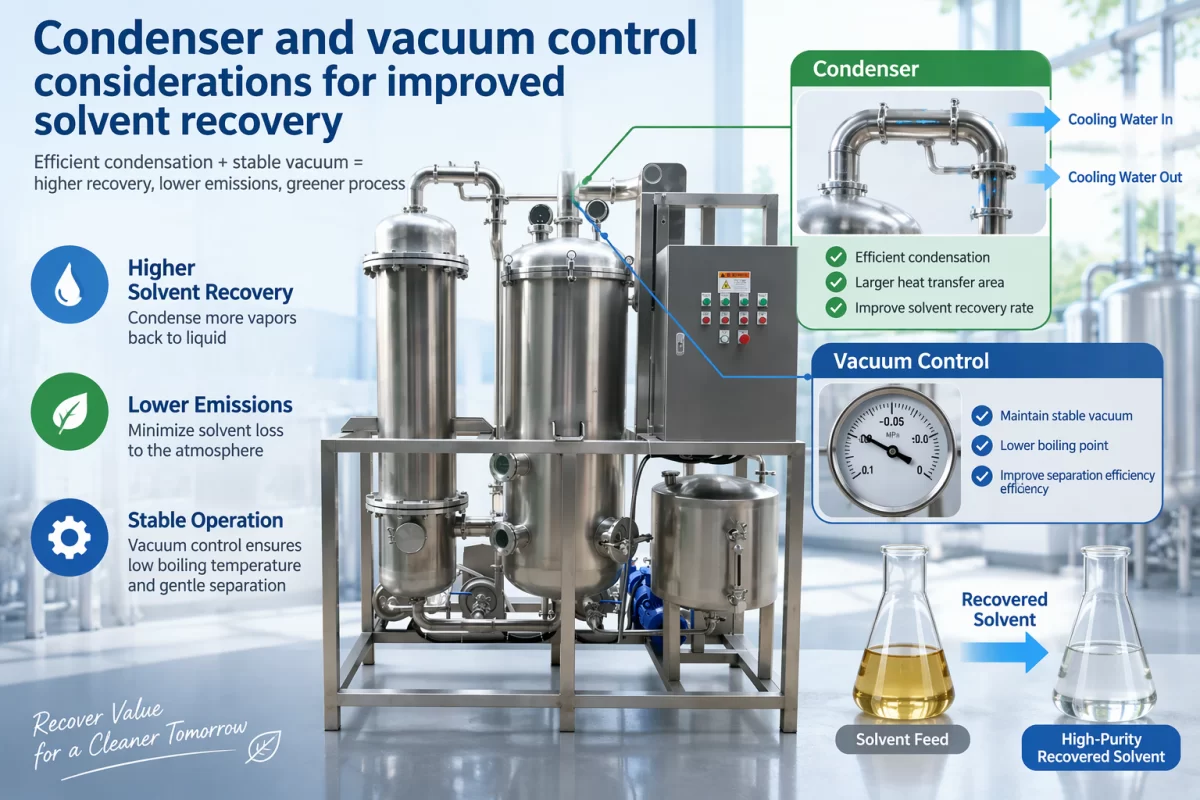
Condenser selection should account for solvent composition, vapor flow, latent heat, operating pressure and the available cooling utility. Cooling-water or chiller inlet temperature alone is insufficient: coolant flow, outlet temperature, exchanger cleanliness and seasonal utility changes also affect the available duty.
If condensation becomes limiting, raising heater output may increase uncondensed vapor rather than collected solvent. Additional vapor reaching the vacuum system can increase its load and destabilize pressure. Check condenser performance alongside receiver collection rate, coolant temperatures and evaporator pressure before deciding that more heating capacity is needed.
Vapor–liquid separation also matters. Entrained droplets can carry dissolved solids or less-volatile material into the condensate. Separator design and, where appropriate, mist removal should be evaluated for the feed's foaming and entrainment behavior. Condenser capacity cannot correct liquid carryover occurring upstream.
Control vacuum as part of the thermal balance
Lower operating pressure can reduce the boiling temperature, which may benefit heat-sensitive feeds. However, deeper vacuum is not automatically the best operating point. At lower pressure, vapor generally occupies a larger volume, and the required condensation temperature may become more demanding for the cooling system.
Select the vacuum arrangement for the required absolute pressure, expected noncondensable gas load, leakage allowance and residual vapor after condensation. Pump selection must also consider solvent compatibility and suitable vapor handling. A pump's nominal displacement is not a guarantee of pressure at the evaporator under process load.
Pressure should be measured at a representative process location. Restrictive vapor piping, leaking seals or poorly controlled receiver discharge can create unstable conditions even when the pump is operating normally. Trend pressure together with feed flow, heat input and coolant conditions; isolated readings rarely explain recovery losses.
Stable feeding protects film formation and heat transfer
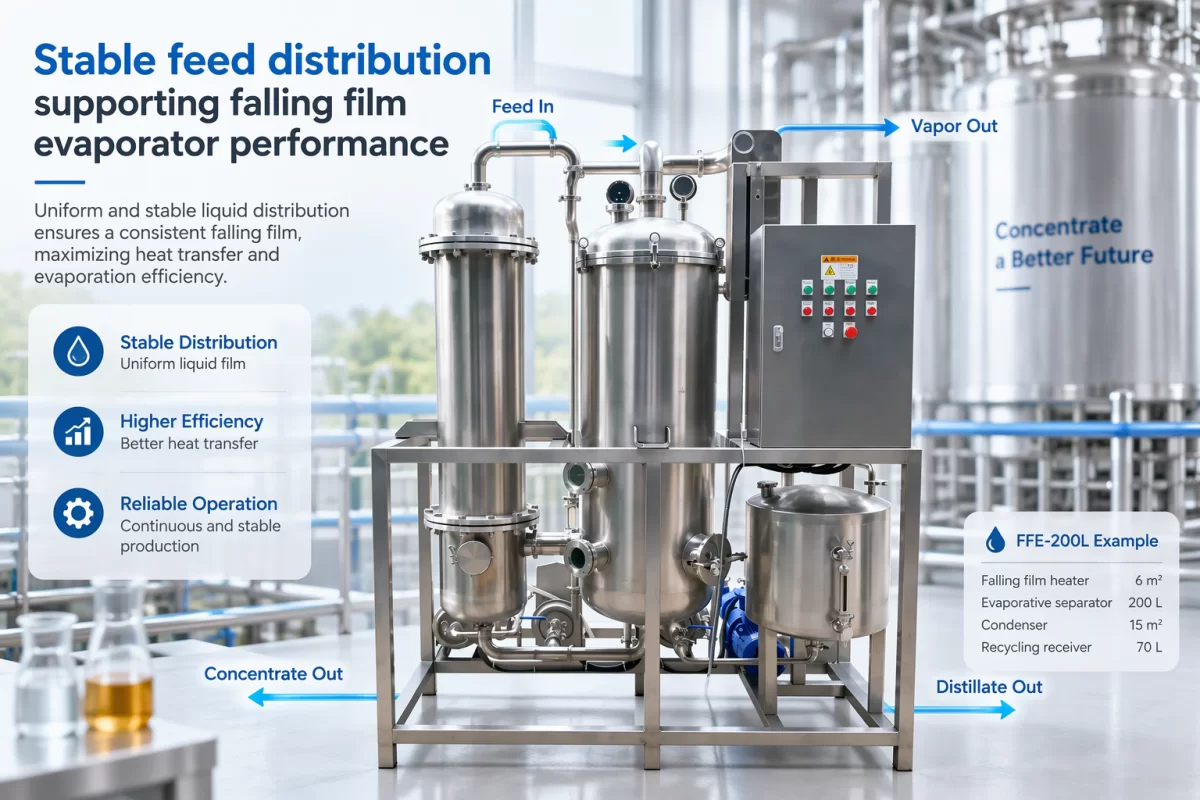
Feed fluctuations can disturb wetting, concentrate composition and vapor generation. Insufficient or uneven distribution can leave poorly wetted areas, while excessive flow can change film behavior and overload downstream separation. The appropriate operating range depends on distributor design, heating-surface geometry and material properties.
Feed viscosity may increase as solvent is removed. Solids, precipitation and fouling can impair distribution or reduce heat transfer over a run. Evaluate feed conditioning, filtration where suitable, temperature control, pump turndown and cleaning access against the specific material. A stable supply tank and coordinated feed control can help prevent upstream batch transfers from repeatedly disturbing the evaporator.
Useful control functions to discuss include coordinated feed and heating adjustments, pressure monitoring, receiver-level management and protective actions for loss of cooling or inadequate feed. These are configuration requirements to evaluate, not assumed features of every evaporator.
Compare recovery on a consistent mass-balance basis
Consider a hypothetical steady-state feed of 100 kg/h containing 80% solvent by mass. Assume one volatile solvent, nonvolatile remaining material, negligible inventory change and no entrainment. If 72 kg/h of solvent evaporates and 69 kg/h is collected as pure solvent, the following definitions apply:
Recovery relative to feed solvent: 69 ÷ 80 × 100 = 86.25%
Collection relative to evaporated solvent: 69 ÷ 72 × 100 ≈ 95.8%
The feed flow is 100 kg/h, not the evaporation or recovery rate. Under these assumptions, 8 kg/h of solvent remains in the concentrate, while 3 kg/h of evaporated solvent is not collected within the defined boundary. That difference requires accounting through measured outlet streams; it should not automatically be assigned to one loss mechanism.
This example is a calculation only, not an equipment guarantee. To compare configurations, keep feed composition, concentration target, viscosity, fouling tendency, heat-source conditions, cooling conditions and working pressure consistent. Compare energy consumption per kilogram of actual recovered solvent while clearly stating whether heating, cooling, vacuum and pumping energy are included. A laboratory result or single-material trial cannot establish a universal industrial throughput or energy value.
Translate process requirements into a purchasing specification
When evaluating falling film solvent recovery equipment, request a configuration matched to the intended duty. The important purchasing question is whether the evaporator, separator, condenser, vacuum arrangement and controls can operate together under the proposed conditions.
| Selection input | Reporting basis | Reason it matters |
|---|---|---|
| Feed and concentrate composition | Mass %, solvent identities, solids content | Defines vapor load, residual solvent and reuse requirements. |
| Target operating duty | Feed kg/h; batch kg; operating hours | Separates incoming material from evaporation and recovery rates. |
| Viscosity and fouling behavior | mPa·s at stated temperature; material history | Influences distribution, heat transfer and cleaning strategy. |
| Pressure and utilities | kPa absolute; temperatures in °C; utility flow rates | Supports boiling, condenser-duty and vacuum-load assessment. |
| Recovered-solvent specification | Mass kg/h; composition; acceptable contaminants | Defines useful recovery rather than condensate volume alone. |
A single evaporator is therefore not a complete production line. Feed preparation, utility supply, solvent storage, transfer, safety provisions and downstream purification must be included in the overall scope where needed. For flammable solvents, specify the applicable electrical, ventilation, grounding and protection requirements without assuming that a listed machine already satisfies them.
Company reference price
Our company's reference price is US$6,800. This is a purchasing reference, not a price commitment for the configuration discussed here. The actual quotation depends on the selected configuration and inquiry results.
Choose balanced recovery performance, not isolated capacity
Improving industrial solvent recovery with a falling film evaporator means maintaining a stable film, providing adequate condensation and controlling vacuum under real process load. Favor proposals that define feed flow, evaporation rate and actual recovery separately, and evaluate those quantities under the same material and utility conditions.
Submit the solvent and material composition, target processing rate or working batch size, desired concentrate and recovered-solvent specifications, operating pressure, available heating and cooling utilities, and required control and safety configuration. These details provide a practical basis for evaluating an appropriate recovery solution and preparing a configuration-specific quotation.