Spray Dryer · Food R&D · Buying Guide
How to Choose a Lab Spray Dryer for Food Powder Trials
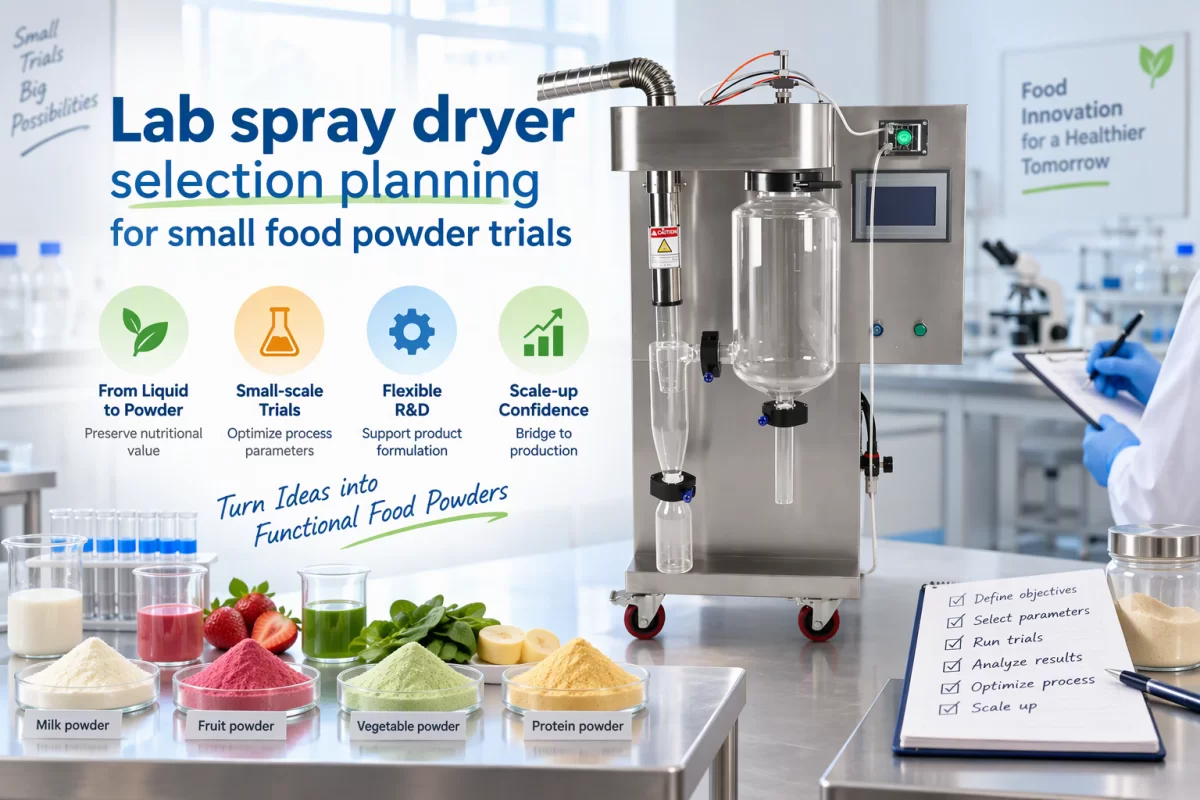
Learning how to choose a lab spray dryer for food powders starts with the trial task—not the equipment name. A useful candidate must handle the available sample, deliver a workable feed, allow meaningful powder collection, and support cleaning between experimental batches.
Start with sample quantity and the intended food powder
Before comparing a Spray Dryer, prepare a short material brief. State the available liquid volume and mass, solids content, viscosity at the intended feeding temperature, and whether the sample is a solution, suspension, or emulsion. Include information about settling, foaming, fat content, and visible particles. These characteristics influence pumping and atomization, so two food feeds with the same volume may require different trial arrangements.
Also define heat sensitivity and the purpose of the collected powder. A sample intended for solubility testing may need different evaluation criteria from one intended for color comparison, flavor assessment, or protein-function testing. General background on spray dryer applications in the food industry can help frame these objectives, but application examples do not establish suitable conditions for a different formulation.
- Available sample: distinguish the total prepared batch from the amount available after feed characterization and other tests.
- Solids and viscosity: record the measurement basis and temperature, rather than describing the feed only as “concentrated.”
- Preparation: assess mixing, settling control, and any screening needs without unintentionally changing the formulation.
- Powder requirement: define how much material is needed for analysis and which properties will determine trial success.
Does a small listed minimum feed quantity ensure enough powder for analysis?
I would treat it as an initial screening specification, not a powder-output promise. The dry solids available, liquid held in tubing, startup behavior, wall deposits, and collection losses all affect the usable sample. A small-batch trial should demonstrate whether enough powder remains for the planned tests.
Check feeding, atomization, and drying conditions by model
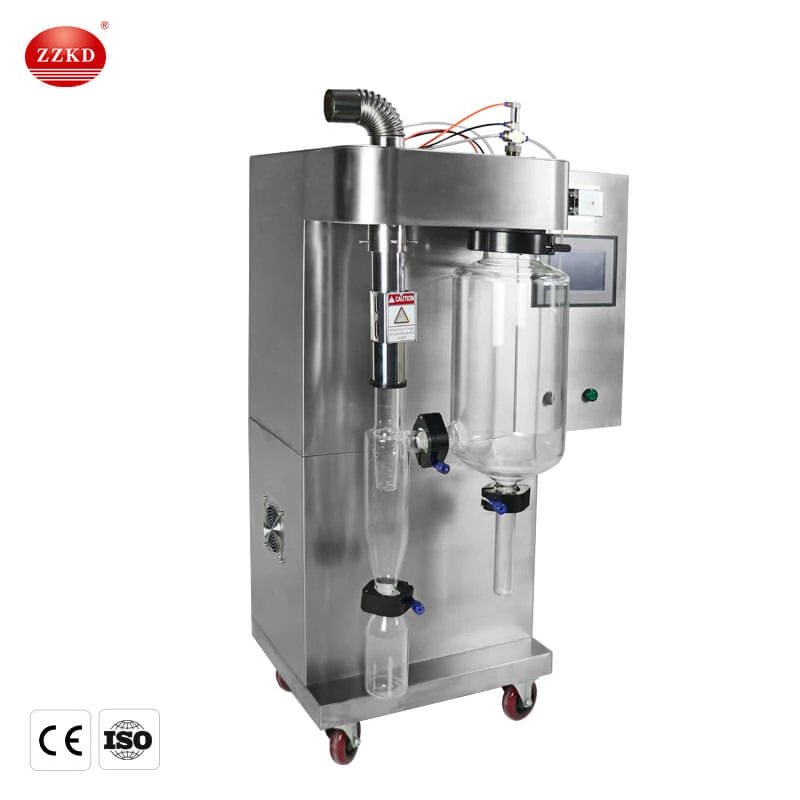
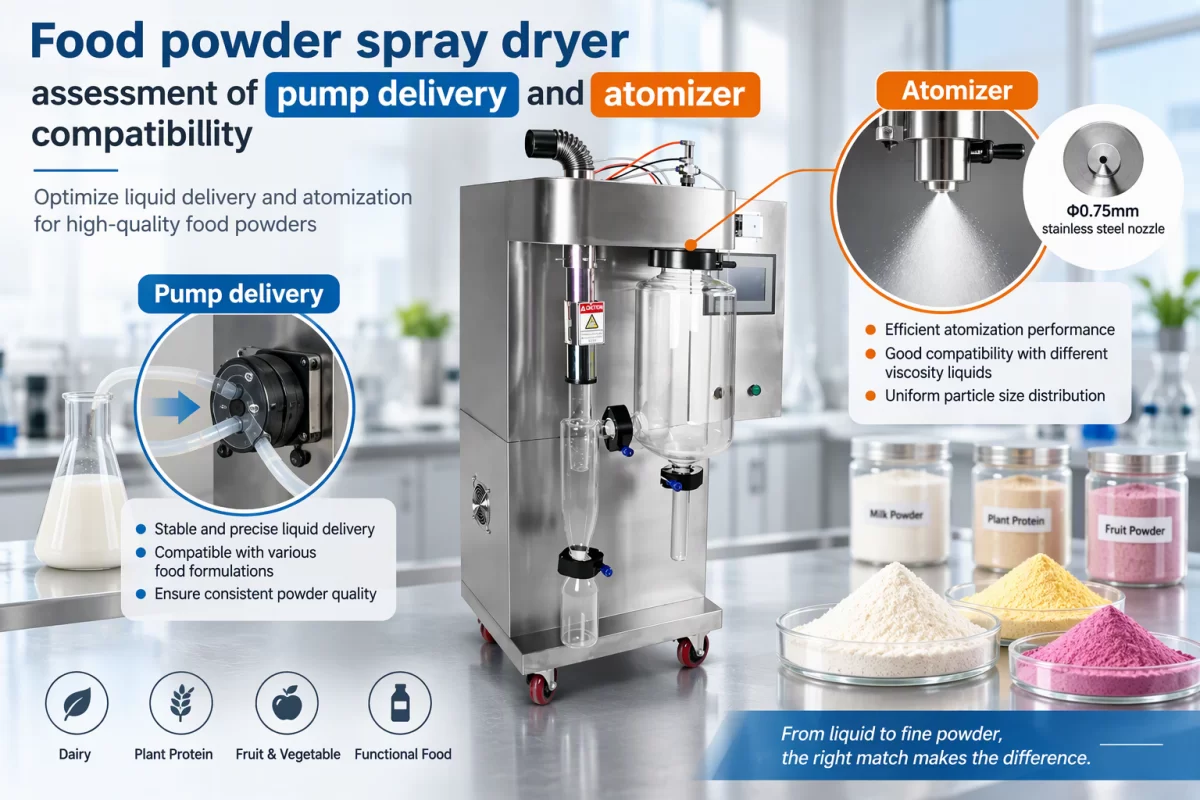
When reviewing mini laboratory spray dryers, compare the actual model specifications rather than assuming that “mini” means a particular working batch or recovery level. For the SD-2L, the listed feeding method is peristaltic-pump adjustment. Evaluate tubing compatibility, pump calibration with the actual feed, and the ability to maintain stable delivery when the sample is viscous or prone to settling.
| Specification | SD-2L listed value | Selection relevance |
|---|---|---|
| Minimum feed quantity | 50 mL | Screen sample availability; verify usable collection in a material trial. |
| Maximum feed volume rate | 2,000 mL/h | Compare with the required liquid throughput, not powder output. |
| Listed evaporated water | 1,500–2,000 mL/h | A water-evaporation specification, not a demonstrated rate for every food feed. |
| Feeding method | Peristaltic-pump adjustment | Assess tubing suitability and actual delivery stability. |
| Nozzle diameter | 1.00 mm | Assess particles and blockage risk; this is not a powder particle-size specification. |
| Inlet air temperature control | 30–300 °C | A control range, not a recommended food-processing temperature. |
| Outlet temperature control | 30–150 °C | Evaluate attainable operation with the selected feed and airflow. |
| Compressed-air working pressure | 2–3 bar | Review the pneumatic supply and the selected atomizer arrangement. |
| Equipment dimensions, L × W × H | 600 × 700 × 1,200 mm | Allow additional space for operation, connections, and cleaning access. |
A nozzle diameter alone does not establish atomization type or acceptable viscosity. Assess the proposed nozzle arrangement, liquid and gas connections, access for clearing blockages, and replacement options. For a centrifugal alternative, the LPG-5 and LPG-10 specifications each list a 25,000 rpm spray-head speed and a 50 mm spray-disc diameter. Those values describe different hardware and should not be transferred to the SD-2L.
The LPG-5 and LPG-10 list maximum moisture evaporation capacities of 5 kg/h and 10 kg/h, respectively. These are not minimum batch sizes or powder production rates. Compare candidates using the same feed composition, solids loading, collection objective, and operating constraints. Increasing evaporation capacity may be useful for a larger task, but it does not by itself establish suitability for a scarce sample.
Review the drying chamber as part of the sample path: atomizer position, droplet clearance, access to surfaces, and the route into the separator and receiver. During a sample trial, look for wet deposits, uneven accumulation, or unstable operation. For heat-sensitive feeds, evaluate the collected powder against the intended quality tests; an inlet setting is not the temperature experienced by every droplet.
Evaluate powder recovery with a clear mass balance
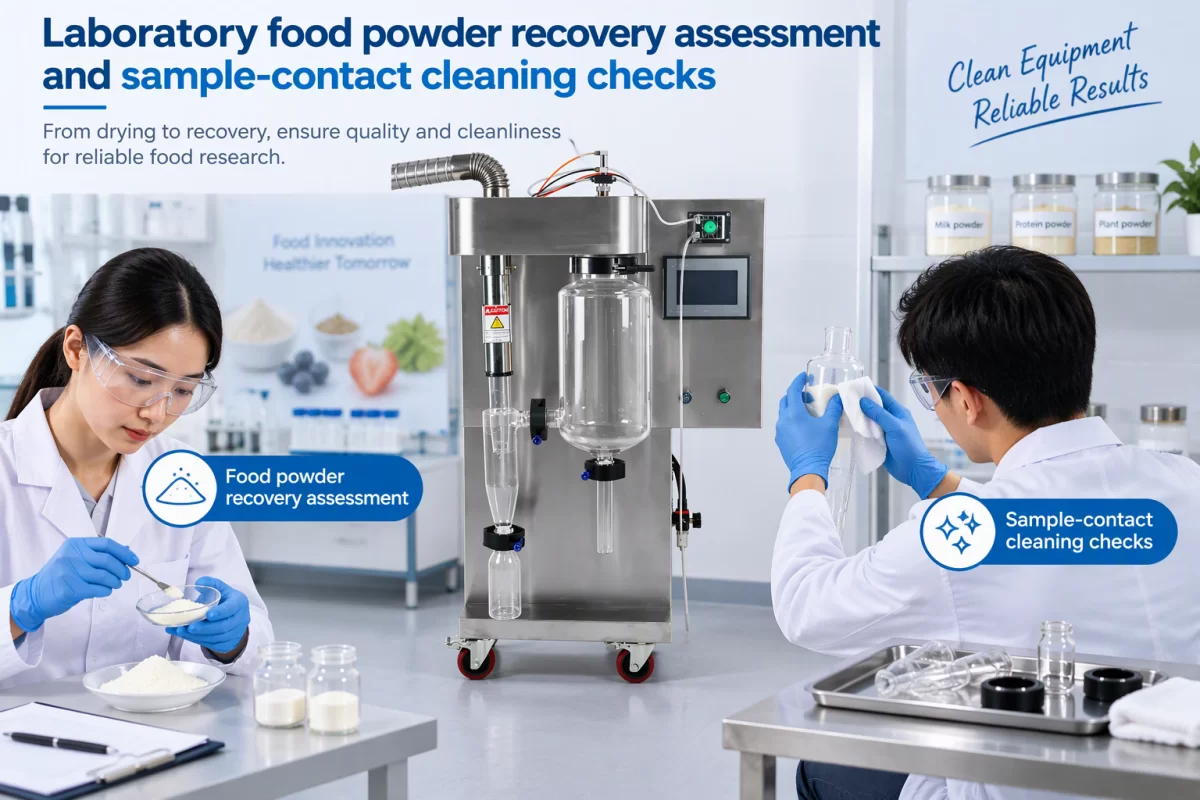
Inspect the proposed separation and collection components, including any cyclone, receiver, connecting ductwork, and final filter included in the configuration. Ask how the receiver is removed, how small quantities are transferred for weighing, and which retained fractions can be measured separately. Do not assume that a named model includes a particular collection arrangement.
A meaningful recovery assessment separates dry matter entering the dryer from collected powder, internal deposits, and other losses. Define whether the denominator is the entire prepared batch or only the feed actually delivered. Feed left in the preparation vessel or tubing should not disappear from the overall batch accounting.
What makes recovery results comparable between candidate dryers?
I compare them using the same feed, a consistent dry-solids basis, and the same collection boundary. I also keep wall deposits separate from receiver powder and correct for residual powder moisture where measured. Otherwise, two percentages may describe different outcomes rather than different equipment performance.
Hypothetical dry-solids recovery example
Assume 500 g of feed actually enters the dryer and contains 20% solids by mass. The input therefore contains 100 g of dry solids. Assume the receiver powder contains 70 g of dry solids after moisture correction, separately measured equipment deposits contain 20 g of dry solids, and the remaining 10 g is unaccounted for across other losses and measurement uncertainty.
Collected dry-solids recovery = 70 g ÷ 100 g × 100% = 70%
This example excludes deposits from collected product and excludes undelivered feed from its denominator. It is an accounting illustration only—not a guaranteed recovery value for the SD-2L, LPG-5, LPG-10, or any food formulation.
Check cleaning access along the sample-contact path
For repeated food powder trials, assess every relevant sample-contact component: the feed vessel, pump tubing, nozzle or disc, drying chamber, separator, collection vessel, and connecting surfaces. Request a practical demonstration of disassembly, washing access, drying, and reassembly. Check whether seals and narrow passages can be inspected and whether frequently removed components are manageable for laboratory staff.
Between formulations, residual color, odor, fat, or protein may affect the next trial. Establish a cleaning procedure suited to the materials and decide how carryover will be checked. For allergen-containing samples, include the laboratory’s allergen-control requirements in the purchase brief rather than relying only on a visual inspection.
Convenient cleaning does not establish food-contact compliance, hygienic certification, or suitability for sterile production. If these are procurement requirements, request the applicable material documentation and configuration-specific evidence as separate acceptance criteria.
Record the conditions that explain the powder result
A sample trial is more useful when the result can be traced to its inputs and operating conditions. Record the raw-material batch, formulation, preparation method, measured solids content, and viscosity where available. Include actual delivered feed quantity and feeding conditions, rather than recording only the pump setting.
Record temperature setpoints and measured readings separately, together with airflow settings or measurements, atomization settings available on the selected configuration, startup and feeding times, and interruptions. Inlet and outlet air measurements should remain identified as air measurements; neither should be relabeled as actual material temperature.
Weigh the collected powder, note how retained material was assessed, and record measured moisture and the powder tests relevant to its intended use. Specific record fields should follow the equipment’s actual controls, sensors, and accessible data—not a presumed logging system.
Can identical temperature settings ensure identical food powders?
I would not use setpoints alone as evidence of repeatability. Feed composition, actual delivery rate, airflow, atomization, ambient conditions, and collection behavior can change the outcome. A useful comparison combines operating records with measured powder properties.
Choose the candidate through sample testing and a configuration quote
The practical path for choosing a lab spray dryer for food powders is to define the trial, match the feed and working batch to the proposed configuration, and then test collection, cleaning, and powder quality with representative material. Select against the task—not simply the smallest equipment label or the highest listed evaporation capacity.
Budget reference: Our company’s reference price range is US$2,800–3,250. This is a budgeting reference, not a model-specific offer. The actual quotation depends on the selected configuration and inquiry result.
Compare candidate quotations on the same scope, including feeding and atomization components, collection parts, utilities, spare parts, and any required trial support. A sample test should produce both a usable powder assessment and a clear record of the operating and recovery conditions.
Submit a focused trial and quotation brief
Provide the material and formulation, available sample quantity, target throughput or working batch, solids content, viscosity, heat sensitivity, intended powder use, operating conditions, available utilities, and required configuration. Include cleaning and documentation requirements so the proposed Spray Dryer solution and quotation can be evaluated against the actual food powder trial.