Glass Reactors for Pilot Reactions: Choosing by Reaction Requirements
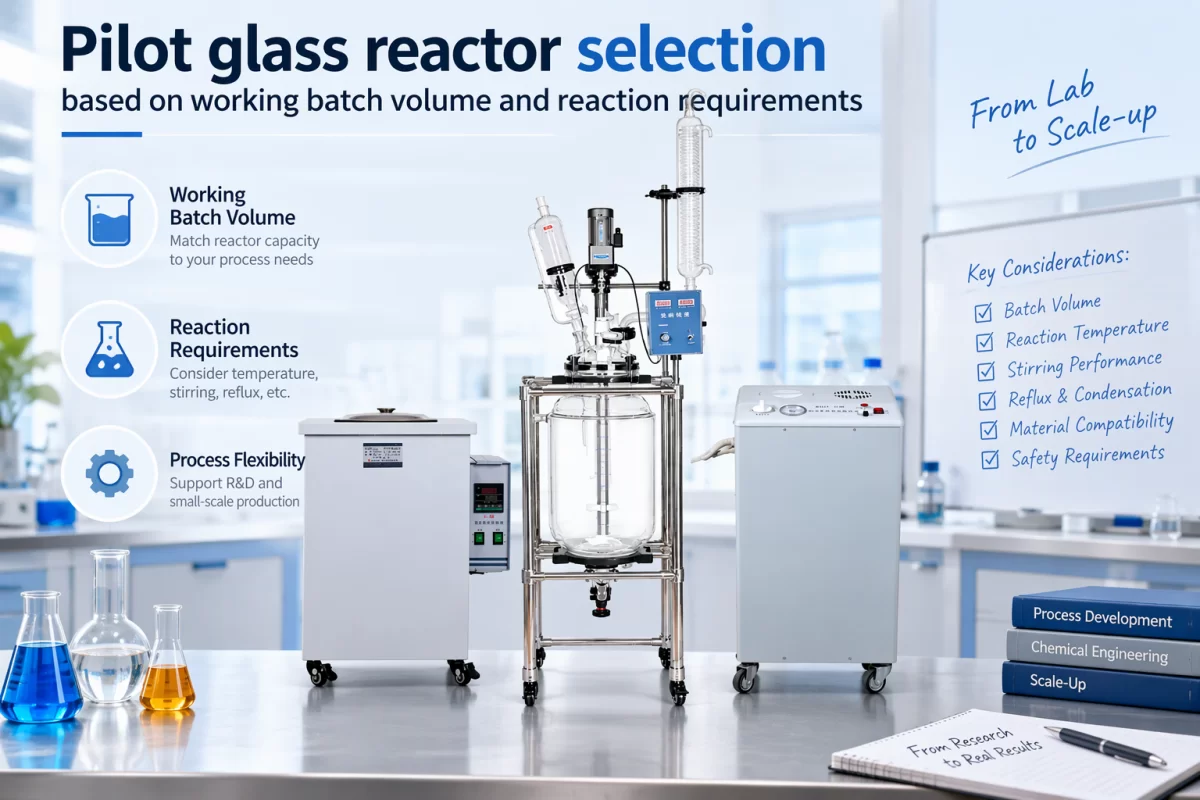
Which glass reactor is best for pilot plant reactions? The useful answer starts with the reaction, not the largest vessel on a quotation. Heat release, changing viscosity, solvent reflux and reagent addition can each make a different part of the reactor system the limiting factor.
A Jacketed Glass Reactor should therefore be compared as an assembled process system: vessel, jacket, agitator, seal, condenser, connections, discharge arrangement and temperature-control equipment. Nominal capacity narrows the shortlist; the intended operating conditions determine whether a configuration belongs on it.
Start with working batch requirements, not vessel size
The S-series capacity choices below provide a starting point for screening. For intermediate pilot batches, explore the 10L to 50L jacketed glass reactors. A capacity listing does not establish a safe working charge, mixing performance or a temperature and pressure operating envelope.
| Model | Nominal capacity (L) | Batch-sizing assessment |
|---|---|---|
| S-1L | 1 | Compare against the initial charge and final batch volume. |
| S-2L | 2 | Allow process-specific space for additions and vapor behavior. |
| S-3L | 3 | Assess mixing at both the starting and final liquid levels. |
| S-5L | 5 | Separate working liquid volume from foam and reflux allowances. |
| S-10L | 10 | Screen against the complete batch sequence, not initial charge alone. |
| S-20L | 20 | Evaluate maximum batch volume alongside heat removal and mixing. |
| S-30L | 30 | Include addition volume, operating margin and discharge requirements. |
| S-50L | 50 | Assess larger-batch demands without assuming proportional performance. |
| S-100L | 100 | Evaluate scale-up as a system-level change, not just extra capacity. |
Keep four quantities separate: the initial charge, the volume change during additions, the process allowance for expansion or foam, and possible future production demand. A single filling percentage cannot represent all solvents, suspensions or reaction sequences.
Illustrative volume calculation: assume an initial liquid charge of 12 L and additions totaling 4 L. Assume additive volumes, with no evaporation, contraction or expansion. The final liquid batch is then:
12 L + 4 L = 16 L of working liquid.
In an S-20L vessel, the arithmetic difference from nominal capacity is 4 L; in an S-30L vessel, it is 14 L under the same assumptions. Neither difference proves adequate operating headspace. Reflux, foaming, agitator immersion and thermal expansion still determine suitability. A future 24 L batch should be assessed separately rather than treated as a requirement of the current 16 L process.
Does a larger nominal vessel automatically make a better pilot reactor?
I would not choose on capacity alone. A larger vessel may leave the initial charge poorly positioned relative to the impeller or require different thermal equipment. I would first compare the minimum and maximum working liquid levels, then assess the actual mixing and heat-transfer configuration.
Exothermic reactions: prioritize heat removal and controlled feeding
For a strongly exothermic process, compare candidates by the jacket circuit, available heat-transfer area, mixing near the heat-transfer surface and the matched cooling system. A jacketed structure alone does not establish that heat can be removed quickly enough during the peak reaction rate.
Use the same material, working batch, addition profile, target material temperature and cooling utility conditions when comparing configurations. Request a model-specific arrangement covering jacket connections, circulation requirements, temperature sensing and the circulator’s cooling capacity at the relevant operating conditions.
The circulator setpoint is the temperature commanded for the heat-transfer system; it is not proof that the reacting liquid reaches that temperature. Material temperature depends on heat generation, circulation, fluid properties and mixing. Use a representative in-vessel measurement for process control and evaluation.
For feed-driven exotherms, compare a controlled metering arrangement with a simple bulk-charge arrangement. Specify feed-rate adjustment, feed location and the required response when cooling or agitation stops. The preferred configuration is the one that supports the intended process-control strategy, not merely the one with more vessel volume.
Viscosity and solids: compare the complete stirring and discharge path
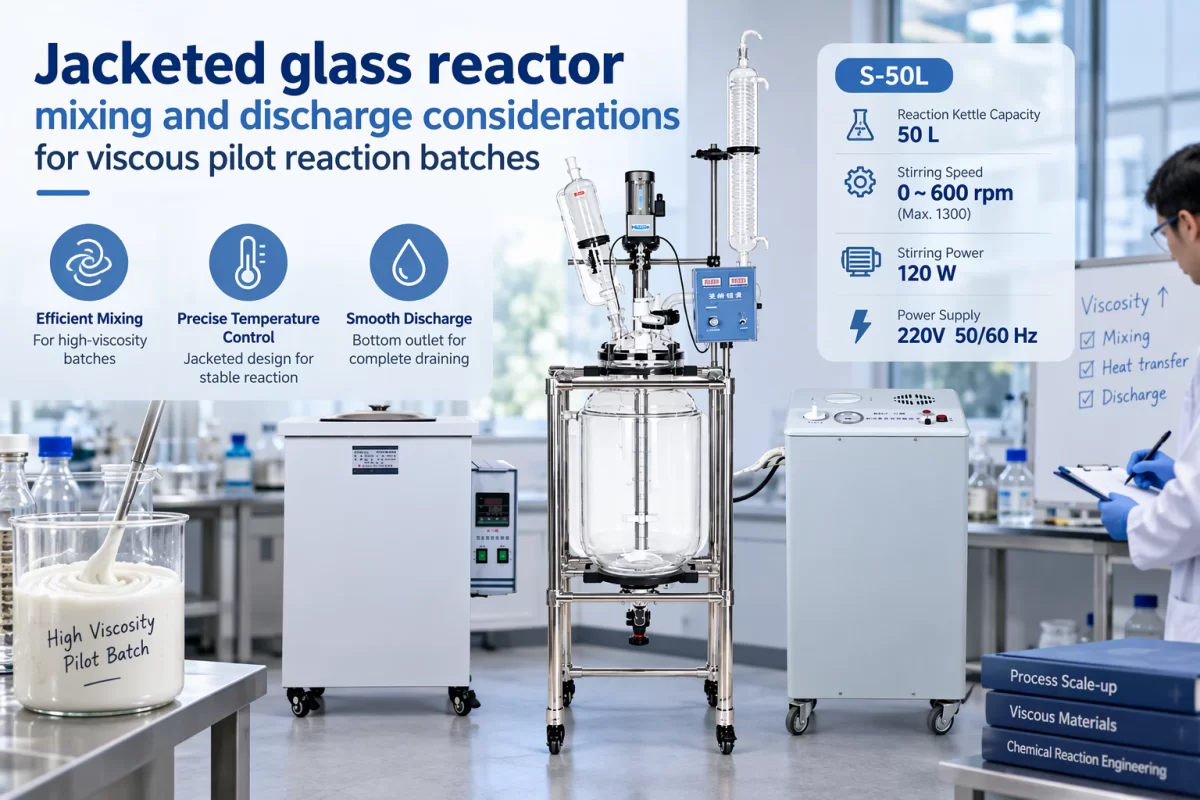
A low-viscosity solution and a thickening slurry can occupy the same working volume but impose very different stirring requirements. Compare impeller geometry, diameter, shaft arrangement, speed range and available torque as one assembly. Motor power alone does not establish usable torque throughout the operating range.
For a process that becomes more viscous during conversion, provide viscosity information across the batch, not just for the starting solvent. For suspensions, include solids loading, particle behavior and whether settling occurs during holds. A candidate configuration must maintain the needed circulation without relying on a speed value as proof of mixing quality.
The shaft seal and all wetted components also belong in this comparison. Evaluate compatibility with reagents, solvents, cleaning agents and operating conditions. For product discharge, assess outlet geometry, valve passage, expected holdup and whether the product remains drainable at the planned discharge temperature.
Can identical stirring speeds produce equivalent mixing in different reactor sizes?
I would treat identical rpm as a setting, not a scale-up criterion. Impeller diameter, shape, liquid level and rheology change circulation and loading. I would compare the full drive-and-impeller assembly under the same process conditions before deciding which size is suitable.
Reflux and addition methods change the preferred configuration
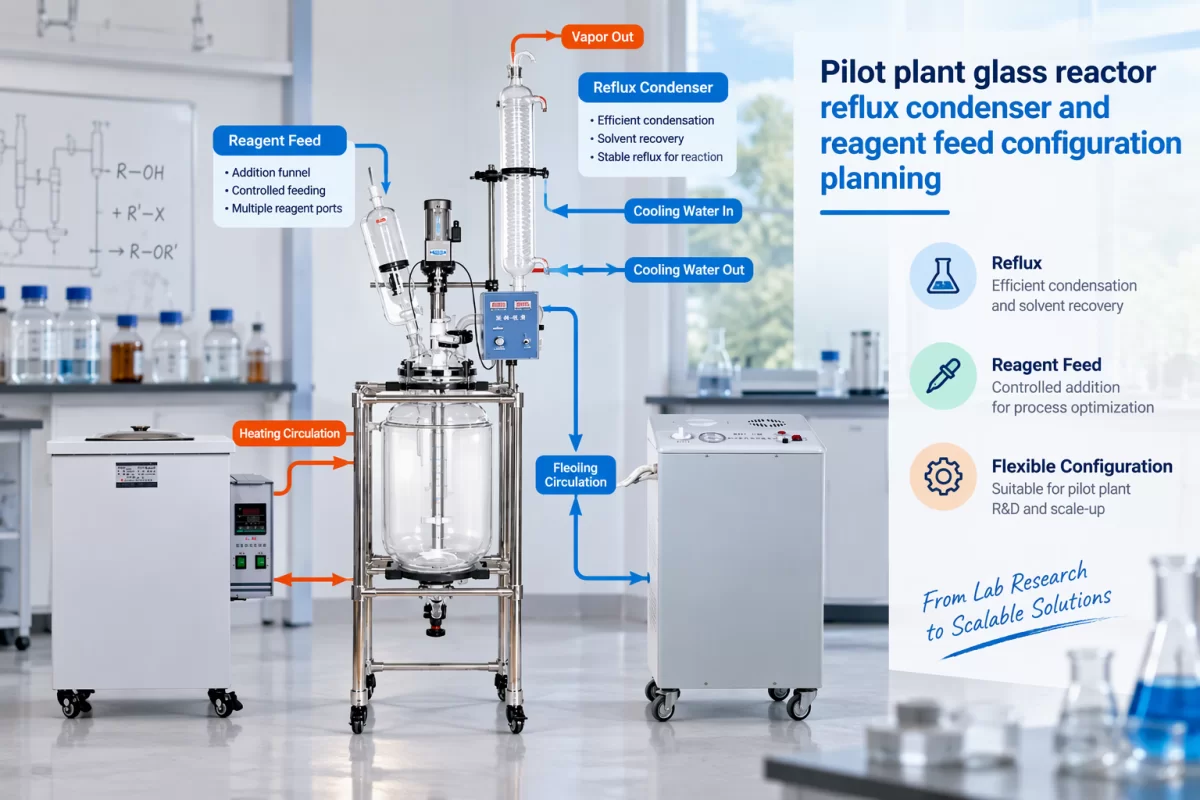
For reflux work, vessel capacity is only one part of the decision. Compare the condenser arrangement against expected vapor generation, solvent properties and coolant conditions. Examine vapor connections, reflux return, receiver requirements and the intended venting or vacuum arrangement. A condenser’s presence does not demonstrate sufficient duty for every boiling process.
| Reaction requirement | Configuration emphasis | Basis for comparison |
|---|---|---|
| Low-viscosity, modest heat release | Stirred jacketed vessel with connections suited to the batch sequence | Liquid-level coverage, temperature measurement and achievable circulation |
| Feed-driven exotherm | Matched cooling circuit and controlled reagent addition | Peak heat load, dosing profile and process interruption response |
| Viscous liquid or slurry | Suitable impeller, drive, seal and discharge passage | Changing viscosity, solids behavior and final-product drainage |
| Sustained reflux | Condenser, vapor path and return arrangement matched to the process | Vapor load, coolant conditions and liquid carryover risk |
| Multiple liquid or solid additions | Dedicated access and feed arrangements with adequate operating space | Addition sequence, port use, containment and mixing at feed entry |
Bulk charging, continuous liquid dosing and intermittent solid addition need different access arrangements. Map each connection before purchase: temperature probe, condenser, feed line, sampling point and any process atmosphere connection. The review should include port dimensions, mechanical support and whether simultaneous operations interfere with each other.
Does ordinary jacketed glass construction establish high-pressure capability?
No. I would not infer pressure capability from the jacket or from a reflux configuration. Any pressure or vacuum requirement must be assessed against the selected vessel, seal, fittings and complete assembly’s documented limits. Temperature limits and hazardous-area drive requirements likewise need model-specific support.
Build a comparable purchasing specification
Use the same process brief for every candidate model. General background on glass reactors for pilot-plant work can help organize the application discussion, but the purchasing decision should rest on the selected assembly and its documented operating envelope.
- Process: materials, solvents, hazards, compatibility requirements and batch sequence.
- Batch: initial charge, additions, maximum working volume, process allowance and separate future expansion target.
- Thermal conditions: target material temperature, heat-release profile, heating and cooling times, and available utilities.
- Mechanical configuration: impeller, drive, shaft seal, condenser, connection layout and discharge arrangement.
- Operating limits: required temperature, pressure or vacuum conditions, and applicable electrical or hazardous-area requirements.
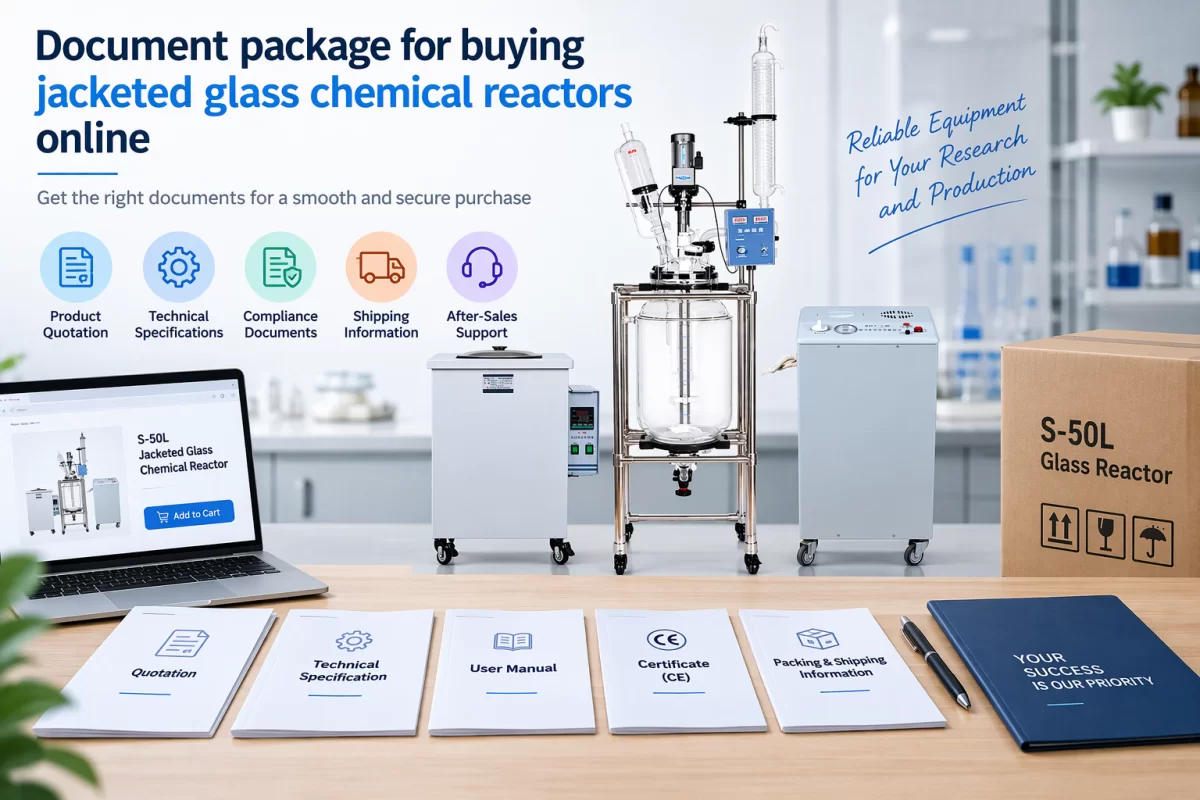
Company reference price: US$1,699. This is a reference across the company’s jacketed glass reactor listings, not a quotation for every capacity or a complete pilot system. The actual quotation depends on configuration and the inquiry result. Compare quotations on an equal scope, including the required condenser, feeding equipment and temperature-control package.
Which glass reactor is best for pilot plant reactions? Choose the limiting requirement first
For an exothermic batch, prioritize heat removal and feed control. For viscous or solids-containing material, prioritize the stirring assembly and discharge path. For sustained reflux, prioritize condenser duty and vapor handling. For complex additions, prioritize connection layout and access. Then choose a nominal capacity that accommodates the actual batch sequence without compromising these functions.
Request a process-matched proposal: submit the material system, target throughput or working batch, initial and final charge volumes, operating conditions, addition method and required configuration. These details support a focused assessment of the Jacketed Glass Reactor, its auxiliary equipment and the quotation scope.