Food processing · Equipment selection
Choosing Spray Dryer and Freeze Dryer Suppliers for Food Processing
Choosing a spray dryer and freeze dryer supplier for food processing starts with the material and the intended finished product—not with the largest capacity figure in a quotation. Establish the drying route first, then compare sample trials, usable loading arrangements, utilities, and the exact equipment included.
Start with the feed material and target product
Spray drying and freeze drying solve different processing problems. Spray drying atomizes a pumpable liquid into a drying gas stream. It is worth evaluating when the target is a powder made from a solution, emulsion, or suitable suspension. Feed viscosity, solids concentration, particle content, and atomization behavior influence whether a material can be processed effectively.
Freeze drying removes water from a frozen material under reduced pressure. Tray-loaded fruit pieces, vegetables, prepared foods, or liquid layers may be candidates when retaining a porous structure or avoiding conventional hot-air exposure matters. Suitability still depends on formulation, freezing behavior, layer thickness, and the required final moisture condition. The explanation of how freeze drying works provides useful background before preparing a trial specification.
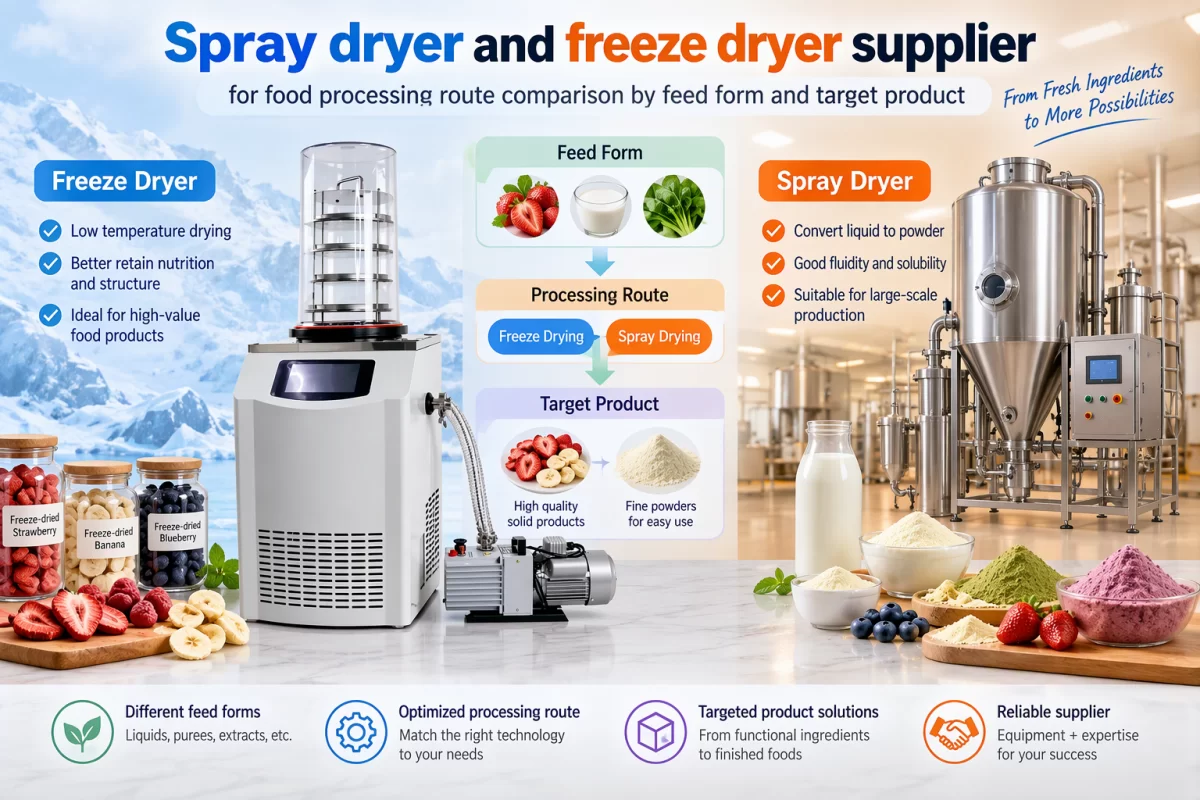
Which drying route suits a food ingredient intended as a powder?
I would first assess whether the feed is consistently pumpable and atomizable. Spray drying is a logical trial route for such feeds. If the formulation requires evaluation in a frozen state, freeze drying may also be investigated, but a later milling step could be needed. Those routes should be compared against the same finished-product specification, not assumed to produce equivalent powders.
For small-scale feed development, mini laboratory spray dryers are a relevant equipment category to explore. Laboratory trials should establish feasibility; they do not, by themselves, demonstrate commercial throughput or production-scale hygiene performance.
Freeze dryer selection: loading geometry before nominal capacity
For tray-based food drying, the number and dimensions of trays are practical starting points. A nominal kilogram rating does not describe how thickly a puree can be spread, how fruit pieces fit, or how much water must be removed. Compare the actual working batch at a defined material composition and loading pattern.
| Model | Shelves (count) | Tray dimensions (mm) | Cabinet dimensions (mm) | Total weight (kg) |
|---|---|---|---|---|
| FD-05H | 4 | 220 × 550 × 20 | 450 × 697 × 785 | 60 |
| FD-08H | 5 | 265 × 612 × 20 | 560 × 814 × 935 | 90 |
| FD-10H | 6 | 265 × 612 × 20 | 560 × 814 × 935 | 95 |
| FD-15H | 7 | 270 × 800 × 20 | 756 × 1045 × 1342 | 120 |
The FD-08H and FD-10H have the same listed cabinet and tray dimensions, but different shelf counts. They should therefore remain separate candidates rather than being treated as interchangeable equipment. Installation planning must also allow for access, service clearance, and any separately positioned accessories beyond the cabinet footprint.
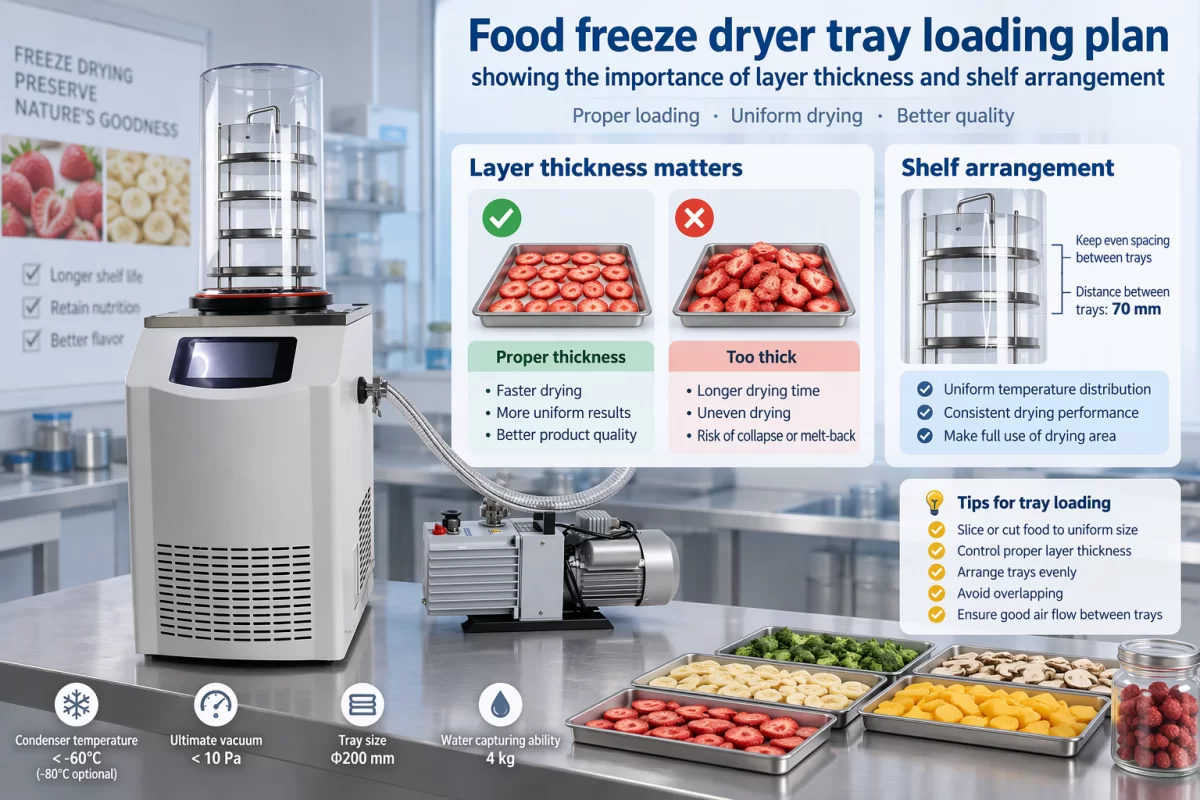
Buyers considering laboratory freeze dryers should assess that equipment as a separate candidate. FD-H dimensions and loading arrangements must not be transferred to another model simply because both products use freeze-drying technology.
Compare freezing, vapor capture, vacuum, and records separately
Pre-freezing determines the material state entering the drying stage. Establish whether the proposed workflow freezes samples inside the dryer or uses a separate freezer. For external pre-freezing, specify tray compatibility, transfer arrangements, and acceptable warming during handling. A freezer performs a preparation task; it is not a substitute for the drying chamber or vapor condenser.
Cold-trap volume, water-capture capacity, sample load, and single-batch processing quantity are different measures. Cold-trap volume describes physical space. Water-capture capacity concerns collected vapor over a defined operating interval. Sample loading concerns the material placed in the system, while batch output depends on composition, loading geometry, and the drying endpoint.
Likewise, a no-load minimum temperature or a vacuum pump’s ultimate vacuum is not the same as the condition maintained during drying. Evaluate chamber pressure, product temperature, and cold-trap performance together under a representative vapor load. Pump selection should address connection compatibility, vapor handling, exhaust arrangements, maintenance, and the intended pressure-control method.
Does a touchscreen establish that a freeze dryer can document a validated process?
I would not treat the display as evidence of that capability. The FD-H series is described with a 7-inch touchscreen, but process documentation depends on the available sensors, recording functions, export format, and calibration arrangements. A useful purchasing specification identifies product-temperature probe locations and the pressure and temperature records needed for each batch.
Manifold vessels, vial stoppering arrangements, additional probes, and other accessories should be considered only where they match the sample format and are available for the selected model. Research equipment must not be presented as a sterile commercial production system without the necessary design, qualification, and application-specific evidence.
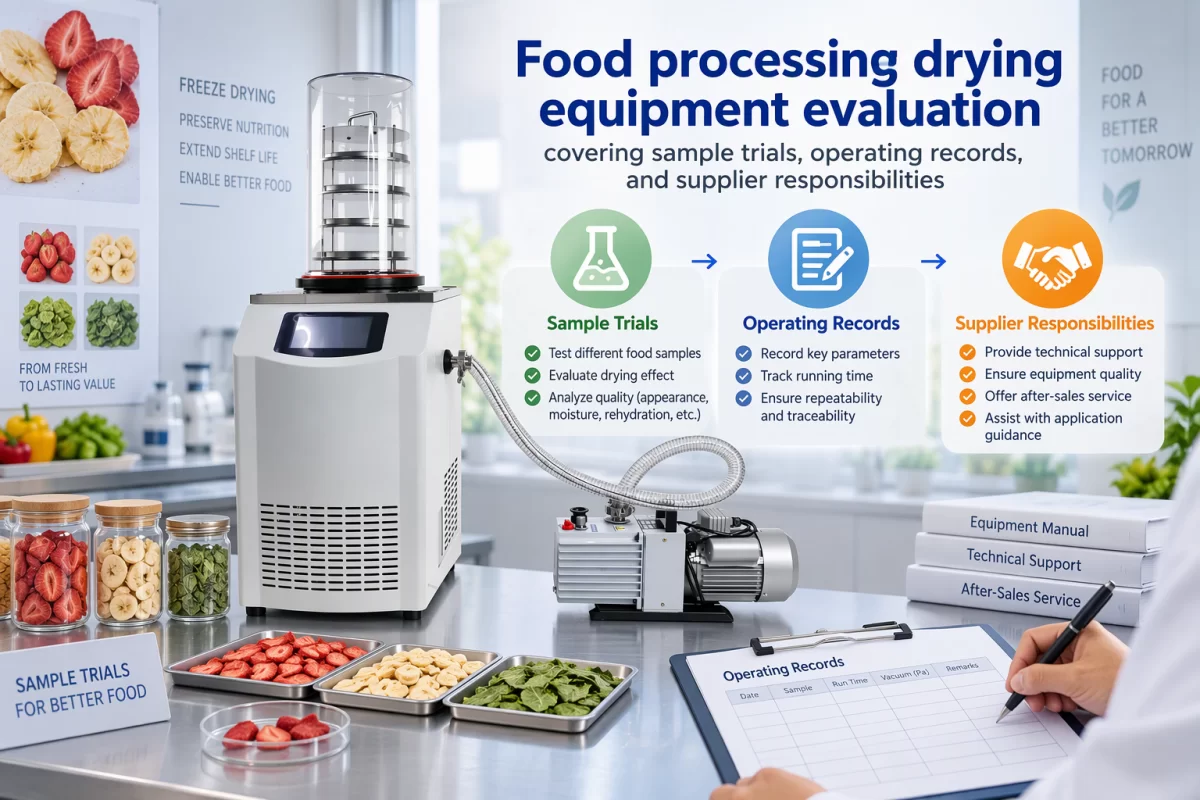
Evaluate suppliers through a representative food trial
A useful trial begins with a written material specification: composition, initial moisture or solids content, preparation method, storage history, target product form, and acceptance criteria. For freeze drying, add piece dimensions or liquid-layer thickness and the pre-freezing procedure. For spray drying, add feed viscosity, solids concentration, and any particle-size limitations relevant to the feed system.
Keep comparisons on the same basis. Record wet feed mass, recovered dry product mass, starting and final moisture, and the boundaries used to measure elapsed time. A freeze-drying batch assessment should distinguish freezing, drying, defrosting, unloading, and cleaning. A spray-drying assessment should distinguish feed processing from startup, shutdown, and cleaning. Neither route should be compared using dry powder output on one side and wet feed input on the other.
Can one successful sample trial establish performance for every food formulation?
I use a successful trial as evidence for the tested material and conditions only. Changes in sugar content, fat content, solids concentration, or loading thickness can change drying behavior. Cycle duration, activity retention, rehydration, and product quality require evaluation against the actual formulation and its acceptance criteria.
Compare supply scope, interfaces, and purchasing cost
A supplier proposal should identify each process unit and its responsibility boundary. Equipment mentioned in a workflow is not automatically included in the dryer’s supply package.
| Unit | Process position and purpose | Interface and scope to specify |
|---|---|---|
| Spray dryer | Atomizes liquid feed and dries droplets | Feed connection, atomizer services, drying gas, exhaust, and powder collection; identify included assemblies |
| Freeze dryer | Dries frozen samples under reduced pressure | Tray or vessel arrangement, vapor path, sensors, electrical supply, and control functions; list included accessories |
| Pre-freezing unit | Freezes material before drying when used externally | Tray fit, transfer procedure, power supply, and whether the freezer is supplied separately |
| Cold trap or condenser | Captures water vapor in the freeze-drying path | Integrated or external arrangement, vapor connection, drainage, and supplier responsibility |
| Vacuum pump | Supports evacuation and pressure operation | Flange, hose, valves, exhaust handling, service items, and whether installation is included |
Our company reference price is US$1,800, based on the middle reference among the fixed-price freeze-dryer listings. It is not a model-specific FD-H quotation or a complete processing-line price. Actual quotations depend on the selected configuration and inquiry result.
Compare itemized proposals that address equipment, accessories, utilities, commissioning, training, maintenance items, and delivery terms. Obtain model-specific electrical requirements before planning the installation. A lower initial equipment price does not necessarily represent the lower cost of a complete, usable drying workflow.
Choose the supplier that matches the process and working batch
The right spray dryer and freeze dryer supplier for food processing should connect the material’s behavior with the finished-product requirement, demonstrate a representative trial, and define a complete supply scope. For freeze dryers, prioritize loading form, pre-freezing arrangements, cold-trap duty, vacuum compatibility, measurement, and records rather than relying on a single nominal capacity figure.
To request a suitable proposal and quotation, submit:
- The food material, formulation, and desired finished-product form.
- Target processing quantity or working batch, with wet-feed and dry-product quantities distinguished.
- Expected operating conditions, available utilities, and installation constraints.
- Required trays or vessels, pre-freezing equipment, vacuum package, sensors, recording functions, and accessories.
- Trial acceptance criteria and the intended research, pilot, or production application.
These details support a configuration-specific evaluation and a quotation aligned with the actual food-processing task.