Laboratory equipment · Online purchasing guide
Buying Jacketed Glass Chemical Reactors Online: Documents to Request
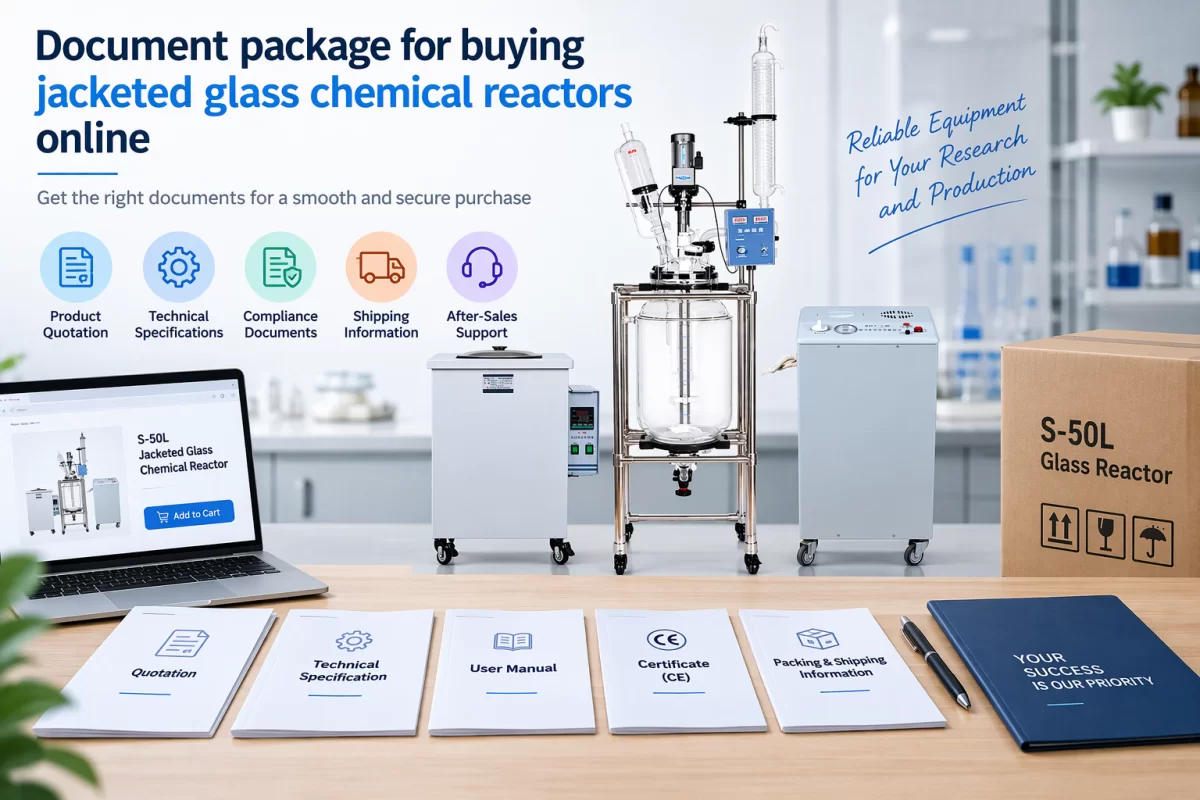
When researching where to buy glass jacketed chemical reactors online, treat the product photograph as a starting point—not as a specification. A useful purchasing decision depends on documents that connect the exact reactor model to its materials, vessel capacity, interfaces, operating limits, and support arrangements.
Start with a model-specific document package
A Jacketed Glass Reactor purchase involves more than the glass vessel. The jacket, agitator, shaft seal, condenser, feed connections, bottom outlet, and temperature-control equipment must function together under the intended process conditions. Visually similar assemblies can have different connection arrangements or supplied accessories.
Before comparing offers, request a dated quotation with a configuration list and a drawing or specification identifying the same model. Separate included equipment from optional items. A condenser shown in a photograph, for example, should not be treated as included unless it appears in the quoted scope.
- Material records: identify the vessel glass and all wetted parts, including seals, agitator components, valves, and adapters.
- Capacity and operating data: distinguish nominal vessel volume from the acceptable working batch for the proposed process.
- Assembly and interface drawings: show the lid ports, jacket connections, condenser arrangement, drain, and required installation clearances.
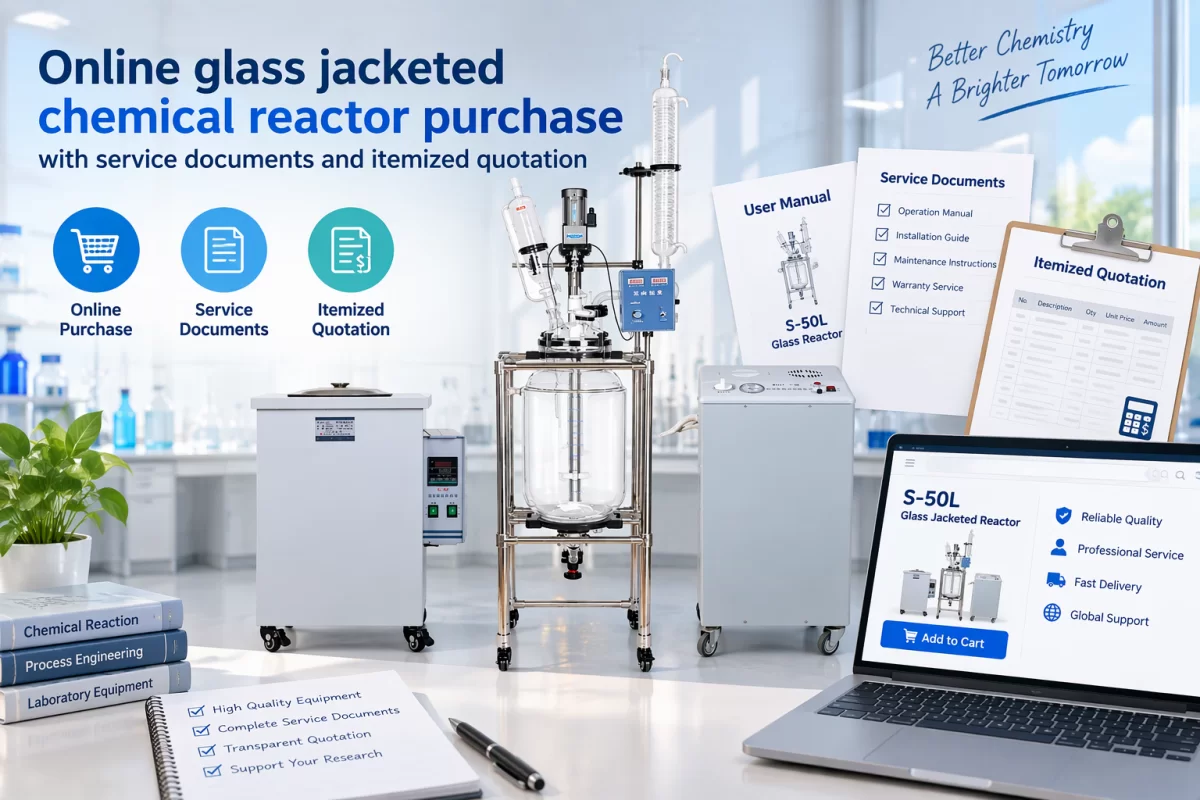
- Support documents: cover installation, operation, maintenance, spare parts, warranty terms, and service procedures.
Request material details and operating limits together
A material description is useful only when it identifies the component concerned. Ask for separate descriptions of the vessel, stirrer, shaft seal, outlet valve, and any wetted fittings. A frame material does not establish the material of a liquid-contact component, and the vessel material alone does not establish compatibility for the complete assembly.
Provide the intended chemicals, concentrations, cleaning agents, temperature conditions, and exposure duration. Compatibility should be assessed across the wetted path, including elastomers and sealing surfaces. Also request operating limits for the reaction vessel and jacket separately, with the applicable temperature, pressure or vacuum conditions, and restrictions on thermal changes.
If a process requires a drive suitable for a hazardous location, request documentation for the exact motor, controls, and installation arrangement being quoted. A general option description does not establish the suitability or certification of the complete supplied system.
Compare nominal capacity with the actual working batch
The available model families include the nominal vessel capacities below. Use these values to organize an initial shortlist, not to set a universal filling percentage. For intermediate capacities, the 10L to 50L jacketed glass reactors provide a relevant starting point for a model-specific inquiry.
| Model | Nominal vessel capacity (L) | Working-batch assessment |
|---|---|---|
| S-1L | 1 | Process-specific assessment required |
| S-2L | 2 | Process-specific assessment required |
| S-3L | 3 | Process-specific assessment required |
| S-5L | 5 | Process-specific assessment required |
| S-10L | 10 | Process-specific assessment required |
| S-20L | 20 | Process-specific assessment required |
| S-30L | 30 | Process-specific assessment required |
| S-50L | 50 | Process-specific assessment required |
| S-100L | 100 | Process-specific assessment required |
Initial charge: document the starting liquid volume and any solids. This determines whether the proposed agitator can engage the batch and whether the temperature probe is appropriately immersed.
Volume changes during processing: list additions, withdrawals, evaporation, and any expected expansion. The largest liquid inventory may occur well after the initial charge.
Process allowance: evaluate foaming, gas evolution, boiling, mixing behavior, and required free space separately. These considerations cannot be reduced to one filling ratio for every material.
Future expansion: describe the anticipated larger batch as a separate operating case. A larger vessel may accommodate growth but still require a different agitator arrangement for today's smaller batch.
Ask for interface drawings, not just assembly photographs
A dimensioned drawing should identify each lid connection by location, size, connection standard, and intended function. Check whether the proposed arrangement accommodates feeding, temperature measurement, condensation, vacuum service, and any required sampling without competing for the same port.
For the agitator, request the impeller geometry, shaft arrangement, speed range, drive configuration, and relevant load limitations for the selected model. Compare these against viscosity, solids content, and mixing objectives rather than assuming the same drive suits every vessel capacity.
The seal documentation should describe the sealing arrangement and its operating requirements. For the condenser, request its configuration, coolant connections, and suitability assessment for the expected vapor load. For the bottom outlet, review the valve construction, wetted materials, outlet dimensions, discharge clearance, and cleaning access—especially when handling slurries or materials that may crystallize.
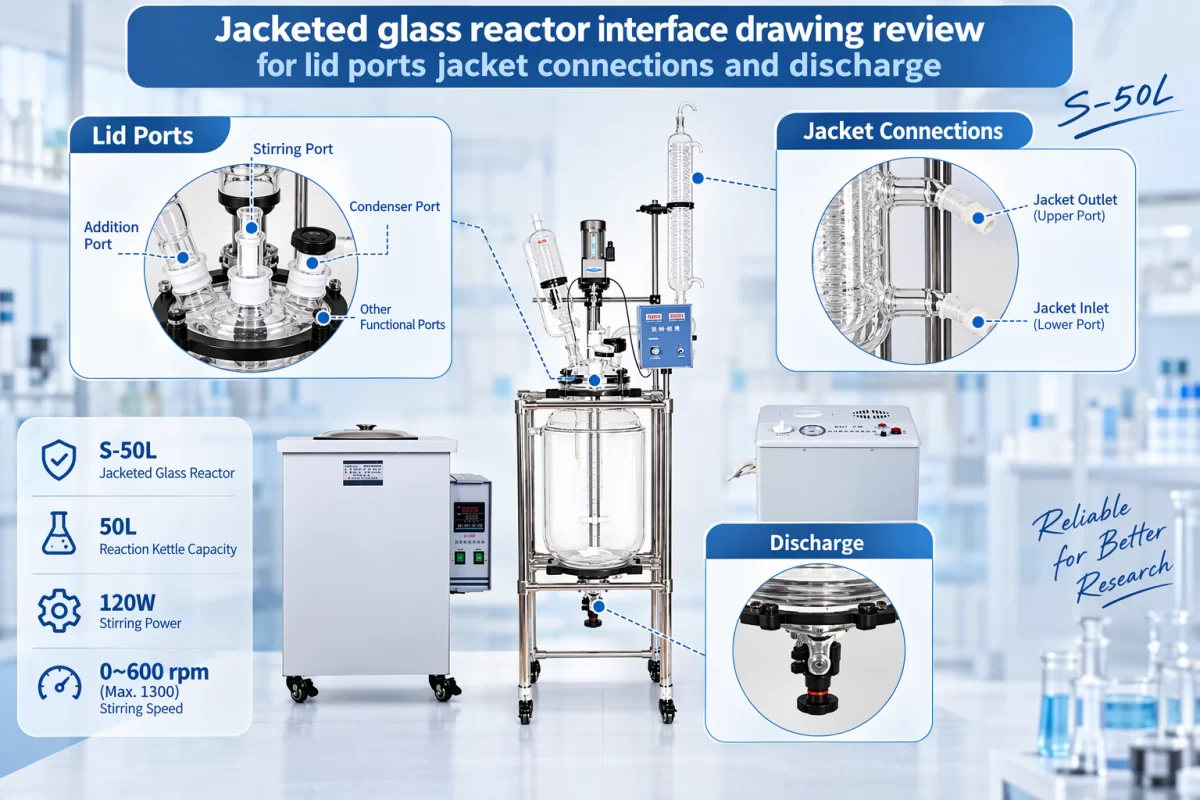
For a broader selection review, the guide to glass reactor purchasing considerations is a relevant companion to the document requests above.
Review the temperature-control package as a separate system
Request documentation identifying the proposed circulator, heat-transfer fluid, hose connections, flow requirements, and jacket operating restrictions. The supplier's assessment should relate heating and cooling performance to the batch, starting temperature, desired process temperature, reaction heat load, and installation conditions.
When comparing proposals, keep those conditions the same. A heating-time estimate for a smaller liquid batch cannot be compared directly with an estimate for a larger, more viscous batch. Ask where temperature is measured and whether the control system uses a vessel probe or only the circulation loop temperature.
Put after-sales support and quotation scope in writing
Request the operating manual, assembly instructions, maintenance schedule, spare-parts list, and warranty terms before ordering. Establish who handles installation questions, how replacement glass and seals are identified, and what information is needed to obtain service. Ask for recommended spare parts and their quoted supply arrangements rather than assuming immediate availability.
The quotation should itemize the reactor, condenser, feeding accessories, temperature-control equipment, vacuum equipment if required, connection hoses, and any installation or training services. Also establish packaging, delivery terms, and the inspection procedure on receipt.
Company reference price
US$1,699This is our company's reference price across the supplied product listings, not a model-specific quotation or a price for every configuration. The actual quotation depends on the selected configuration and inquiry results. Compare itemized scope before using this reference for budget planning.
Where to buy glass jacketed chemical reactors online: choose by documentation
A sound online purchase begins with a traceable link between the offered model and its material records, nominal capacity, working-batch assessment, interface drawings, operating limits, and support documents. Photographs help identify the general arrangement; they cannot establish chemical compatibility, pressure capability, mixing suitability, or the temperature reached inside the batch.
Shortlist the vessel size, then assess the complete assembly—including jacket, drive, seal, condenser, connections, discharge, and temperature-control equipment—under the same intended process conditions.
Prepare a process-based inquiry
Submit the materials and concentrations, target throughput or working batch, initial charge and planned additions, temperature and pressure or vacuum conditions, viscosity or solids information, available utilities, and required accessories. Include future expansion needs separately. These details provide the basis for evaluating a suitable Jacketed Glass Reactor configuration and preparing an itemized quotation.