100 Liter Glass Reactor Procurement: Vessel, Circulator and Vacuum Scope
Buying a 100 liter glass reactor is a system-sizing decision, not simply a vessel-capacity purchase. A useful quotation separates the reaction vessel and stirring assembly from the heating/cooling circulator and the vacuum accessories, then connects each package to the same process requirements.
Start with working batch requirements—not the 100 L label
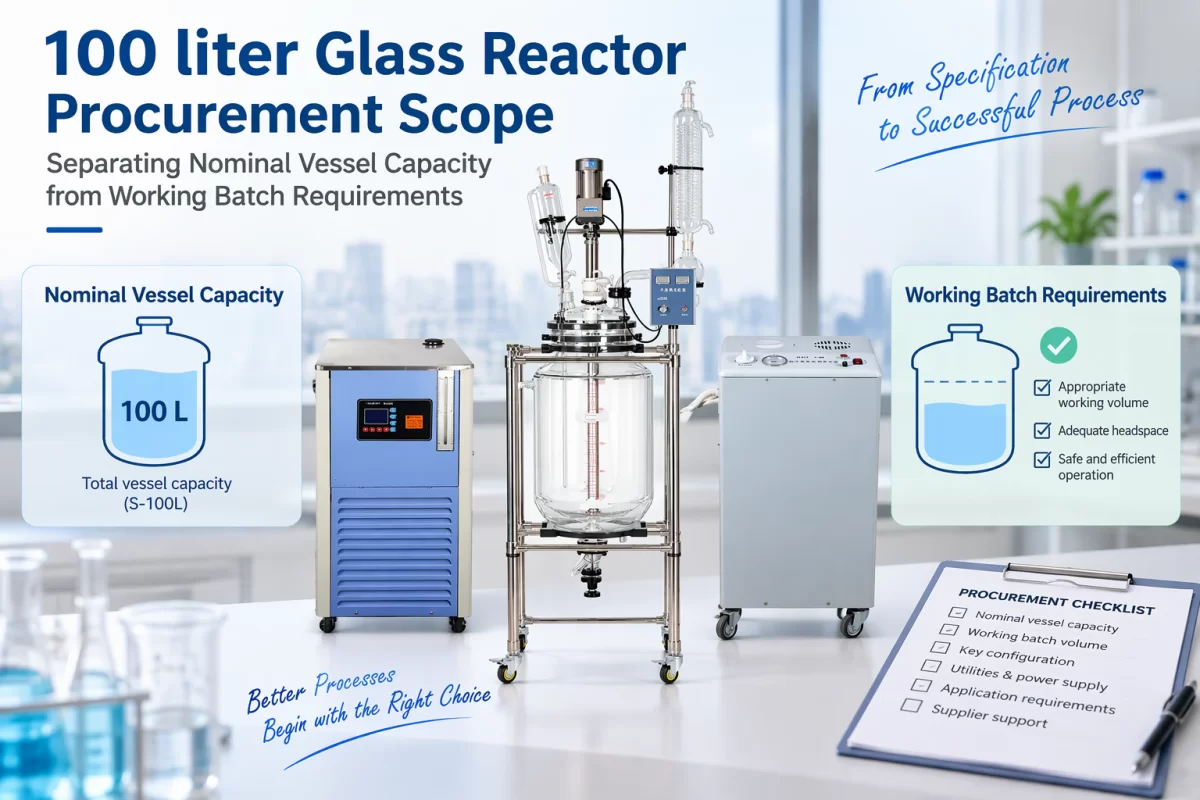
The S-100L model has a listed reaction kettle capacity of 100 L. That capacity should not be treated as a recommended operating charge or a guaranteed finished-product batch. Initial charging, later additions, vapor space and process behavior must be considered separately.
For product selection, the 80L and 100L jacketed glass reactors page is a relevant starting point. Define the intended duty before comparing configurations: mixing a low-viscosity liquid, managing solids during crystallization and handling a foaming process can impose different requirements even at the same liquid volume.
Does a 100 L nominal vessel imply a 100 L working batch?
I would not use nominal capacity as the working-batch specification. I would first establish the maximum liquid inventory during the process, then assess the space needed for agitation, foaming, vapor disengagement and additions. A single filling percentage is not an appropriate rule for every material.
Assume an initial liquid charge of 55 L and subsequent additions totaling 15 L, with additive volumes and no evaporation or contraction. The final liquid inventory is 55 + 15 = 70 L. Against a nominal 100 L capacity, the arithmetic difference is 30 L. This difference is not a validated usable headspace allowance; vessel geometry, foam, solids and mixing behavior still determine whether that batch is suitable.
Keep future expansion separate from the present batch. Increasing daily throughput through more batches is different from increasing the volume of each batch. A larger future charge may also require greater agitation capability, condenser duty and heating or cooling capacity; spare vessel volume alone does not establish expansion capability.
Define the vessel package as a complete mechanical scope
The listed S-series capacities provide a straightforward nominal-volume comparison: S-10L, S-20L, S-30L, S-50L and S-100L correspond to 10, 20, 30, 50 and 100 L respectively. Moving between those capacities should prompt a fresh review of the complete assembly rather than an assumption that every component scales proportionally.
Broader guidance on large glass reaction vessel configurations can help organize that review. For the purchase itself, request a model-specific equipment schedule covering the vessel, jacket, agitator, shaft seal, condenser, lid connections and discharge arrangement.
| Package element | Specification to include | Procurement significance |
|---|---|---|
| Vessel and jacket | Nominal vessel capacity (L), jacket volume (L), connection sizes and applicable temperature/pressure limits | Defines the vessel envelope and thermal-circuit requirements. |
| Agitation and seal | Impeller arrangement, drive power (W), operating speed (rpm), torque, seal materials and operating conditions | Relates mixing capability and seal suitability to viscosity, solids and vacuum duty. |
| Condenser and lid ports | Condenser configuration, cooling connections, feed ports, temperature-probe access and vacuum connection | Supports simultaneous feeding, measurement and vapor handling. |
| Bottom discharge | Valve geometry, wetted materials, outlet size and collection arrangement | Addresses draining, solids passage, cleaning and downstream transfer. |
Specify material compatibility for every wetted component, not only the vessel wall. Seals, valves, tubing and condenser components may encounter different exposure conditions. For hazardous-area use, define the site's electrical classification and require documentation for the exact supplied assembly; a motor option alone does not establish certification of the complete system.
An ordinary jacketed glass reactor should not be assumed suitable for high-pressure operation. Positive pressure, vacuum service, jacket pressure and temperature limits are separate conditions that require support for the selected model and configuration.
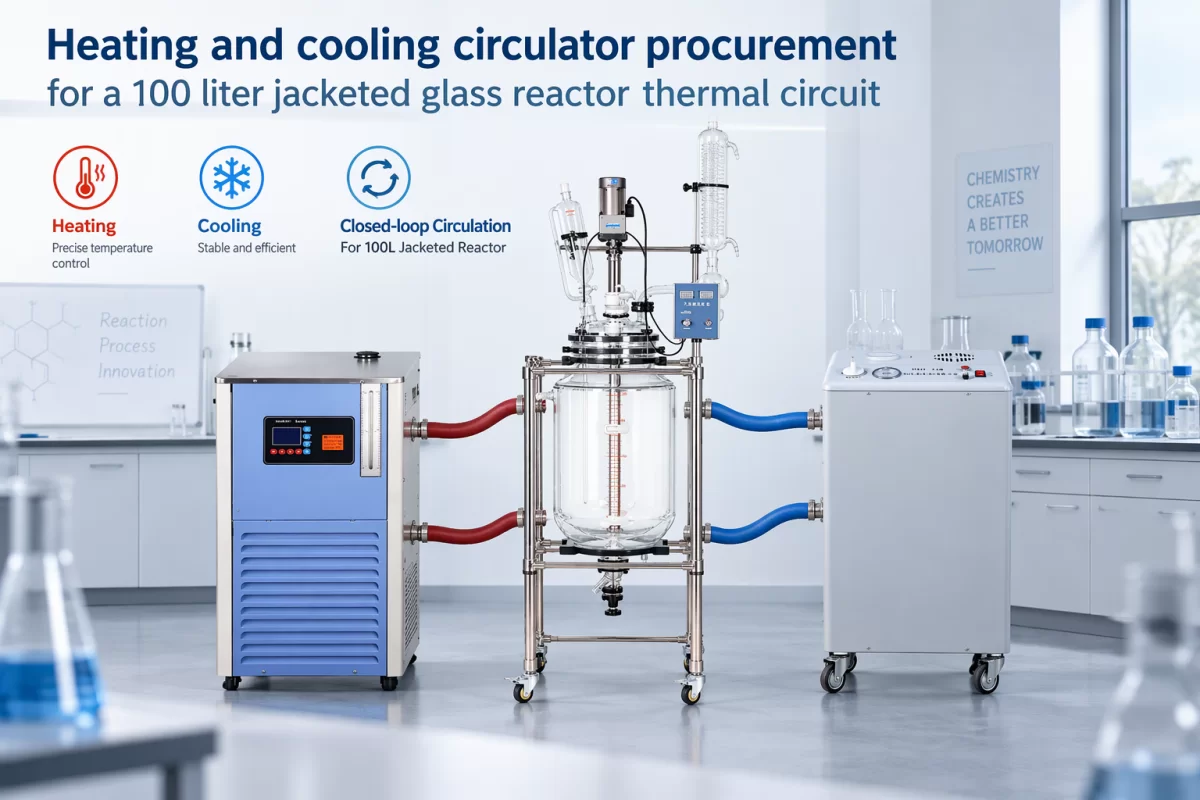
Size the circulator for heat duty and hydraulic compatibility
A heating/cooling circulator needs its own specification. State the material's starting temperature, target temperature, allowable ramp time, hold duration and expected reaction heat. Include heat-transfer-fluid compatibility, jacket connections, hose routing and the jacket's permitted pressure conditions.
Compare heating and cooling capacity at the same relevant operating temperatures, rather than comparing headline power figures alone. Available cooling duty can vary with operating temperature. Pump flow and pressure must also suit the jacket and connecting circuit; more pump pressure is not automatically beneficial.
Does the circulator setpoint establish the material temperature?
I treat the circulator setpoint as a thermal-fluid control value, not proof of the temperature inside the reactor. Material temperature depends on heat transfer, mixing, fluid flow and process heat. I would specify a suitable material-temperature measurement point and define whether control uses the circulator sensor or a reactor probe.
Assume 60 L of liquid with density 1.0 kg/L and specific heat capacity 4.0 kJ/(kg·K), heated through 20 K in 30 minutes. The assumed mass is 60 kg, giving:
Q = 60 × 4.0 × 20 = 4,800 kJ
Average material-only duty = 4,800 kJ ÷ 1,800 s ≈ 2.67 kW
This calculation excludes the vessel, thermal fluid, heat losses, phase changes and reaction heat. It is an illustrative energy requirement, not a circulator recommendation or a guaranteed heating time. Heating and cooling quotations should use the same batch basis and include the relevant additional loads.
Separate vacuum generation from vapor handling
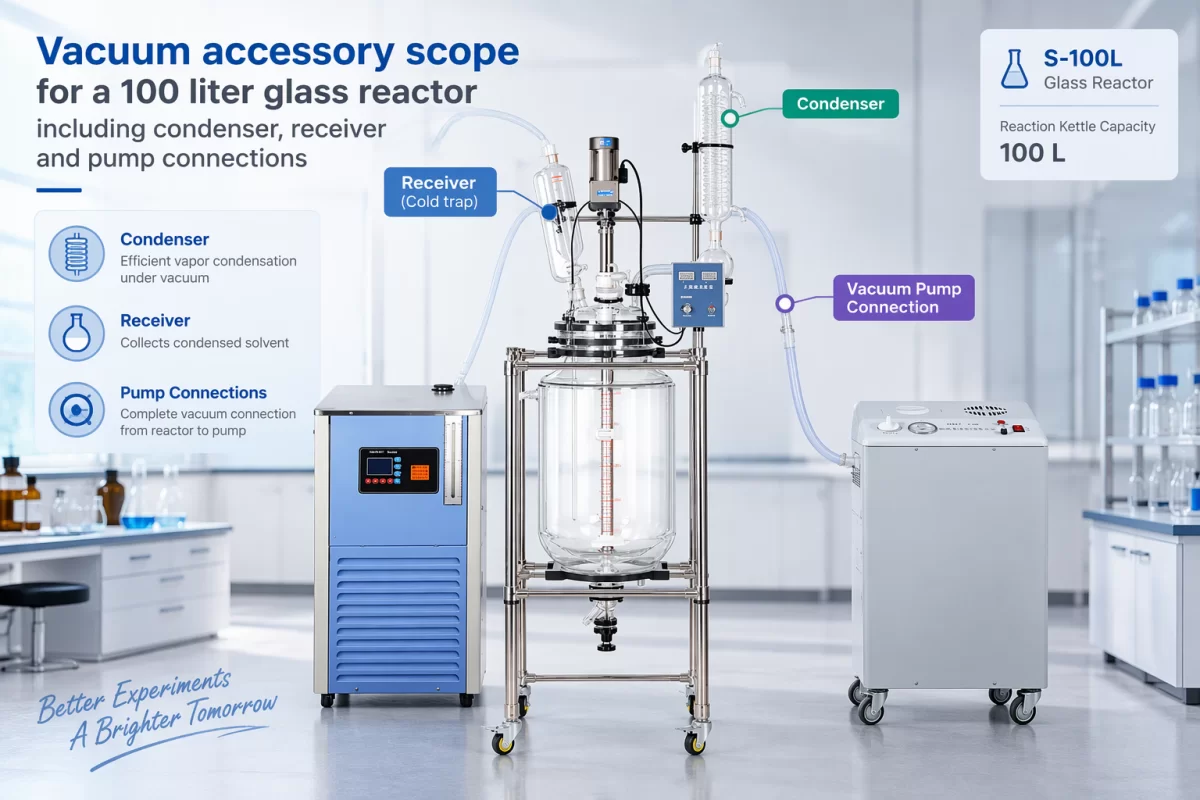
A vacuum scope is more than a pump. Define the required operating pressure in absolute units, the process temperature, the vapor composition and the expected vapor load. Distinguish the pressure required at the reactor from a pump's ultimate-pressure specification.
The quotation should identify the condenser, coolant provision, receiving vessel, any required trap, vacuum hoses, pressure measurement and isolation or control components. If condenser cooling is separate from jacket temperature control, list that utility independently rather than assuming one circulator can satisfy both duties.
Is a larger vacuum pump always the better procurement choice?
I would select the vacuum package around the required reactor pressure and vapor load. Pump size alone does not resolve restrictive tubing, inadequate condensation or seal leakage. I would also assess chemical compatibility, vapor protection and exhaust handling for the intended materials.
Condensation requirements depend on vapor composition, evaporation rate and available coolant temperature. Specify how condensate will be collected and removed, and whether the process requires reflux, distillate recovery or simple vapor capture. Those operating modes can lead to different accessory arrangements even when the reaction vessel is unchanged.
Compare quotations on the same equipment boundary
Ask for separate line items for the vessel assembly, thermal circulator and vacuum package. Identify included hoses, adapters, sensors, controls and installation accessories. A vessel-only quotation and an integrated-system quotation are not directly comparable, even if both use “100 L reactor” in the description.
Company reference price: US$1,699. This is a catalog-level reference across our supplied jacketed glass reactor listings, not a price for a complete 100 L vessel, circulator and vacuum system. The actual quotation depends on the selected configuration and inquiry results.
For meaningful comparison, keep the material, maximum working inventory, temperature program and vacuum duty identical across proposals. Request clear inclusion and exclusion statements, applicable utilities and an acceptance plan tied to the agreed operating requirements.
A practical purchasing decision for a 100 liter glass reactor
Select the vessel around the maximum process inventory and required operating space. Select the circulator around thermal duty and jacket compatibility. Select the vacuum accessories around reactor pressure, vapor load and condensation requirements. Treat these as three coordinated specifications rather than one capacity-based purchase.
For a configuration assessment and quotation, submit:
- Material composition, viscosity, solids content and relevant compatibility requirements.
- Initial charge, planned additions, maximum working batch and target daily throughput.
- Starting and target temperatures, ramp times, hold periods and expected reaction heat.
- Required operating pressure, vapor composition, reflux or collection needs and site utilities.
- Agitation, discharge, control, hazardous-area and future expansion requirements.
These details make it possible to evaluate a 100 liter glass reactor package against the intended process and prepare a quotation with clearly defined vessel, circulator and vacuum scope.